The Rifle
A recording: episode 4 of Listen, the library read aloud
Action, calibre, bullet and zero. How the thing actually works, and how to make it hit where you look.

The machine
A bolt-action rifle is a steel tube with a door at the back. You open the door, slide a cartridge in, close it and lock it. Squeeze the trigger and a spring-driven pin hits the back of the cartridge. That is the whole idea, and the basic design is well over a century old.
It has lasted because it suits hunting. The bolt locks up solid right behind the cartridge, so the action is strong and stiff and shoots accurately. There are few moving parts to clog with mud, dust or snow. And it is slow in a useful way: every shot needs a deliberate movement of your hand, which gives you a moment to think about the next one.
Learn the parts by name. When someone says check your chamber or safety on from the back of a ute in the dark, there is no time to work out what they mean.
Stock
Walnut, laminate or synthetic. It holds the action and barrel, and it is where you hold the rifle. The butt sits in the pocket of your shoulder, the comb along the top carries your cheek, and the rubber pad at the end takes some of the sting out of the recoil.
Grip
Your firing hand wraps here, thumb over the top or along the side, so your index finger falls naturally to the trigger. Hold it firmly, like a handshake, not a strangle.
Safety catch
A small lever, usually on the right behind the bolt handle. On most rifles it blocks the trigger, and on some it also locks the bolt or the firing pin. Many have three positions: safe with the bolt locked, safe with the bolt free to unload, and fire. It is a mechanical part, and mechanical parts fail. A muzzle pointed somewhere safe is the real safety.
Bolt and handle
A steel cylinder that slides and turns inside the action. Its face pushes a cartridge into the chamber, and its locking lugs turn into recesses to hold it shut. A spring-loaded firing pin runs down its centre. The handle on the right is how you work it, and it tells anyone watching whether the rifle is open.
Trigger and guard
Pressing the trigger lets the sear slip, which frees the firing pin. The NSW Hunter Education Handbook recommends a crisp trigger of about 1.4 kg (3 lb) for a hunting rifle, and says never to lighten one yourself. The guard is the steel loop around it. Your finger lives outside the guard, flat along the stock, until the crosshair is on the animal and you have decided to shoot.
Magazine
Holds the spare cartridges under the bolt, pushed up by a spring. It may be a blind box, a box with a hinged floorplate, or a detachable box that drops out. A rifle with rounds in its magazine is a loaded rifle, in practice and in the law, even with the chamber empty.
Action
Also called the receiver: the steel body that holds the bolt, with the barrel screwed into its front. The chamber, where the cartridge sits when the rifle is ready to fire, is the back of the barrel, right in front of the bolt face. The opening on top, where fired cases fly out, is the ejection port.
Scope
A telescopic sight: magnification, plus a crosshair called the reticle, set so that what you see lines up with where the bullet goes at one chosen distance. The turrets on the top and side move it. The Optics volume covers scopes properly.
Rings and bases
Clamp the scope to the action. Loose screws here make a rifle wander off its zero, so they are the first thing to check after a knock or a fall.
Fore-end
The front of the stock, under the barrel. This is where a rest goes: a bag, a pack, a bipod or your leading hand. On most good hunting rifles the barrel is free-floated, with a small gap between it and the fore-end, so nothing presses on the barrel as it vibrates.
Barrel
A steel tube with shallow spiral grooves cut inside it, the rifling, which spins the bullet so it flies point first. Ammunition makers test their loads in 24 inch (61 cm) barrels. A shorter hunting barrel gives up a little speed.
Muzzle
The business end. The edge of the bore here, the crown, is machined with care because it is the last thing the bullet touches. Keep it out of mud and snow, and never look down it to check. A barrel with mud or snow in it can bulge or split when it is fired.
Loading and unloading are the same four movements of your hand: lift, back, forward, down. Practise them with an empty rifle until you can do them without looking, the muzzle pointed somewhere safe the whole time. Drag the slider to step through one cycle.
Unloading
Muzzle somewhere safe and safety on. Empty the magazine first: drop the box, open the floorplate, or work each round out. Then lift and draw the bolt slowly with a hand over the port to catch the chambered round. Look into the chamber and the magazine, and feel with a finger, before you call it clear.
Closed on a fired case
The rifle has just fired. The empty case is still in the chamber, the bolt is locked and the firing pin is forward. Nothing more can happen until you work the bolt.
Lift the handle
Turning the handle up rotates the locking lugs out of their recesses so the bolt can move. On most modern hunting rifles the same movement draws the firing pin back and cocks it (the red tab at the back of the bolt), and a cam on the handle eases the fired case loose in the chamber.
Draw it back
The extractor claw drags the case out by its rim, and at the end of the stroke the ejector flicks it out through the port. With the bolt clear, the magazine spring pushes the next cartridge up. Draw it all the way back, briskly. A half-hearted stroke can leave the case in the action.
Push it forward
The bolt face catches the base of the top cartridge, strips it out of the magazine and pushes it up into the chamber. The next round rises to take its place.
Turn it down
The lugs turn into their recesses and lock. There is now a round in the chamber and a cocked firing pin behind it, held only by the sear, and the safety is the one thing between the trigger and a shot. Safety on, finger off, muzzle safe. This is the state that hurts people.
New Zealand's Firearms Safety Code gives the states of a rifle names, and guides use them. They are worth knowing on both sides of the Tasman.
- Load
- Safety on, rounds in the magazine, bolt closed on an empty chamber.
- Action
- Safety on, a round in the chamber. Only when a shot is close.
- Instant
- Safety off, about to fire, crosshair on the target.
- Unload
- Magazine and chamber emptied, then checked by looking and feeling.
Lore
The three-position safety on many hunting rifles goes back to the German army's Gewehr 98 of 1898. Its wing safety had the same three settings: hard right blocked the firing pin and locked the bolt, the middle let you open the bolt to unload with the safety still on, and left was fire.
The 98 also brought the big claw extractor that grips a cartridge the moment it leaves the magazine and holds it until it is thrown out. Rifles built that way are still sold as controlled-round feed, and Mauser's layout inspired military and sporting rifles right through the twentieth century.
One shot, slowed down
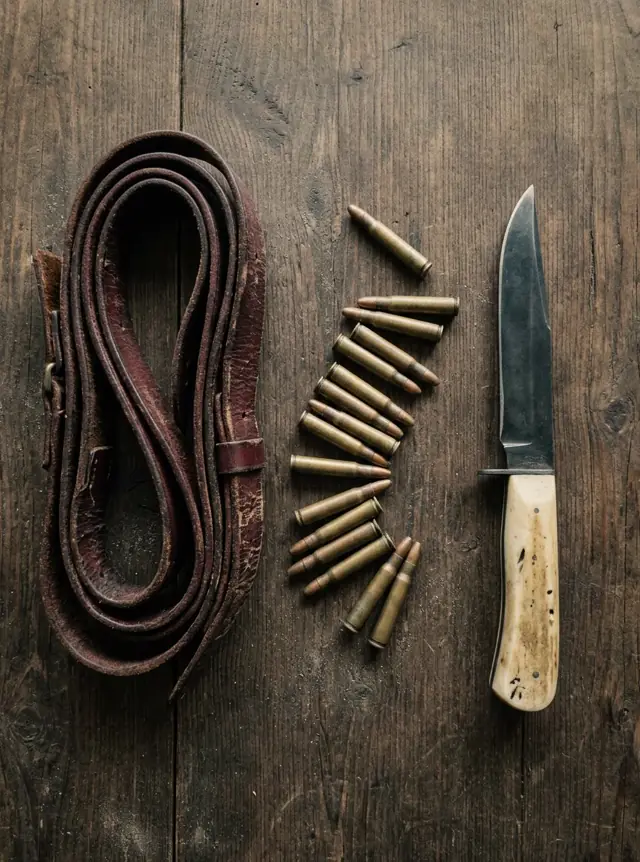
A cartridge, or round, is four things in one: a brass case, a primer in its base, a charge of powder inside, and the bullet, also called the projectile, seated in its mouth. The bullet is the only part that leaves the rifle.
Every box and every case head is stamped with what it is, and so is the barrel, near the breech. Read both every time you load a rifle. The wrong cartridge in the wrong chamber can wreck the rifle and the person holding it.
Primer
A small metal cup pressed into the base of the case, holding a pinch of shock-sensitive compound. The firing pin dents it, the compound detonates, and a jet of flame goes through the flash hole into the powder. The 6.5 and the .308 take large rifle primers, the .223 a small one.
Case
Drawn brass, in one piece, 48.8 mm long in the 6.5 Creedmoor. It holds everything in line, and when the powder burns it swells hard against the chamber walls and seals the gas in behind the bullet. The stamp on its base, the headstamp, names the cartridge.
Powder
Smokeless powder, in fine grains, sticks or flakes. It burns very fast rather than exploding, and turns into a large volume of hot gas in a space with nowhere to go. That gas is what pushes the bullet.
Bullet
Usually a lead core in a copper jacket, often with a polymer tip, cut away here to show the core. Bullets are weighed in grains: the 6.5's 143 gr ELD-X weighs 9.3 g, a little less than a 20 cent coin.
The whole shot, from the trigger breaking to the bullet leaving, takes about four or five thousandths of a second. Here it is slowed down, one step at a time.
Squeeze
Your finger presses the trigger straight back. Nothing moves yet except the trigger, until the pressure reaches its break weight.
The sear lets go
At the break, the sear slips off the notch that was holding the cocked firing pin, and the pin's spring drives it forward.
Pin meets primer
The time from sear to primer is the lock time. On a modern hunting bolt action it is about 3 milliseconds: 2.6 to 3.2 for a Remington 700, 4 to 5 for an old Mauser 98. Any wobble in that time goes into the shot, which is why you keep still and keep pressing through the break.
Primer flash
The pin dents the primer, the compound inside detonates, and a jet of flame shoots through the flash hole into the powder.
Powder burns
The powder catches and burns, and gas pressure climbs at an astonishing rate. The brass case swells against the chamber walls and seals the gas in.
Into the rifling
The gas shoves the bullet out of the case mouth and into the rifling, which cuts spiral grooves into its jacket. From here on the bullet is spinning as well as moving.
Peak pressure
Pressure peaks early, at up to about 4,300 bar (62,000 psi) in the 6.5 and the .308, the industry limit for both, and about 3,800 bar (55,000 psi) in the .223. By the time the bullet has gone a few centimetres up the barrel it already has a large share of its final speed.
Out of the muzzle
From primer to muzzle took about 1 to 1.5 ms. The 6.5's 143 gr bullet leaves at 823 m/s, about two and a half times the speed of sound, spinning at roughly 243,000 rpm. Hot gas follows it out: that is the bang, the flash and a good part of the kick. In the time the bullet took to clear the barrel, the rifle had moved back only a millimetre or two.
Lore
Why grains? The grain is nominally the weight of a single seed of wheat or barley, and from the Bronze Age into the Renaissance cereal grains were written into the legal definitions of weight. Today it is fixed at exactly 64.79891 milligrams, and 7,000 of them make a pound. Bullets and powder charges are still weighed in it, everywhere, including here.
Calibre and bullet
Calibre is the size of the bore. Some cartridges are named for the bullet's diameter, some for the bore between the raised lands of the rifling, and some for neither. The .308 Winchester fires a bullet 0.308 inches (7.82 mm) across, the 6.5 Creedmoor one of 6.7 mm (0.264 in), and the .223 Remington a slim 5.7 mm (0.224 in). The second half of the name is whoever brought it out.
What matters more than the name is the load: a particular bullet, at a particular speed, out of a particular rifle. The Silent Grove rack runs a 6.5 Creedmoor and a .223 Remington. Alongside them this volume uses the .308 Winchester, the classic deer cartridge, as a yardstick. Each comes with a typical factory load, and every number in this volume comes from these three loads and the makers' published figures.
| Calibre | Load used here | Bullet | Leaves at | Job |
|---|---|---|---|---|
| 6.5 Creedmoor | Hornady Precision Hunter 143 gr ELD-X | 9.3 g, polymer tip | 823 m/s (2,700 fps) | Fallow deer. The easiest of the three to shoot well. |
| .308 Winchester | Federal Power-Shok 150 gr soft point | 9.7 g, cup-and-core | 860 m/s (2,820 fps) | The yardstick. A classic deer cartridge, with more kick. |
| .223 Remington | Federal Power-Shok 55 gr soft point | 3.6 g, soft point | 988 m/s (3,240 fps) | Foxes and roos. Not deer. |
Energy is what a bullet brings to the animal. An old rule of thumb, usually credited to the American gun writer Townsend Whelen, asks for about 1,000 ft-lb (1,356 J) at impact on deer-sized game. Drag through the ranges. The 6.5 stays above the line past 500 m, the .308 to about 380 m, and the .223 drops under it about 80 m from the muzzle.
Treat the line as a sanity check
Energy alone misleads. Construction and placement decide what happens in the animal. Hornady's 58 gr varmint bullet out of a .243 leaves the muzzle with more energy than the 80 gr load NSW's deer-culling guidance uses as its small-deer benchmark, and it is still the wrong bullet for a deer.
Fig. 6Recoil worked out with SAAMI's free-recoil formula and typical powder charges. Drift for a full-value crosswind.
6.5 Creedmoor
Built by Hornady in 2007 for long-range target shooting and named for Creedmoor Sports, whose Dennis DeMille helped develop it. Hunters took it up because it is accurate, flat and gentle. Its long, sleek bullets slip through the air best of the three, so it drops and drifts least at distance. Mild enough that new shooters shoot it well.
.308 Winchester
Released by Winchester in 1952, two years before the army version became NATO's standard round. It starts a little faster than the 6.5 with a slightly heavier bullet, so it hits harder close in, but its soft point sheds speed sooner. More kick. A proper deer rifle and the large-deer example in NSW's deer-culling guidance, which makes it the yardstick here.
.223 Remington
On sale to hunters since 1964. Light, cheap to feed, accurate, and it barely kicks. Its light soft point opens fast on small animals. The national code for shooting kangaroos lists the .222, .223 and .22-250 class, soft or hollow points only, out to 200 m and brain shots only. Too light for deer: NSW guidance, the Australian Deer Association and the R-Licence course all put the floor for fallow at a .243 with an 80 gr bullet.
The .223 and its parent
The .223 grew out of the .222 Remington, a 1950 cartridge with a slightly shorter case and a little less speed. The kangaroo code lists them together, and on a fox or a roo they do much the same job. Its military twin is the 5.56 mm NATO round.
Over the ditch
In New Zealand the rifles step up for longer shots across valleys: a 6.5 PRC, the Creedmoor's bigger-cased and faster cousin, and a .270, both suppressed and on bipods. DOC's permit allows nothing smaller than a .222 on public conservation land. Everything in this volume applies there too.
A hunting bullet has two jobs that pull against each other. It has to open up, ideally to about twice its width, to make a big wound. And it has to hold together long enough to get through hide, ribs and the far side of the heart and lungs. Too soft and it comes apart near the surface. Too hard and it punches a pencil hole and the animal runs.
The answer is in how the bullet is built. Here are the four kinds you will meet, and the one to keep away from deer.
Lore
In a 2009 study, 30 deer shot with lead-core bullets were processed into mince. Lead fragments turned up in mince from 24 of the 30, and in about a third of the 234 packages. The fragments were scattered over 24 cm on average, and as far as 43 cm. It is one reason some hunters choose copper, and a good reason to trim well around any bullet wound.
Cup-and-core soft point
A copper jacket drawn around a lead core, with a little lead showing at the nose. On impact the soft nose flattens and the jacket peels back into a mushroom. Cheap and proven, and reliable at ordinary deer ranges. Hit something hard, close and fast, and it can shed a fair bit of its weight. This is the .308 load in this volume.
Polymer tip
A plastic tip in the nose makes the bullet sleeker in the air, then drives back into the core on impact to start the expansion. Hornady says its ELD-X, the 6.5 load here, keeps 50 to 60 percent of its weight at ordinary ranges, out to about 365 m (400 yd), and 85 to 90 percent at long range, where it arrives slower.
Bonded
The jacket is fused to the core, so the two cannot part company. It still mushrooms, but it holds most of its weight and keeps driving straight through bone. Federal bonds its Fusion jacket electrochemically. A good choice for bigger animals and awkward angles, and for bullets that may arrive fast and close.
Monolithic copper
One piece of copper alloy and no lead at all. The hollow nose splits into petals that fold back, and the shank keeps going. Hornady quotes 95 percent weight retention for its CX. Copper is lighter than lead, so a copper bullet is longer for its weight, and it needs enough speed at impact to open properly. No lead fragments in the meat.
Varmint
Built to come apart. On a fox or a rabbit that means a fast kill and little chance of the bullet carrying on into the next paddock. On a deer it means a wide, shallow wound that may never reach the heart and lungs. The right idea for a fox, and the wrong bullet for a deer out of any calibre.
Fig. 7Bullets in section before impact, and as they are typically recovered. Drawn for the page, not to scale.
Lore
The .223 has a famous parent. Remington's Mike Walker first shot the .222 in a benchrest match in 1950, and it went on to rule that sport, where the whole point is the smallest possible group of holes, for years. In 1957 Remington and Fairchild Industries started work on a small, fast cartridge for the US Army from the .222's case. The result became the 5.56 mm NATO round, and hunters got the .223 Remington in 1964.
The zero
A scope does not look where the barrel points. It sits about 4 cm above the bore, looking dead straight, while the barrel is tipped up a fraction so the bullet's curved path rises to meet your line of sight. Zeroing is setting that tilt so the bullet crosses the crosshair exactly where you want: the zero range.
The bullet never rises. It starts falling the instant it leaves the muzzle. It only climbs relative to your line of sight because the barrel was pointed slightly up. With a 200 m zero the path crosses your crosshair twice: once on the way up, about 25 m out, and again at 200 m on the way down.
Turrets and reticles work in angles, because an angle grows with distance exactly the way a miss does. A shot 3 cm off at 100 m will be 6 cm off at 200 m with the same error. There are two units, and a scope uses one or the other.
- MOA
- Minute of angle, a sixtieth of a degree: 2.91 cm at 100 m, 5.8 cm at 200 m, 8.7 cm at 300 m. A typical hunting scope moves a quarter MOA per click, 0.73 cm at 100 m.
- MIL
- Milliradian, a thousandth of the distance: 10 cm at 100 m, 30 cm at 300 m. MIL scopes click in tenths, so each click moves the shot exactly 1 cm at 100 m. One MIL is about 3.44 MOA.
Lore
An Australian 20 cent coin is 28.65 mm across. Pinned on a target at 100 m it covers 0.98 of a minute of angle, near enough exactly one. A hunting rifle that puts three shots under a 20 cent coin at 100 m is shooting about one-MOA groups, which is as good as most hunters will ever need.
- On the bench
Check the mounts
Ring and base screws tight, the scope level, and eye relief set so you see a full, sharp picture with your head where it naturally sits on the stock. Use a proper range with a solid bench and a safe backstop. Sighting in is not allowed on NSW public hunting land.
- Optional
Bore-sight
With the bolt out, look through the bore at a mark and move the crosshair onto the same mark, or use a laser bore-sighter. It only gets you onto the paper. It is not a zero.
- 25 m
First shots, close
Fire a careful group at 25 m and bring it to the mark. At 25 m each click moves the shot a quarter as far as it does at 100 m. If you want a 200 m zero, landing on the mark at 25 m gets you close, because that is where the path first crosses the line of sight.
- 100 m
A three-shot group
From a solid rest, fire three careful shots at the same mark. Measure from the centre of the group to the aim point, never from your best shot.
- Dial
Move the turrets
Turn each turret the way its arrow points for the direction you want the shots to go: UP to raise them, R to move them right. Work out the clicks from the distance and the click value.
- Confirm
Shoot again
Another group. If it is centred, you are zeroed. Then check where it lands at 200 m, and further if you will shoot that far, and write it down.
- Every day
Check before you hunt
A knock, a rough drive, a helicopter ride, a new batch of ammunition or a big change in temperature can all move a zero. Check it on paper before each day's hunting. The kangaroo code requires exactly that before every day's or night's shooting, and on the mountain nobody shoots until the rifles are confirmed on target.
Your rifle has been knocked off zero. Fire a group at the 100 m target, read where it landed, and dial the turrets to bring the next group onto the bull. Pick a MOA or a MIL scope first. Every click moves the shot by the real amount.
Elevation
Windage
Fire a group to start. Three careful shots at the centre of the diamond.
Your rifle, your numbers
Once you have a zero, the next job is knowing where your own rifle and load land further out, in the day's weather. The Dope app works that out and keeps working with no reception, on the bench or on the hill.
open the Dope appZero at 100 m and the rifle hits the crosshair at 100 m and low everywhere past it: the 6.5 is 12.5 cm low at 200 m and 44 cm low at 300 m. It is simple to check and suits shooters who dial their turrets for every longer shot.
Zero at 200 m and the same load prints about 6 cm high at 100 m, dead on at 200 m and 25 cm low at 300 m. You can hold straight on a deer's chest from the muzzle to about 240 m without thinking about it, which is the point. The NSW handbook notes that most hunters zero 25 to 75 mm high at 100 m, which with these loads means a zero somewhere between about 145 and 235 m.
The shot that counts is the first one
A hunting shot is almost always the first from a cold barrel. When you check your zero, pay most attention to where the first shot of the session lands, not to the tidy group that follows.
Drop and drift
Once the bullet leaves the muzzle, two things work on it all the way: gravity pulls it down, and the air slows it. The slower it gets, the longer gravity has to work on it, so the drop grows faster than the distance. On a 200 m zero the .308 load is 28 cm low at 300 m and 85 cm low at 400 m. That last hundred metres triples the drop.
How well a bullet holds its speed is its ballistic coefficient, or BC. Long, pointed, streamlined bullets have high ones. The 6.5's ELD-X has a high BC, the .308's soft point a middling one and the .223's light 55 grain soft point a low one. That is the whole story of the chart below.
| At this range | 6.5 CM | .308 | .223 |
|---|
These are three factory loads in standard air
Your rifle, your ammunition and the day's temperature and height will move them. For a drop and wind table built for your own rifle, use the offline ballistic calculator.
open the Dope appChoose a zero so the bullet never rises more than 10 cm above your line of sight, and you can hold dead on a 20 cm heart-lung zone until the bullet drops 10 cm below it. That distance is the maximum point-blank range.
With the best zero, about 230 to 245 m, it reaches about 280 m for the 6.5, 270 m for the .308 and 285 m for the fast little .223. The NSW handbook works with a tighter tube, 7.5 cm either way, which brings those down to about 240 to 260 m. Past point-blank, you need the range and a hold or a dial.
Lore
New Zealand's Firearms Safety Code says a .308 bullet fired at about 30 degrees up can travel around 4 km, and a .300 Winchester Magnum about 5 km. That is why every shot needs a backstop you can see, and why nobody shoots at an animal standing on a skyline.
Drop you can look up. Wind you have to read, and it is rarely the same at your end, in the middle and at the animal. A wind from straight across, 3 or 9 o'clock, is full value. From an angle it pushes less: about 70 percent at 45 degrees off your line and half at 30 degrees. Head and tail winds barely move the bullet sideways.
A 10 km/h breeze from 3 o'clock moves the 6.5 about 10 cm at 300 m, the .308 20 cm and the .223 25 cm. Misjudge it at 400 m and the .308 is 38 cm off, more than the whole heart-lung zone. If you cannot read the wind, get closer.
- 1 to 5 km/h
- Light air. Smoke drifts, but you barely feel it.
- 6 to 11 km/h
- Light breeze. You feel it on your face and the leaves rustle.
- 12 to 19 km/h
- Gentle breeze. Leaves and small twigs in constant motion.
- 20 to 28 km/h
- Moderate breeze. It raises dust and loose paper and moves small branches.
- 29 to 38 km/h
- Fresh breeze. Small trees in leaf begin to sway. Get much closer, or leave it.
From the Beaufort scale
Steep country
Shooting up or down a steep face, a level-range hold puts the bullet high, uphill and downhill alike, because gravity only works on the horizontal part of the distance. The Optics volume covers angle-compensating rangefinders and the sums.
Cold, heat and height
Powder burns a little slower in the cold, so bullets leave a touch slower and land a touch lower. Thin air up high has less drag, so they drop a little less. On a long shot both matter. Over in New Zealand the rifles are checked on target after the flight in, before anyone hunts.
Behind the rifle
Once the rifle is zeroed, the NSW Hunter Education Handbook puts it plainly: the main thing deciding whether you hit is your own skill. The rifle and the ammunition can hold a group the size of a 20 cent coin at 100 m. What spreads it out is the person: a wobbly position, a breath held too long, a snatched trigger, a flinch.
So get support under the rifle and get closer. In 2,281 first shots recorded by British deer stalkers, shots off shooting sticks hit 96 percent of the time and freehand shots 87 percent, and hit rates fell from 95 percent under 75 m to 83 percent past 150 m.
Aebischer and others, 2014: 102 stalkers' field records, not a controlled trial, so position and distance are tangled together.
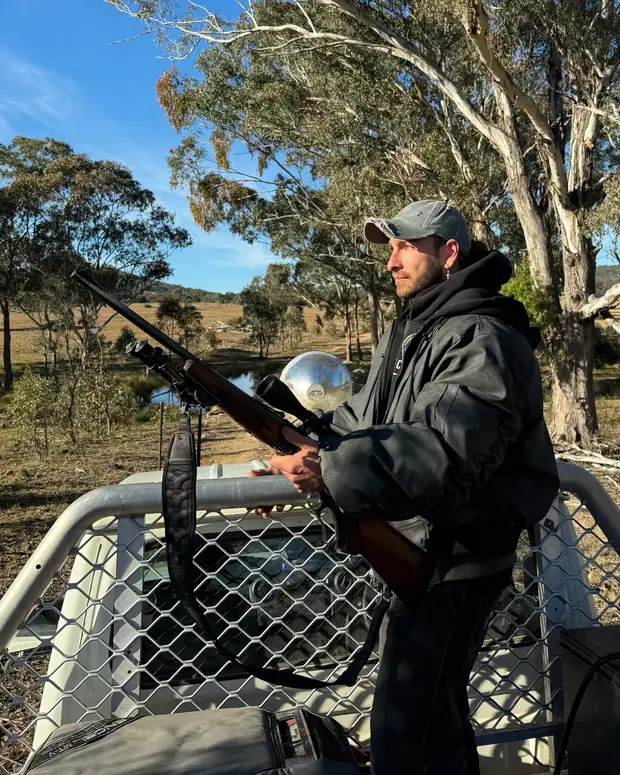
Off the ute
Much of the hunting at Silent Grove happens from the back of the ute. Engine off and everyone still before a shot, a bag or folded jacket on the rail, and the fore-end on that. The shooter stands in front of the spotlight operator, never behind.
Over the cab is fine, with the rifle on the rest and the muzzle forward and well clear of the roof. Never shoot across anyone, at a pair of eyes or a reflection, at anything moving, or over a crest you cannot see past. The NSW handbook adds that vehicle rollovers while spotlighting are the most commonly reported hunting incidents in the state, so the driver's job matters as much as yours. Roos are never shot from a moving vehicle.
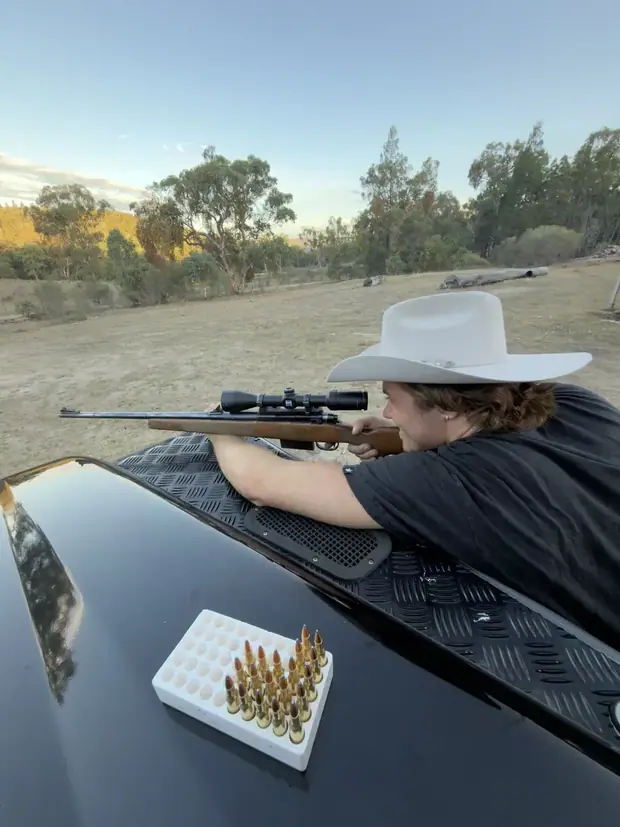
Off a bonnet
A bonnet or a tailgate with a rubber mat or a bag on it is a fine bench for range work. Pad the fore-end, keep the barrel off the metal, and keep your body square behind the rifle so the recoil comes straight back into your shoulder.
Rest on something hard and the rifle bounces off it as it fires. The NSW handbook warns a fore-end rested on a hard surface can throw the shot high.
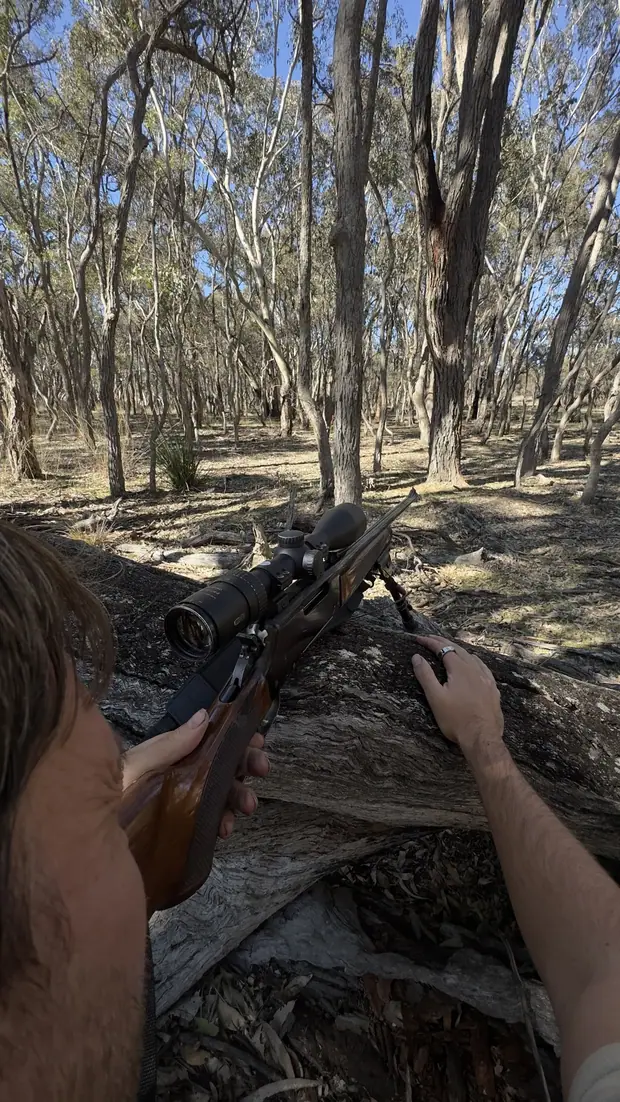
Off a log, a rock or a post
Whatever the country offers. Put your hand, your hat or your pack between the rifle and anything hard, and keep the barrel clear of it. Check what is in front of the muzzle too: a scope sits 4 cm above the bore, so the scope can see over a log the bullet will hit.

Prone
Lying flat behind a bipod or a pack, body straight behind the rifle or angled a little. The NSW handbook rates fully supported prone the most stable position there is. Useless in long grass, and on a downhill slope your head creeps forward on the stock: watch your eye relief or wear the scope.

Sitting
Seat on the ground, knees up, with your arms or elbows braced on your knees so bone, not muscle, holds the rifle. The NSW handbook's pick when you have no rest at all. Quick to get into, and it gets you up over grass that would block a prone shot.

Shooting sticks
Two or three legs joined at the top give you a rest at sitting, kneeling or standing height anywhere. They were the steadiest support in the British stalker records. Practise setting them up quietly, fore-end in the fork, your leading hand on the sticks or the rifle.
Settle
Build the position so the crosshair sits on the target with your muscles relaxed. If you have to hold it there, the position is wrong. Close your eyes, breathe, open them: if the crosshair has drifted off, move your body, not your arms.
Breathe out
Breathe normally, then breathe out and let the natural pause at the bottom of the breath arrive. That pause is when the shot goes. Hold your breath too long and you start to shake.
Press
Pad of your finger on the trigger, press straight back, slowly and steadily, and let the shot surprise you. Don't snatch at it as the crosshair swings across the spot.
Follow through
Keep your eye in the scope and the trigger pressed through the shot, and try to see where it lands. Then work the bolt, safety on, and keep watching the animal.
Recoil is the rifle being shoved back as the bullet and gas go forward. It is why people flinch: they learn to brace against the bump, then start bracing before the shot breaks, which pulls the rifle off the target. The NSW handbook names anticipating the trigger break as the most common cause of a flinch, and a heavy trigger as a common way to learn one.
The cures are dull and they work. Hold the rifle firmly into your shoulder, because a loose rifle gets a run-up. Wear earplugs, because the noise drives a flinch as much as the shove. Dry-fire an empty, checked rifle at a mark and watch whether the crosshair jumps as the pin falls. And start on the .223. It barely moves, so you learn to keep your eye open and watch the shot land.
Scope bite
A scope's eyepiece sits 8 to 10 cm from your eye for a reason (the Vortex Diamondback 3-9x40 is 84 mm). Creep closer and the recoil drives the eyepiece into your eyebrow: a crescent-shaped cut, plenty of blood, and a flinch for years. It happens most shooting prone or uphill, when your head slides forward on the stock. Before every shot, check you see a full, sharp circle with your head where it naturally falls.
Ears
An unsuppressed .308 is about 165 dB at the shooter, and New Zealand's Firearms Safety Code warns that one unprotected shot can do permanent damage. Earplugs are supplied at Silent Grove. Wear them in the ute too: whoever stands beside the shooter cops it as well.
Looking after it
Look after a rifle in the field and it goes on shooting where you zeroed it. Most of the job is keeping it dry, keeping grit out of the action and checking the screws, not scrubbing the barrel.
Tick these off at the end of each day. The list remembers on this device.
- Unload it and check itChamber and magazine, by looking and by feeling.
- Wipe it down, and dry it if it got wetNever leave a wet rifle zipped in a bag overnight.
- Look through the bore with the bolt outMud, snow, a cleaning patch or a wasp: anything in there comes out before the next shot.
- Check the ring and base screwsA loose scope is a lost zero.
- Clean the lenses properlyBlow the grit off first, then a lens cloth. The Optics volume has the method.
- A light film of oil on bare metalA film, not a puddle, and very little in freezing weather.
- Lock it away, ammunition separateSee the storage note below.
How often does the barrel need cleaning?
On a hunting trip, rarely. A hunting rifle shoots well for a good many rounds between cleans, and a freshly cleaned barrel can put its first shot or two somewhere other than the rest. Clean at the end of the trip and after any soaking. If you clean it mid-trip, fire a shot or two on paper before you hunt.
Which way does the rod go?
From the breech, with the bolt out, so you never drag grit across the crown. A coated one-piece rod with a bore guide, or a pull-through. Finish with a dry patch, because oil left in the bore can move the first shot.
What if mud or snow gets in the barrel?
Stop and unload. Never fire to clear it. Push it out with a rod from the breech end, look through to check the bore is clear, and if there was any doubt, check your zero on paper before you hunt again.
Tape over the muzzle?
Plenty of hunters in wet country run a single strip of electrical tape over the muzzle to keep out rain, mud and snow, and shoot straight through it. Put a fresh piece on after every shot, and still look through the bore at the end of the day.
What about cold huts and frozen rifles?
Bring a frozen rifle into a warm hut and it sweats, and that water can freeze in the action and the trigger once it goes back outside. Many hunters leave the rifle in its bag in the cold, or dry it thoroughly before it goes back out. Use very little oil when it is freezing.
Storage and transport in NSW
When it is not in use, the Firearms Act wants a Category A or B rifle (bolt-action centrefires are Category B) in a locked receptacle of hardwood or steel, fixed in place if it weighs under 150 kg empty, with the ammunition locked away separately. In a vehicle it travels unloaded and out of sight. NSW firearms law is part way through a set of reforms, so check The Law in NSW for where they stand.