Field Craft
There’s no recording of this volume, so your phone reads it out, section by section.
How to find a deer before it finds you, and get close enough to do the job properly.

Find it first
Most deer that get away were never seen by the person they got away from. He walks in, the deer sees him first, and the first he knows of it is a white rump going away through the trees. Glassing turns that around. You sit somewhere with a view, put the binoculars on the country, and find the deer before it has any idea you exist.
It is the least glamorous part of hunting and the part that does the most work. The rule of thumb Victoria's Game Management Authority teaches is ten times as long still and watching as walking. That feels wrong for the first hour and right for the rest of your life.
Fallow make it easier than most. The ones collared in a recent New South Wales study moved most around sunrise and sunset, at all three sites. So the first and last hour of light are when they are up, feeding and visible, and when your glass should be on the edges where they come out to feed.
The glass
The NSW hunter education handbook puts the minimum for this kind of hunting at an 8x42. Eight power is steadier and wider in timber. Ten pulls more out of open country but shows every shake, so brace it: knees, a pack, a tree, a tripod.
Never glass with the riflescope. Whatever you look at, you are pointing a rifle at, and sooner or later that is a person.
- Before you look
Sit high, sit still, sit braced
Somewhere with a view over feed and the edges around it, with the sun behind you if you can manage it. Get comfortable enough to stay put for half an hour. Fidgeting ruins more glassing than bad eyes.
- Strips
Near to far, left to right
Work the country in overlapping strips like mowing a lawn. Start close, because the deer closest to you is the one most likely to see you. Hold each view for a few seconds before you shift. A slow sweep finds nothing: the eye needs the picture still to spot what is wrong with it.
- Pieces
Look for parts, not deer
You almost never see a whole one. You see an ear, a flick of a tail, a flat horizontal line in a world of upright trunks, a pale patch that is too pale, legs under a bush, a shape that moves when the bush beside it does not. One wrong piece is enough to look harder.
- Where
Edges and shade
Fallow like the seam where timber meets open grass: cover behind, feed in front. In the early morning look at sunny, north-facing slopes where they warm up. Later, look into the shade under trees. In the afternoon, look at the feed and the trails leading to it.
- Again
Glass it twice
Deer stand up, step out and lie back down. A patch that was empty ten minutes ago can hold a mob now. Before you write a slope off, go over it again.
Each of these engravings has a fallow in it, drawn into the bush the way they really sit. Move the glass over the scene (on a phone, tap where you want to look) and tap again on anything that looks wrong. If you give up, let it work the grid for you and watch how the method finds it.

Somewhere in the timber is a doe
Start at the bottom of the picture and work across, then up a strip. Look for the piece that does not belong.
Fig. 1Four scenes, four hidden fallow. The same scenes turn up in the field game.
Lore
Watch for the tail. A feeding fallow flicks its tail almost constantly, black on top and white beneath. In a still paddock at last light, that small black-and-white metronome is very often the first thing that moves.
The wind first
A deer's nose is the one sense you cannot beat. The UK's Deer Initiative calls smell probably their primary sense, good for human scent over many hundreds of metres. No clothing, spray or technique fixes a bad wind. You either keep it in your face or you are not hunting that deer.
So check it constantly, not once at the ute. A pinch of fine dust or ash dropped from shoulder height, a thread of cobweb on the rifle, a puffer bottle of unscented powder. Watch which way it drifts, and how fast.
Then watch the country bend it. Wind curls over ridges and swirls in gullies, so the breeze on the hilltop is not the breeze in the creek. On top of that sit thermals. Through the warm part of the day, sun-heated slopes push air uphill. As the evening cools, the air drains downhill and keeps draining through the night.
That gives you a rule worth knowing: at first and last light, come at a deer from below, because your scent is sliding down the hill away from it. In the warm middle of the day, come from above. Whenever a real wind is blowing, the wind wins over both.
A mob is feeding in the clearing at the top right. You are at the ute. Pick a wind, then pick a route, and watch what happens. The shaded wedge is your scent. Open paddock lets them see you. The creek bed is dead ground, and the timber hides you until you are close.
The wind is coming from the
Take route
Pick a route
Three ways in. One is quick, one is sneaky and one is long. The wind decides which of them works.
Fig. 2A stalk plan. Scent drifts downwind in a widening wedge. Moving in the open within a few hundred metres gets you seen.
Dead ground is the stalker's best friend: anywhere the deer cannot see because something is in the way. A creek bed under a bank, the far side of a rise, a fold in a paddock that looks dead flat until you lie in it. Before you move, look at the country between you and the deer and plan from one piece of dead ground to the next, ending somewhere you can see it and it cannot see you.
The catch is in the plan above. Dead ground hides you from eyes and does nothing at all for the nose.

Keep something between you and them: a trunk, a bush, a rise. Never show yourself on a skyline, and stay in the shade. A person in shadow is a dark shape among dark shapes. The same person in sun is a moving bright thing. The handbook's advice is plain: stick to the shadows and use ground cover, trees and the contours of the land.
Hunting pace is slower than you think, then slower again. A few steps, three to five metres in the NSW handbook, then stop and look. Each step uncovers new country, so you look into it before you take the next. Move when the deer's head is down feeding or hidden behind a tree. Feel for sticks with your foot before you put weight on it. If you snap one, stop where you are for a few minutes and let the bush settle.
Deer are superb at movement and poor at still shapes. That is the whole trick. When a head comes up, stop. Mid-step if need be, rifle half-raised if that is where it is. A deer staring at a shape it cannot make out will usually go back to feeding if the shape stays a shape.
The next move is the deer's, not yours. Wait until the head goes down and stays down a few seconds, then move.
When a doe stamps or barks
The old doe is the sentry, and a mob takes its cue from her. A suspicious deer stares, ears forward, and may stamp a front foot. A fallow doe that is sure something is wrong gives a single short, gruff bark, and when they are properly alarmed the tail goes up.
Freeze completely. Do not try to sneak the last bit. If she settles and feeds again, give it several minutes before you move. If she barks again, starts to circle, or the mob bunches with tails up, the stalk is over. Let them go, back out the way you came, and come back another day with a better wind. Never chase an alarmed mob with a rushed shot.
Lore
Research on white-tailed deer found their eye is built for the horizon: a horizontal pupil and a horizontal band of densely packed cells across the retina, a design for spotting a predator on the skyline. Which is why a hunter standing on a ridge stands out like a lighthouse, and why you cross a crest on your belly or not at all.
After dark
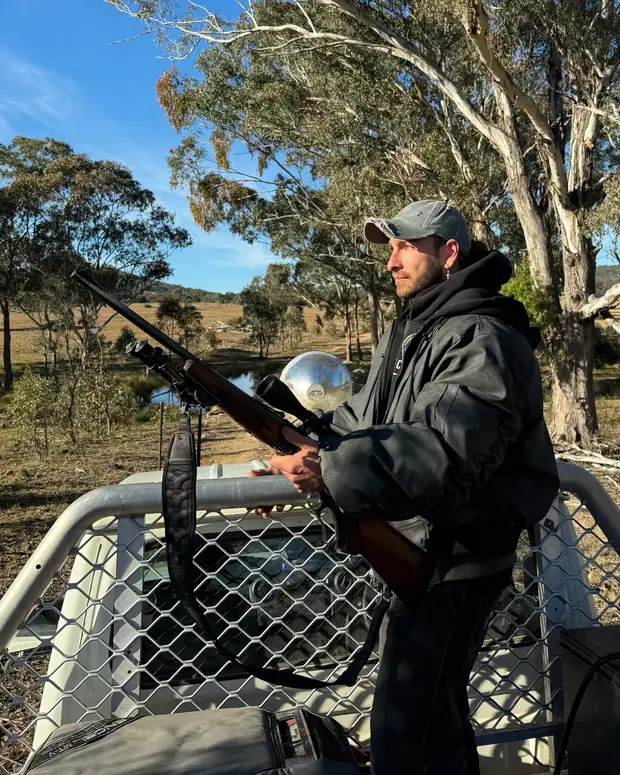
Dusk and dark are the main game at Silent Grove, and most of it is done off the back of the ute. It is far and away the easiest hunting there is, and the reason a first-timer gets animals on their first trip. Where the ute cannot go, we get out and stalk in on foot, into the wind.
The team is three: a driver, a spotter on the light and a shooter. The ute crawls along a track the driver knows by daylight. The spotter sweeps the light across the paddock edges and the light comes back as eyeshine. When it finds eyes, the light holds steady on them, the ute stops, and everyone works out what is actually standing there before anything else happens.
Many animals will stand and stare into a light, which is what makes this work. It also means you get time, and the right use of that time is identification, not hurry.
- Unloaded while the ute movesA round goes in only when the ute has stopped, the shooter is set on the rest and the animal is identified.
- Three in the tray, no moreShooter, light and whoever's up next, with the driver in the cab. The shooter stands in front of the light.
- Seated or holding on whenever it rollsNobody stands unbraced in a moving tray.
- Slow, on tracks, on ground everyone saw in daylight
- Never at a moving animalEvery shot is at a standing, stationary animal.
- Never at eyes alone, never at a reflectionSee the whole animal, clearly, before the safety comes off.
- A backstop you can seeEarth behind it. Never over a crest or a hill. Mind ricochet off hard ground and water.
- Extra care near fences, boundaries, roads and tracks
- Unload and show it clear before anyone climbs downThen fetch the animal.
- One voice calls the shotAnd if anyone says stop, it stops.
The real danger is the driving
Vehicle rollovers while spotlighting are the highest reported hunting incidents in New South Wales, according to the state's own hunter education handbook. Not bullets. The driver, the speed and the track matter more than anything the shooter does.
The light
Lumens tell you how much light a lamp makes. Candela tell you how far it throws. By the standard torch makers rate to, a 100,000 candela lamp reaches about 630 metres.
A red filter may make the light less obvious to deer, which see red poorly but do see it. White light is what you identify with. Thermal finds heat, not identity: it can tell you something is there, never what.
Is it legal?
In New South Wales, spotlighting deer on private land with the landholder's permission is lawful. On public land, hunting is daylight only and vehicle spotlights are banned. No NSW statute bans shooting deer from a stationary vehicle on private land, but every code says never from a moving one, and a loaded firearm on a public road is an offence. Kangaroos are protected native animals under a different law entirely. The detail is in The Law in NSW.
Seven animals are standing the same distance out, so you can compare height and spacing. Watch how each pair moves, then tap a pair to put the white light on it. The colours here are typical, not rules: eyeshine shifts with the angle, the animal's age and the colour of your light. That is exactly why colour alone never identifies anything.
Who is out there?
Colour, height, spacing and movement, in that order of unreliability. You read all four together, and then you still put the light on the whole animal.
Fig. 3Eyes at one distance. Heights are rough and colours are typical, not fixed.
Never shoot at eyes alone
The NSW handbook says it in one line: never fire at a pair of eyes or a reflection. A cow's eyes, a dog's, a reflector on a fence post and a mate's head torch all come back out of the dark looking much the same.
Identify the whole animal in white light, then look past it. The beam lights the animal, not what is behind it, and you are responsible for where the bullet stops.
New Zealand keeps better records on this than we do, and they are sobering. Mistaken identity is the leading killer of big-game hunters there. In 80% of those cases the shooter and the person shot were in the same party, and in 92% they were less than 75 metres apart.
That is not strangers in the dark at long range. That is mates, close, with someone certain of what he saw. The brain sees what it expects to see. The only cure is a rule you never break.
Lore
The reflectors down the middle of the highway are named for this. Percy Shaw of Halifax patented his road studs in 1934 and called them cat's eyes, after the eyeshine that comes back from a cat in a car's headlights. Strictly, the reflecting lens inside them had been invented six years earlier, for advertising signs, by an English accountant called Richard Hollins Murray. Shaw got the name.
When fallow answer
Fallow are chatty for deer. Does and fawns keep in touch with soft bleats and mews, does bark when alarmed, and in the rut the bucks groan: a deep, rhythmic belch that carries a long way through cold autumn air and sounds like nothing else in the bush.
Calling works in the rut, and the job it does is narrower than people think. A buck on his stand answers a challenge. Victoria's game authority puts it well: calls and rattled antlers can entice a buck to croak and reveal where he is. Often that is all you need. You know where he is, and you go to him, into the wind.
The research says the groan is mostly a threat aimed at rival bucks, not a love song for does. Bucks groan harder with other vocal males nearby, and they read a rival's size and rank from the sound itself: deeper groans come from bigger, higher-ranking bucks. In a three-year study, the share of the rut a buck spent groaning was the best single predictor of how many does he mated with.

So, in October
Bucks are in hard antler or have just cast it, and does are heavy in fawn, with birthing from late November. There is no rut, nothing to defend and no reason for any deer to come to a call. Calling fallow outside the rut is limited at best, and on this trip nobody calls. We glass, we stalk and we use the light.
The one sound worth knowing in spring is your own silence. A walking deer that will not stop is not a shot, and some hunters make a soft whistle or bleat to pull it up for a look. It works sometimes, and it also tells the deer exactly where you are. We would rather wait for it to stop on its own.
In the rut, two cautions. Other people may be calling the same buck, so never fire at a sound or a shape you have not fully identified. And a buck coming to a groan is coming to fight, which makes him faster and closer than you planned. Know your backstop before he arrives.
Lore
To deepen his groan, a fallow buck drops his larynx down his neck, lengthening his vocal tract like a trombone slide. When researchers CT-scanned the heads of two bucks in 2018, they found the groan resonates through the nose and the mouth at the same time.
Read the block
Before you can find a deer, you need to know where to look, and the block tells you if you read it. Sign is everything deer leave behind: prints, droppings, worn paths, beds, rubbed saplings, hair on a fence. Each piece says something was here. Read together, they tell you where deer feed, where they lie up, where they drink and which way they travel between them.
That matters because fallow are creatures of habit. In the New South Wales study that GPS-collared 68 of them, bucks ranged over a median of about 1,850 hectares a year and does about 650, travelling two to two and a half kilometres a day. But they kept coming back to the same ground.
So the question for any piece of sign is not just "deer?" but "how fresh, and what does it tell me to do?" Fresh sign on a path between bedding timber and feed means sit downwind of that path at last light. Old sign means they used to come here, and the question is why they stopped.
Tap the marks on the block below. Each one is a piece of sign, and the note tells you what to do with it. Reading prints and droppings properly, and following blood, is a whole book of its own: Tracking.
1. Beds in the timber
Flattened ovals in the grass under the trees, often with a little hair in them. This is where they lie up through the middle of the day to chew the cud. Don't walk through it. You will push them out, and they learn.
2. The pad
A worn path from the bedding timber down toward water and feed. Fallow use the same routes again and again until something pushes them off. Find a pad with fresh sign on it and sit downwind of it at last light.
3. Droppings on the pad
Shiny, soft and greenish means hours. Dull, dry and dark means days or more. Fresh droppings here say the pad is in use now, not last month.
4. Slots in the mud at the dam
Water is a fixed point that every animal on the block has to visit. In very fresh prints the soil at the bottom is still damp. Sharp edges and a damp base mean recent.
5. Hair on the fence
Where a pad meets a fence, deer jump it or go under it and leave hair on the wire. It tells you exactly where they cross, which is a good place to be downwind of at dusk.
6. Frays along the edge
Saplings with the bark stripped off by a buck's antlers, at about knee to chest height. Rubbing starts as the velvet comes off in February and peaks through the rut. A line of them along an edge is a buck's beat.
7. An old scrape
A pawed patch of bare earth from the April rut, once soaked in urine and scent. In October it is history, but it tells you where a buck held his stand, and the ground that suits one buck tends to suit the next.
8. The feed
Green pick on the paddock edge, close to the timber. The edge is where fallow are happiest feeding: cover behind, food in front. Glass it first thing and last thing.
Lore
Fallow are homebodies with long legs. The collared bucks in that New South Wales study covered nearly three times the ground the does did over a year, and in the mating season they travelled much further at night. Then the rut ended, and they went home.
The moment
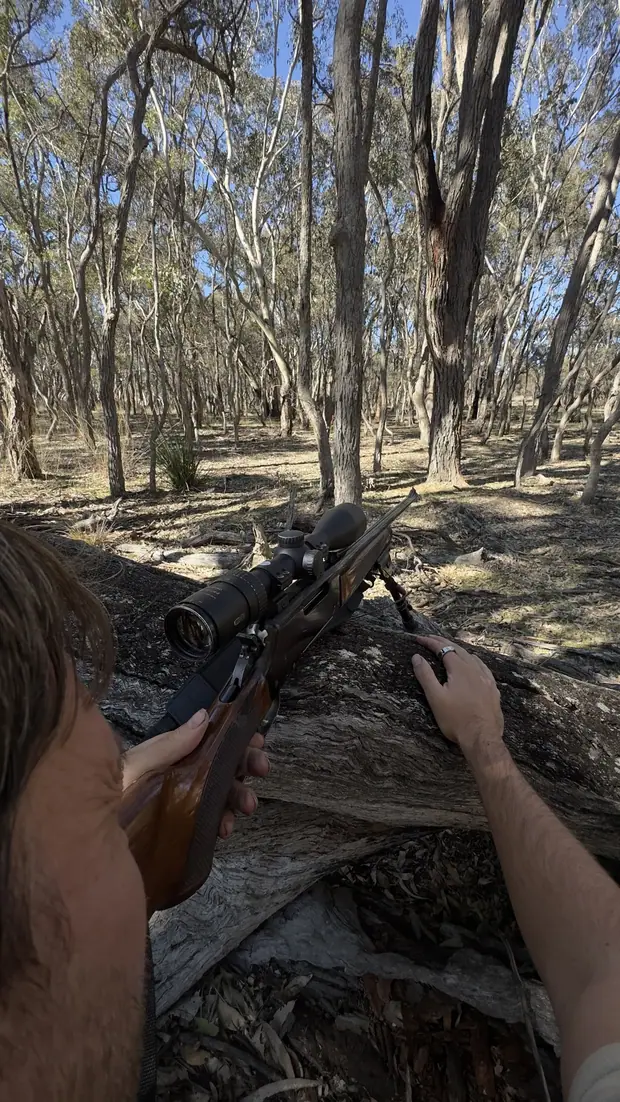
All of it, the glassing, the wind, the creeping, comes down to a few seconds when the deer is in front of you. And it is almost always wrong in some small way. The head is behind a tree. A branch crosses the chest. It is facing you. It is walking. There is a ridge behind it and you cannot see what is over the top.
The skill nobody talks about is doing nothing. Waiting for the step that brings the chest clear, for the deer to stop, for it to turn broadside. Waiting two more seconds costs you nothing. Not waiting can cost a deer a slow death and you a long night. There is always another deer. There is never another chance to unshoot one.
Where the bullet goes once it is right is its own book: Shot Placement. What to do in the half hour after the shot is in Tracking.
Only the head
He has stepped to the edge and is looking. You can see a head and antlers and nothing you should shoot at. Stay frozen. This is the moment he is most likely to see you.
Close, and still wrong
The neck and the front of the shoulder are out, but branches cross the chest and the vitals are half in the scrub. A bullet through twigs goes where it likes. One more step.
Now
Standing, broadside, clear of the scrub, rising ground behind him to stop the bullet. You are on a rest and inside the distance you have proven on the gong. This is the shot you waited for.
Moving: wait
Same buck, same distance, but walking. Never shoot a moving animal. Wait for him to stop, and he usually will, to feed or to look back.
Let it go
Going away, rear on, into cover. There is no clean shot at a deer going away from you. Let him go and know that you did the right thing, which is the part of hunting nobody photographs.
Fig. 6Five seconds in the life of a buck at the edge of the scrub. Drag through them.
- It is the animal you want, seen wholeNot eyes, not a shape, not a patch of colour.
- It is standing still
- Broadside, or quartering awayFacing you, wait. Going away, never.
- Nothing in front of itNo branches, grass or fence wire across the line.
- Earth behind itA backstop you can see. Nothing over a crest.
- You are on a restSticks, bipod, pack, the ute rail. Off-hand is a last resort, never a default.
- Inside the distance you have provenOn the gong, not in your head.
- You know where you will look after the shotA landmark where it stands, so you can find the spot.
Lore
A British study went through 2,281 first shots taken by 102 deer stalkers. Off shooting sticks they hit 96% of the time, off a bipod 93%, freehand 87%. Under 75 metres they hit 95%, and beyond 150 metres 83%. The stalkers who practised every month hit 95%, against 79% for the rest. Rest, range, practice: none of it is a secret.
Try the field game, and see whether you can find the deer against the clock.