The Law in NSW
There’s no recording of this volume, so your phone reads it out, section by section.
Licences, permission, and where the line actually sits, as the law stands in October 2026.

The licence
In New South Wales a firearm comes with paperwork, one person at a time. The Firearms Act 1996 treats owning or using one as a privilege conditional on public safety, and it backs that up with a blunt offence: possess or use a firearm without a licence or permit and the maximum is five years' jail (s 7A). The offence covers having the rifle, not just firing it.
A licence answers three questions. Which firearms you may have (the category). Why you want them (the genuine reason). And whether you can be trusted with them (the checks, the course and the wait). Using a rifle outside your genuine reason, or breaking a licence condition, counts as the same offence as having no licence at all (s 7A(2)).
Category A
Air rifles, rimfire rifles that aren't self-loading, shotguns other than pump, lever or self-loading, and shotgun and rimfire combinations. The bolt-action .22 most people learn on lives here.
Category B
Centre-fire rifles that aren't self-loading, muzzle-loaders, shotgun and centre-fire combinations, and lever-action shotguns holding five rounds or fewer. A bolt-action 6.5 Creedmoor, .308 or .223 is a Category B rifle. On top of your genuine reason you must satisfy the Registry of a special need for one (s 13).
Category C
Self-loading rimfires holding up to 10 rounds, and self-loading and pump-action shotguns holding up to 5. Issued essentially to people running land for primary production, and usable only on that land or adjoining land with written permission. One rifle and one shotgun, unless a special need for more is proved (s 8, s 14).
Category D
Self-loading centre-fire rifles, and the bigger-magazine versions of Category C firearms. For government agencies, professional pest controllers and primary producers in authorised eradication campaigns, who are then held to three firearms on one named property (s 8, s 15).
Category H
Pistols, including air pistols. Only for sport or target shooting, business or employment, or a collection, with a special need on top (s 16). Recreational hunting isn't one of the genuine reasons a pistol licence can rest on.
Parliament passed the biggest change to NSW firearms law in a generation on 24 December 2025, after the Bondi Beach terror attack. Parts of it apply now. The parts that move firearms between categories don't yet: they start on a date the government will proclaim. This is where things stood on 5 October 2026.
| Firearm | Today | Once the reform starts |
|---|---|---|
| Bolt-action centre-fire | Category B | Category B, magazine of 10 or fewer |
| Bolt-action rimfire | Category A | Category A, magazine of 10 or fewer |
| Straight-pull rifle | Category A or B | Category C |
| Pump-action rifle | Category A or B | Category C |
| Button or lever-release | Category A or B | Category C |
| Semi-automatic air gun | Category A | Category B |
| Belt or link-fed | By category | Prohibited |
- Step one
An approved safety course
The Firearms Licence Qualification Course, or another course the Commissioner approves, with an approved instructor (Regulation cl 144). Theory, safe handling, and a practical.
- Step two
Your genuine reason
For hunting: own or occupy rural land, hold written permission from someone who does, or join an approved hunting club (s 12). The permission must describe the land and the type of game (cl 30).
- Step three
Apply to the Registry
To the NSW Police Firearms Registry. Since 1 July 2026, identity verification is mandatory before an application goes anywhere.
- 28 days
The wait
A first licence can't be issued until 28 days after you apply (s 11(2)). New licences now run for two years, not five (s 21).
- Before you buy
Storage, then a permit to acquire
One permit to acquire per firearm, with its own 28-day wait for your first in a category (ss 31, 31A). Since 1 July 2026, no permit until your storage passes a police inspection.
- Then
Registered to you
Every firearm is registered in the licence holder's name, and the licence covers only registered firearms of its category (s 8).
- Storage
- Category A and B: a locked hardwood or steel receptacle, fixed down if it weighs under 150 kg, ammunition locked separately (s 40). C, D and H: a steel safe bolted to the building (s 41).
- On demand
- Produce your licence when police ask. If it isn't on you, you have up to six hours (s 68).
- Reasonable care
- All reasonable precautions so the firearm isn't lost, stolen or picked up by someone unauthorised (s 39).
- Since 24 Dec 2025
- No permit to acquire if it would put you over the coming cap: four firearms for recreational hunters, ten for primary producers and some others. Licence refusals go to internal police review, not the tribunal.
- Not yet
- The cap itself, Australian citizenship for licences (with exceptions), compulsory club membership and the reclassifications above all wait on proclamation.
Lore
The Firearms Act came into force on 1 July 1997, NSW's part of the national response to the Port Arthur massacre. The licence categories and the genuine reason test date from then.
Introducing the 2025 reforms, the Police Minister told parliament NSW had over 250,000 licence holders with just over a million firearms between them.
Without one
This is the line people get wrong most often, so here it is plainly. NSW has no rule that lets an unlicensed adult fire a rifle on private land because a licensed mate is standing beside them. Not at a target, not at a deer, not at a kangaroo. Supervision only counts in two places, and a farm isn't one of them.
The Act has one exemption for people without a licence (s 6B). You may possess and use a firearm, other than a prohibited one, only on a approved range or in an approved firearms safety course, and only under supervision. Everywhere else, the general offence applies: up to five years for possessing or using a firearm without a licence or permit (s 7A). Handing a firearm to someone who isn't authorised to have it carries up to five years as well (s 50B), so the licence holder who passes the rifle across commits an offence of their own.
An approved range
Yes · s 6B(1)(a)One licensed supervisor to one shooter, P650 signed first.
An approved course
Yes · s 6B(1)(b)Inside a safety course, under an approved instructor.
Private land
No · s 7AA licensed mate beside you doesn't change it, on a farm of any size.
Fig. 1 · The only two places an unlicensed person may hold and fire a rifle in NSW.
- Where
- A range approved by the Commissioner, or an approved safety course (s 6B(1)).
- Who supervises
- On a range, someone licensed for that kind of firearm. An interstate licence holder counts (Regulation cl 128). In a course, an approved instructor.
- How closely
- Direct supervision: one supervisor, one shooter (s 6B(1A)).
- How old
- Twelve or over (s 6B(3)). A minor's parent or guardian shows photo ID and gives written consent (cl 129(8)).
- The P650
- Before the first shot, a declaration covering licence refusals, firearms prohibition orders, recent convictions, violence orders, self-harm and mental health. One "yes" and the club must turn the shooter away. The club records name, address, date of birth and photo ID (a passport for overseas visitors) and keeps it for police (cl 129).
- Ages 12 to 17
- A minor's firearms training permit, after a safety course and with written parental consent, covers non-pistol firearms under the supervision of an A, B or C licence holder, for instruction or events the Commissioner approves (s 32). The supervisor keeps the minor in direct line of sight, ready to step in (cl 156). It ends at 18.
- Interstate
- A resident of another state or territory with the equivalent of an A or B licence may use those firearms in NSW for their licence's genuine reason (s 26, cl 26).
- Overseas
- Only with a safari/hunting participation permit: for people who live outside Australia and are licensed at home, on a named safari tour run by a safari tour permit holder or a hunt run by an approved hunting club (cl 65, cl 66).
- Everyone else
- The Commissioner has a general power to issue permits (s 28), but none of the permits the Regulation sets out lets an unlicensed adult hunt on private land.
Changing, not yet changed
The 2025 reforms will remove the s 6B exemption and replace it with a permit the NSW Police Firearms Registry issues and records, following a coronial inquest recommendation. At 5 October 2026 that part hadn't started, so ranges and courses still run on the P650. Each P650 covers one occasion: come back next week and you fill in a new one.
Deer
Deer in NSW live a double life. On paper they are still game animals, listed in Schedule 3 of the GFAC Act. On private land they're treated like rabbits, foxes and pigs, and every landholder carries a legal duty to deal with the damage they do.
Until 2019 you needed a game hunting licence to shoot a deer on private land. From Friday 6 September 2019 an order moved deer into Part 2 of Schedule 3, the list that already held pigs, goats, foxes, rabbits, hares, feral cats and wild dogs. The Act exempts Part 2 animals on private land from game licensing (s 17(1)(a)), so the licence went overnight. The Game and Feral Animal Control Regulation 2022 then stripped out the deer rules left behind, including the old ban on electronic devices for deer.
What's left on private land is short. No game licence. No season, for any species, at any time of year. No ban on spotlights, thermal or night vision. You need the landholder's permission and your firearms licence, and the cruelty law and the codes of practice come with you.
Deer become game
The Act lists deer as game animals in Schedule 3. Until 2019, shooting one even on private land needs a game hunting licence.
The licence goes
An order moves deer into Part 2 of Schedule 3, beside pigs, goats, foxes and rabbits. On private land, no game licence is needed from that day (s 17(1)(a)).
The leftovers go
The new regulation drops deer rules that no longer made sense, including the ban on electronic devices for deer. The public land rules stay.
The firearms reforms pass
Ten days after the Bondi Beach terror attack, parliament passes the Terrorism and Other Legislation Amendment Act 2025. Straight away: no permit to acquire past the coming cap, and no tribunal review of licence decisions.
Two-year licences
New and renewed licences run for two years. Identity verification becomes mandatory, and a permit to acquire waits on a passed storage inspection.
The buyback opens
Phase 1 of the national gun buyback starts in NSW, at fixed prices, for firearms caught by the new limits and reclassifications. Phase 2, for higher-value firearms, is due in early 2027.
New regulations due
Both the Firearms Regulation 2017 and the Game and Feral Animal Control Regulation 2022 are due to be repealed and remade. Expect detail to move.
Still to come
The four and ten-firearm caps, straight-pull and pump-action firearms moving to Category C, magazine limits, Australian citizenship for licences, compulsory club membership, and a police permit replacing the range exemption.
| Rule | Private land | Declared public land |
|---|---|---|
| Game licence | None for deer | R-licence (restricted game hunting licence) |
| Permission | Owner or occupier | DPIRD written permission for the area and dates |
| Season | None | None |
| After dark | No ban on spotlight, thermal or night vision | Firearms and bows in daylight only, no vehicle spotlights |
| From a vehicle | No statutory ban, never while moving | Banned |
| Blaze orange | Not required | Required |
| Near houses | No fixed distance, but Crimes Act ss 93G and 93H apply | At least 100 m from a dwelling |
| Harvest return | None | Within 30 days |
| Firearms licence | Required | Required |
The R-licence. To hunt game on declared public land, mostly State forests, you need a restricted game hunting licence: twelve or older, an accreditation course, and membership of an approved hunting organisation (GFAC Act s 19). Every hunt also needs DPIRD written permission for that area and those dates, and its conditions bind you. The current conditions date from 22 September 2025. On private land an R or G licence is optional, and DPIRD points out it brings 25 million dollars of public liability cover.
The pest side. No Biosecurity Act control order has been made for deer, but every landholder carries the general biosecurity duty to reduce the risks they pose. Deer law isn't in one place: the GFAC Act decides who may hunt and where, the Biosecurity Act puts the duty on the landholder, and the eleven Local Land Services regional pest animal plans decide where control effort goes. Feral deer are a priority species in all eleven. In March 2026 the government sought a technical review of how feral pig and deer management is delivered.
The Northern Tablelands. Tenterfield sits in the Northern Tablelands region, whose 2024–2028 plan calls fallow the most widespread and common deer, with red, rusa and hybrids mainly in the east. Chital are establishing along the Queensland border. Sambar are on alert, not established. Control there is aimed at protecting assets on every kind of tenure, with aerial and ground shooting as the main tools.
Grazing and trampling by feral deer is listed as a key threatening process for NSW biodiversity. That is why public agencies shoot deer from helicopters while private hunters shoot them for the freezer, and why the law no longer stands between the two.
Lore
You can shoot a wild fallow on private land in NSW with no game licence at all. Catch a fawn alive and take it home, though, and you've committed an offence: possessing, moving or releasing live wild deer is banned under the Biosecurity Regulation (cl 17B), because releases are how new deer populations start.
Kangaroos
Deer are the animal the law wants gone. Kangaroos are the animal it protects. Kangaroos, wallaroos and wallabies are protected under the Biodiversity Conservation Act 2016, and harming one (killing, injuring or capturing it), or attempting to (which includes hunting and pursuing it), is an offence without a licence. NSW grants those licences to manage damage, and says in as many words that licences aren't granted for recreational shooting.
A landholder with a kangaroo problem works through three options first: non-lethal measures, then a commercial harvester if the property is in a commercial zone, and only then a licence to harm, applied for online to the Biodiversity and Heritage Regulator. The licence names the property, the species and the number. It usually runs for six months at most, and the Regulator aims to authorise the smallest number that will deal with the damage.
The ceiling depends on the species, the zone and the size of the property. Here's the 2026 ceiling for eastern greys in most zones.
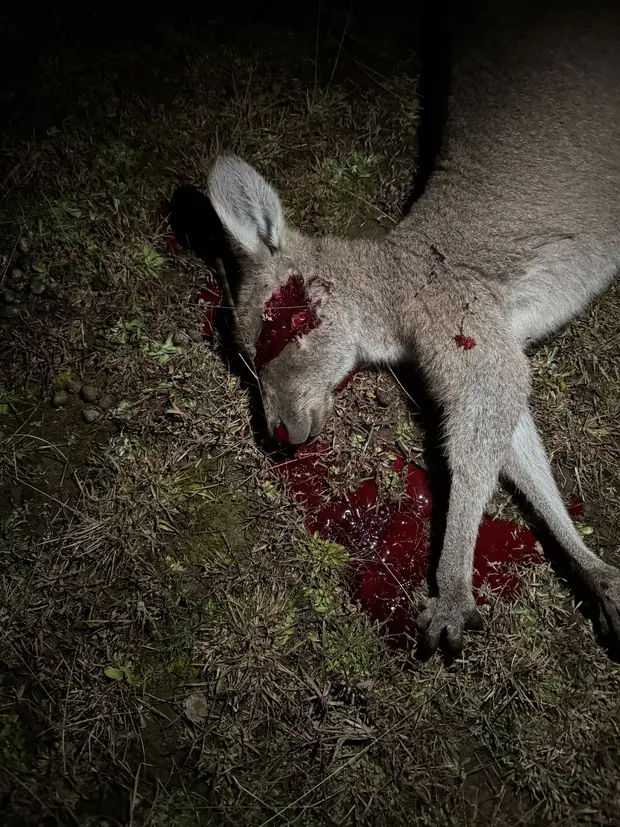
Maximum per licence. Some zones and species are assessed case by case, with lower limits.
- Shooters
- Anyone with a current firearms licence for the firearm they use, carrying a genuine reason consistent with kangaroo shooting. Shooters are no longer named on the application.
- Firearms
- Category A or B only (licence condition 13).
- The register
- The landholder records every shooter's name and firearms licence number and gives each a copy of the licence and of the Code. Shooters carry the licence while shooting or holding carcasses.
- Tags
- None, since 8 August 2018.
- The carcass
- Any non-commercial use, including bait for pest control. Never sold, swapped or traded, by the landholder or by anyone shooting under the licence.
- The return
- Species and numbers to the Regulator within 7 days of the licence expiring.
- Before dark
Sight in
A telescopic sight, checked on an inanimate target before each day's or night's shooting. Centre-fire .222 or .223 class (or a .204 Ruger) with soft or hollow points, out to 200 m for the big species. No self-loaders. No subsonic ammunition.
- The animal
Standing, still, clear
The kangaroo is standing, stationary and clearly visible, within range. Never from a moving vehicle or any other moving platform.
- The shot
Brain only
With a rifle the shooter must aim for the brain. No other point of aim is allowed.
- After
One at a time
Be certain each animal is dead before targeting the next. A wounded one comes first, ahead of anything else.
- Females
The young
Avoid shooting a female with obvious pouch young or young at foot. If one is shot, examine the pouch straight away and euthanase any young exactly as the Code sets out, and shoot dependent young at foot as soon as possible.
Lore
Until 8 August 2018, a NSW roo shot under a landholder's licence needed a carcass tag, and a "shoot and let lie" condition meant it stayed where it fell. Both went in that year's drought changes, which is why roo taken under a licence can now go home for the dogs, or the table.
Land, night and the ute
Permission is what makes a licensed hunter lawful on someone else's dirt. The Crimes Act puts it bluntly. Carry a firearm onto land other than a road without the owner's or occupier's permission, a reasonable excuse or a lawful purpose, and the maximum is five years. Fire onto it and the maximum is ten. It's up to you to prove you had permission, not up to police to prove you didn't (s 93H).
Permission can be spoken, but you have to be able to back it up. If police or an authorised officer ask, you produce written permission or a statutory declaration, on the spot or within 48 hours if it isn't on you, and it has to describe the land and the type of game (Firearms Regulation cl 30). The Inclosed Lands Protection Act 1901 adds its own offences for entering farmland without consent, with heavier ones for doing it with a firearm or hunting gear (ss 4, 4B).
Permission comes with the landholder's rules, and they bind you as tightly as the law. Boundaries, stock, the house, the sheds, the neighbour's lane. A shot that crosses the fence onto land you have no permission for is the same s 93H problem as walking in uninvited.
- The landProperty name and location. Required (cl 30(3)).
- The gameFallow deer, pigs, foxes, whatever is agreed. Required (cl 30(3)).
- Who it coversEach shooter by name.
- WhenThe dates, or that it's open-ended until withdrawn.
- The conditionsNo-go paddocks, stock, buildings, vehicles, night shooting.
- The landholderName, signature, date and a phone number.
Roads. Public roads change the rules again. Having a loaded firearm in a public place, or firing in or near one, carries up to ten years (Crimes Act s 93G). A firearm counts as loaded if there's a round in the chamber, or in a magazine fitted to it.
After dark. No NSW law bans spotlighting, thermal or night vision for deer, pigs, goats or foxes on private land. The kangaroo Code doesn't forbid night shooting either: it forbids shooting from anything moving. On declared public land, firearms are daylight only. The law permits the night, and the codes ask more of you in it: the whole animal identified, a backstop you can actually see, and a target standing still.
At the hut. Storage rules don't take the weekend off. A firearm can't be stored in a dwelling unless someone lives there while it's stored, and it can't be left in a shed unless that shed can easily be watched from an inhabited dwelling, or meets a monitored-alarm standard (cl 28B). Category A and B firearms go in a locked hardwood or steel receptacle, fixed down if it weighs under 150 kg, with the ammunition locked separately (s 40).
Drink. Handling or using a firearm while under the influence of alcohol or any other drug carries up to five years. So does handing one to someone you know, or should suspect, is affected (s 64). The only workable rule is the simple one: rifles away before the first drink, and they stay away.
In a rack, on show
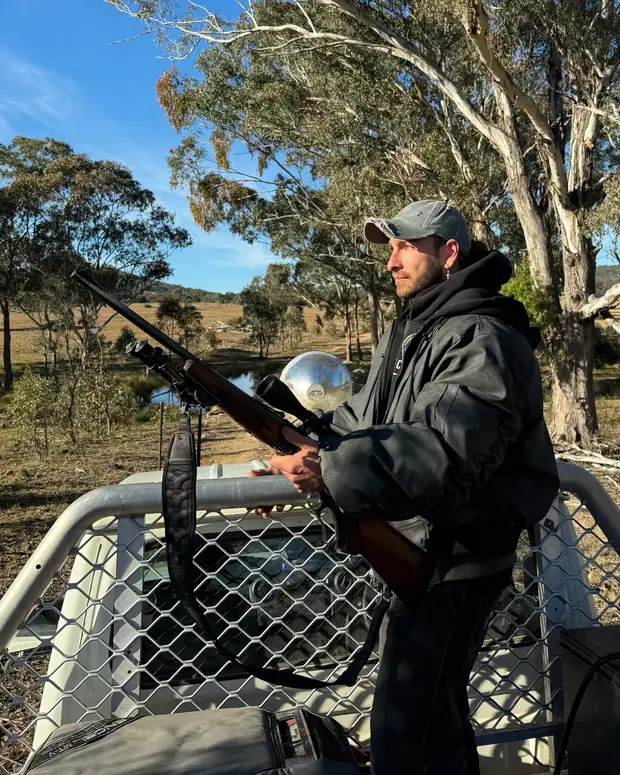
Fine for a photo, wrong for the drive. A Category A or B firearm in a vehicle must be unloaded and not visible from outside it (Regulation cl 149). A rifle in a window rack is also an advertisement to every thief who walks past, and s 39 asks for all reasonable precautions against theft.
Lawful for travelCased, behind the seat
Unloaded and out of sight meets the transport rule. Ammunition rides separately. If you leave the ute in town, the rifle comes with you or is properly locked away: a cased rifle on a back seat is still the easiest theft in the car park (s 39).
Best for the driveA locked box in the tray
Out of sight, locked and fixed to the vehicle. Keep the ammunition in its own locked box. Separate locked ammunition is a condition on public land and plain good sense everywhere else.
Only while shootingAcross the bonnet, stopped
Shooting from a stationary vehicle on private land isn't banned in NSW, and the transport rule stops applying while a firearm is actually being used (cl 149(3)). The ute is stopped, the shooter is set and the animal identified before a round is chambered. Never from a moving vehicle, and on declared public land never from a vehicle at all.
Lore
The law that makes it an offence to walk onto a farm without consent is the Inclosed Lands Protection Act 1901. It dates from the year of Federation and still does its job. The firearms and hunting-gear offences were added much later, aimed squarely at people who shoot on land they have no right to be on.
After the shot
The law's welfare test for hunters fits in a phrase: no unnecessary pain. NSW's POCTA makes cruelty an offence with up to a year's jail, and aggravated cruelty up to two. Hunting and shooting are a defence only when done "in a manner that inflicted no unnecessary pain" (s 23B). That defence doesn't cover a hopeful shot at the edge of your range, an animal left to suffer, or young left to starve.
The codes turn the phrase into practice. For game licence holders the NSW Code of Practice is mandatory, and it's the right standard for everyone else. Shoot only an animal you've clearly identified, with no discernible risk to people or property. Stay inside your firearm's accepted killing range and aim for a humane kill. If you wound one, every reasonable effort goes into finding and killing it. If you kill a lactating female, the same effort goes into her dependent young.
NSW's deer code narrows the aim to two places, the brain or the heart and lungs, and asks you to confirm death: no breathing, no blink when the eye is touched, no response. If there's any doubt, another shot straight away. No season doesn't mean no consequences. In October fallow does are heavily pregnant, with fawns due from November.
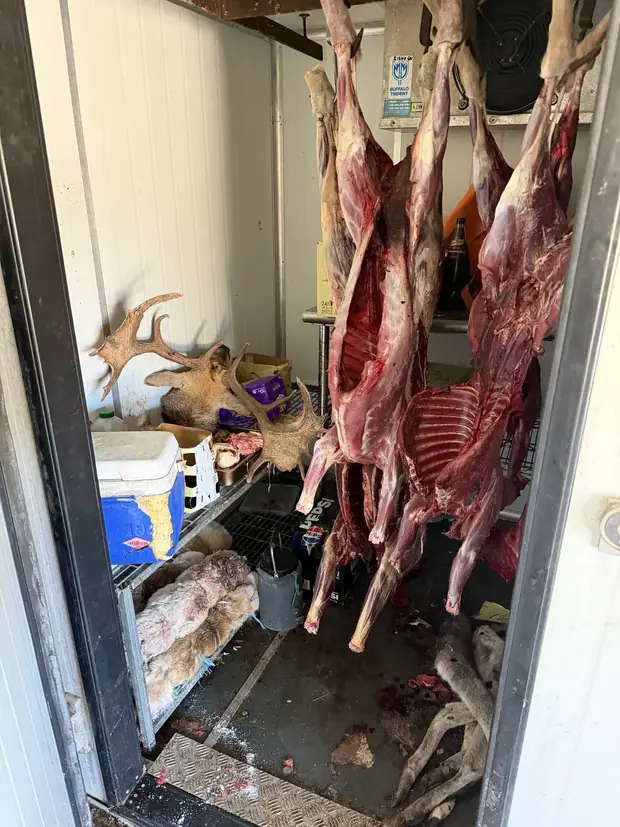
Eat it and share it. Your venison is yours to eat, and to give to family and friends. Selling it is another matter. Game meat sold for people to eat has to come through the NSW Food Authority's licensed chain: a licensed harvester vehicle run by a shooter trained in the game harvester skill set, a licensed field depot with a chiller, and a licensed processing plant, all to the Australian standard for wild game meat (AS 4464). Each carcass is tagged with who shot it, where and when.
Kangaroo is stricter. Anything taken under a licence to harm can never be sold, swapped or traded. Kangaroo meat in shops comes only from professional harvesters working under the commercial quota and their own Food Authority licences.
Biosecurity travels with the carcass. Never feed meat scraps to pigs: it's the classic route for foot-and-mouth disease. If you see blisters, drooling or lameness in deer, pigs or stock, report it to the Emergency Animal Disease Watch Hotline on 1800 675 888.
Lore
NSW writes fair chase into its cruelty law. Shooting animals released for the purpose is an offence (POCTA s 19), and so is running paid hunts of animals confined in a game park (s 19A). The animal has to have a chance of leaving.
Can I shoot this?
Every rule in this book feeds one question, asked in the field in about four seconds: can I shoot this, here, now? Run the tree with your own situation. Each answer names the rule that decides it.
Can a licensed mate use my rifle?
Yes, if their licence covers that category and they're using it for their own genuine reason. A licence covers "a registered firearm" of its category (s 8). Giving possession to someone who isn't authorised is the offence (s 50B).
Do I have to carry my licence?
You must produce it when police ask. If it isn't on you, you have up to six hours to produce it (s 68). Written permission to shoot is separate: on the spot, or within 48 hours (cl 30).
Do bows need a licence?
A bow isn't a firearm, so no firearms licence. Landholders can give permission to a skilled bowhunter for deer. Crossbows are a different story: they're prohibited weapons in NSW (Weapons Prohibition Act 1998, Sch 1).
Are suppressors legal?
No. Silencers are prohibited weapons in NSW (Weapons Prohibition Act 1998, Sch 1). So are aiming lasers over 1 milliwatt.
Do I need a game licence on private land at all?
Not for deer, pigs, goats, foxes, rabbits, hares, feral cats or wild dogs (GFAC Act Sch 3 Part 2, s 17(1)(a)). You do for the introduced game birds in Part 1, such as pheasant and quail, and native ducks are a separate, quota-based scheme.
Who do I ask when it matters?
Licences, permits and storage: the NSW Police Firearms Registry. Hunting rules and public land: DPIRD's hunting team, 1800 748 848. Kangaroo licences: the Biodiversity and Heritage Regulator, 1300 173 376. Selling meat: the NSW Food Authority.
Check it yourself
This book is a plain-English field reference, current as of 5 October 2026, and not legal advice. NSW firearms law is mid-reform: parts of the 2025 Act start on dates still to be proclaimed, and both main regulations are due to be remade by September 2027. Before you act on anything here, check it with the agency that runs it.