The Law in NZ
There’s no recording of this volume, so your phone reads it out, section by section.
Who can pull the trigger, what permits you need, and how a cape gets home, under New Zealand's brand-new Arms Act.

A new Act
New Zealand rewrote its gun law this year. The Arms Act 2026 received Royal Assent on 5 August 2026, and most of it came into force on 23 September 2026, replacing the Arms Act 1983. The rest switches on in stages, the last parts by 23 February 2028 (s 2). Older guides, and some DOC pages, still quote the 1983 Act. The ideas mostly carry over. The section numbers don't.
Its first principles will sound familiar from NSW: the possession and use of arms is a privilege, and anyone doing anything involving arms must act in the interests of personal and public safety (s 4).
The regulator changed too. Licensing used to sit with Te Tari Pūreke, the Firearms Safety Authority, run by New Zealand Police. The new Act sets up the Arms Regulator, an autonomous agency of the Police (s 303). From 23 September 2026 it trades as Firearms Safety and Education New Zealand, FSE for short, at firearmssafety.govt.nz.
The arms registry set up under the old Act carries on (s 359). It records every licence and, where the Regulator holds them, the make, model, markings and location of each licence holder's firearms. Sales, purchases, imports, exports, thefts and losses all have to be reported to it, though lending a rifle to someone for less than 30 days doesn't (s 361).
| The rule | Arms Act 1983 | Arms Act 2026 |
|---|---|---|
| Who runs it | Te Tari Pūreke, inside Police | The Arms Regulator (FSE), an autonomous Police agency |
| Licence needed | s 20 | s 14 |
| Supervision defence | s 22(2)(a) | s 16 |
| Ammunition | s 22B | s 30 |
| Careless use | s 53 | s 265 |
| Drink or drugs | s 47 | s 274 |
| Reporting an injury | s 58 | s 276 |
| The registry | s 93 | s 359, continued |
| Visitor licence | Up to a year | One trip, up to a year. Multi-trip, up to 18 months, from 23 Feb 2028 |
Which firearm is which
The rifles a hunting guide hands you are standard firearms. Most semi-automatics, and pump-action firearms with detachable or large magazines, are restricted firearms under s 9, with endorsements and permits of their own. Everything in this book is about standard firearms, which is all a guided tahr hunt involves.
Who pulls the trigger
Here New Zealand is looser than NSW, and one sentence of law is the reason. You may possess a standard firearm only if you hold a firearms licence or a visitor licence (s 14). But it's a defence if the rifle was in your possession for use under the immediate supervision of a firearms licence holder, and you stayed under that supervision the whole time (s 16). Ammunition works the same way (s 30).
That defence is how a visiting hunter with no New Zealand licence shoots a tahr with a guide's rifle. It's narrower than it sounds, and the Act puts the burden on the shooter: the defendant proves it. FSE reads immediate supervision as three things together. It doesn't apply at all if supervising you would breach bail conditions or a protection order, or if you're subject to a firearms prohibition order.
- One
Present and watching
The licence holder is physically there and actively supervising you. Not at the hut, not on the radio.
- Two
Within reach
Close enough to take control of the rifle you're using, if it comes to that.
- Three
Not shooting
Not using another firearm while supervising you. A guide with their own rifle up isn't supervising anybody.
Side by side
This is the defence working as written. The guide is beside you, watching the shot, hands free.
Within reach
The Act doesn't set a distance. The test is whether the guide could take control of your rifle if they had to. A step or two away on open ground, yes.
The guide shoots too
The moment the guide is using their own firearm, they aren't supervising yours. Two rifles up at once means one of you is outside the defence.
Over the gully
Being able to see you isn't enough. Across a gully, nobody can take control of anything. The defence has gone, and so has the ammunition defence under s 30.
Gone solo
Hunting on your own needs a visitor licence. Without one, possessing the rifle is an offence with up to three years (s 14).
- When you need it
- To possess and use firearms in New Zealand without a licence holder's immediate supervision, or to bring your own rifle.
- What it takes
- Age 16 or over, a firearms licence from a country with similar licensing, an online theory test on the Firearms Safety Code, secure storage arrangements, and a fit and proper check (FSE).
- Lead time
- Apply online at least four months before you arrive. NZ$25, non-refundable.
- How long
- One trip: it ends on the date set, no more than a year out, or when you leave New Zealand, whichever comes first (s 131). Multi-trip licences of up to 18 months start on 23 February 2028.
- Limits
- You can't buy a firearm to own in New Zealand, or sell one (s 132). Anyone staying a year or more applies for an ordinary licence instead.
- Practical
- Apply online with a RealMe login. FSE may ask for your outfitter's booking and your DOC permit, and its system doesn't accept @bigpond.com or @bigpond.net.au email addresses.
- Two papers first
- A visitor licence, and a permit to import for every firearm and for the ammunition (s 56).
- Without them
- Customs or Police can seize the rifle at the border (s 207). Importing without a permit carries up to a year in prison.
- The way home
- Export and Australian re-import paperwork have to be sorted before you leave. With a guide's rifles supplied, very few people bother.
- Ammunition
- Shops may only sell or supply ammunition to a firearms licence holder (s 48). On a supervised hunt, the licence holder buys it.
- At the airport
- A police officer issues the visitor licence and the import permit in the arrivals hall, and everything gets declared to Customs.
The guide's rifles. A licensed hunting guide who supplies no more than six firearms to clients isn't treated as carrying on a business activity under the Act (s 6(1)(b)(i)), so no dealer's licence is needed behind the rifles you're handed. The guide's own firearms licence is what matters.
Suppressors. In New Zealand a silencer is a non-restricted part of a standard firearm, legal for licence holders, and the same supervision defence covers it (s 27). You can shoot a guide's suppressed rifle under supervision. You can't bring a suppressor into the country without a permit.
Permits and places
A rifle you're allowed to hold is half of it. The ground decides the rest. Under the Wild Animal Control Act 1977, deer, chamois and tahr may be hunted by anyone, subject to every other law, but never on land without the express authority of its owner or occupier. Firing into, over or across land without that authority is an offence in its own right (s 8).
In a national park there's a second layer. The National Parks Act 1980 makes it an offence to have a firearm in a park, or fire one, without the Minister's authority (s 60(4)), and the burden of proving that authority sits on the person charged. For hunters, the DOC permit is that authority.
On public conservation land, the permit is the whole key. It's free, issued online by email, valid for twelve months and fine to show on your phone. Every person in a party who intends to hunt needs their own, supervised hunters included, and you produce it when a warranted officer, DOC staff member or police officer asks.
One wrinkle, honestly put. DOC's permit page says supervised hunters need their own permit, while the Game Animal Council's guidance says you need a firearms licence to get one. If you'll be hunting under supervision, ask DOC how you should apply, and do it before you fly.
- No loaded rifle after darkHalf an hour after sunset to half an hour before sunrise: no loaded firearm, no shot.
- No lightsNo spotlights, torches, headlights or night vision for hunting.
- Nothing on the rifleNo thermal, night vision or light attached to a firearm. Hand-held thermal for finding animals in daylight is fine.
- .222 Remington or biggerCentre-fire only. No shotguns, rimfires, .17s, .22 Hornet, air rifles, tracer or incendiaries.
- Clear of peopleNo shooting near huts, tracks, campsites or road ends, and none within 500 m of a Great Walk hut or track.
- Carcasses awayNot within 100 m of huts or campsites, or 50 m of tracks and waterways.
- No dogs or vehiclesUnless your permit's special conditions say otherwise.
Westland Tai Poutini
Hunting is open under the DOC permit, with local rules in its special conditions. No hunting in the Copland, Fox and Franz Josef valleys from 20 December to 31 January, or from Good Friday to Easter Monday. None in the Fox and Franz Josef glacier valleys below the 500 m contour, and none within 500 m of the Southside and Te Weheka walkways and cycleways at Fox Glacier. No dogs, and drones need a permit of their own.
Aircraft may land only where the park's management plan and the operator's concession allow, so helicopters put hunters down at a handful of designated sites. That's a large part of why the park stays quiet. The plan in force dates from 2001, amended in 2008 and 2014, and its review is paused.
Aoraki/Mount Cook
Tahr and chamois may be hunted all year on the DOC permit. You sign in your intentions at the Aoraki/Mount Cook visitor centre when you enter the park. Helicopter access is to designated huts only, with an operator who holds the landing permissions, and avalanches can come down in any season.
Private land
The owner's or occupier's express authority is the whole permission (Wild Animal Control Act s 8). No DOC permit applies, but the Arms Act goes everywhere with you. Get permission in writing if you can, with the boundaries marked, because a shot that crosses onto the neighbour's land is outside it.
Lore
Westland Tai Poutini National Park dates from 1960. It straddles the Alpine Fault, where two tectonic plates meet, and it's the only home of the rowi, the rarest kiwi there is.
Tahr and chamois
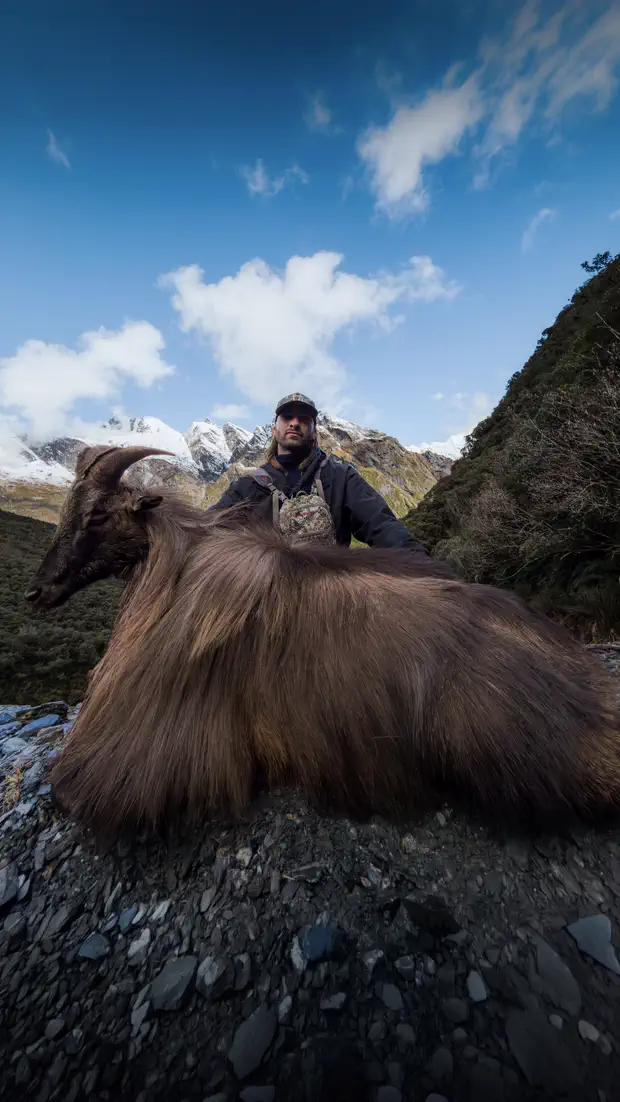
The law looks at a bull tahr three ways at once. Under the Wild Animal Control Act 1977 he's a wild animal, alongside deer, chamois, feral goats and wild pigs. Under the Game Animal Council Act 2013 he's a game animal, alongside chamois, deer and wild pigs, with a statutory council to advise the Minister, educate hunters and promote safety. And inside a national park he's an introduced animal that the National Parks Act 1980 wants exterminated as far as possible.
The plan that holds those together is the Himalayan Thar Control Plan 1993, made under the Wild Animal Control Act and in force since 1 July 1993. It caps tahr at 10,000 across all land. It splits their range into seven management units covering 706,000 ha, with exclusion zones north and south where every tahr is removed. The two national parks form a unit of their own, where the target is under one per square kilometre, heading towards zero.
Intervention densities in the 1993 plan. Above these, DOC controls tahr.
What that means now. In 2024/25, known removals inside the units totalled 8,599 tahr, 4,641 of them by DOC's own shooters. In the 2026/27 plan, DOC shoots every tahr it meets inside the national parks, bulls included. Elsewhere its shooters spare identifiable bulls and white tahr. DOC's 2023 survey put tahr on public conservation land inside the units at about 29,800, well above the plan's ceiling, and a new survey is planned for 2026/27.
Helicopters, two ways. DOC's own aerial control in the 2026/27 plan runs from 1 July to 13 November 2026, from 3 August in the more accessible parts of the parks, so you may hear it. Aerially assisted trophy hunting, where the helicopter is used to find the animal, is a concession activity that runs only from 10 February to 31 August, and each trophy obliges the operator to kill five nannies or juveniles. Being flown to a landing site and hunting on foot is neither.
Herds of special interest. The Game Animal Council Act lets the Minister designate a herd of special interest and hand its management to the Council. Wapiti and sika became herds of special interest in July 2026, and a 2026 amendment to the National Parks Act lifts the extermination duty for a designated herd. No tahr or chamois herd has that status, though tahr hunters have asked for it.
Chamois sit in the same two Acts as tahr: wild animals to be controlled and game animals to be hunted. Neither species is listed under CITES, which matters when it's time to take a trophy home.
Lore
Both animals were gifts. Tahr came from the Duke of Bedford: five released near the Hermitage at Aoraki/Mount Cook in 1904 (the Game Animal Council's history says 1905). Eight chamois from Emperor Franz Joseph's hunting grounds reached the Hermitage in 1907, from the same emperor whose name was already on the Franz Josef Glacier, a valley north of Fox. Shooting either was illegal until a special warrant in May 1925.
Conduct and consequences
The hardest lesson New Zealand hunting learned is about identification. Te Ara records 33 deerstalkers shot dead between 1979 and 2002, and DOC notes that most hunters who killed someone believed they had seen all of a deer. That's why the fourth of the seven rules says beyond all doubt. It's also why the law treats a careless shot that injures or kills as a crime with up to seven years, and a careless-use charge doesn't shield anyone from manslaughter (s 265).
The numbers since are better and still sobering. The Mountain Safety Council puts hunting deaths at an average of 1.8 a year, firearms are involved in 45% of them, and falls caused 10 of the 11 deaths among alpine hunters in the 16 years to 2025. On steep country the slope is as dangerous as the rifle.
If a firearm injures anyone, the person who fired it must report it in person, at the nearest police station or to a police employee, as soon as is reasonably practicable (s 276). Blaze orange isn't compulsory in the rules, but DOC advises clothing that contrasts with the bush, and high-vis when you carry an animal out.
Treat every firearm as loaded
Always point firearms in a safe direction
Chamber a cartridge only when ready to fire
Identify your target beyond all doubt
Check your firing zone
Store and transport firearms and ammunition safely
Avoid alcohol or drugs when handling firearms
| Offence | Section | Maximum |
|---|---|---|
| Firearm without licence or supervision | s 14 | 3 years |
| Ammunition without licence or supervision | s 30 | 2 years, or a fine |
| In charge of a firearm while drunk or drugged | s 274 | 3 years, or a fine |
| Careless use causing injury or death | s 265(1) | 7 years |
| Firing in a way likely to endanger anyone | s 265(3) | 5 years |
| Firing near a house or public place, to danger or alarm | s 263 | 3 years |
| Firearm in a public place without lawful purpose | s 257 | 3 years, or a fine |
| Not reporting an injury in person | s 276 | 3 months, or a fine |
Drink: the s 274 test is being under the influence to the point you can't properly control the firearm. The rule worth keeping is simpler: rifles away before the first drink.
- In the helicopter
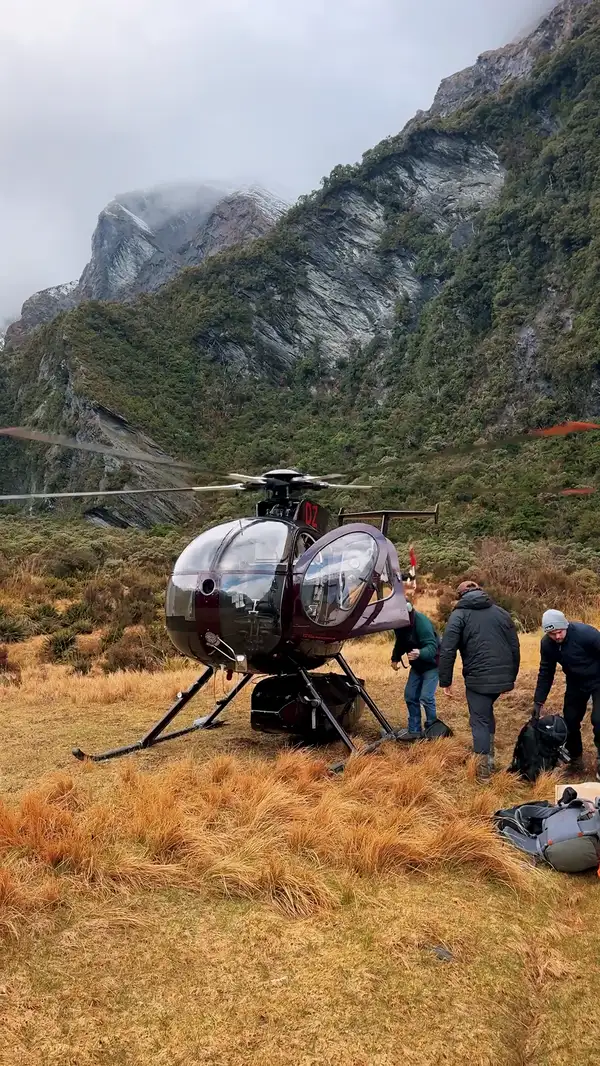
- Civil Aviation Rule 91.9 bans firearms in aircraft unless an exception applies. On a charter carrying only the hunting party, the operator must permit the rifle and it must be disabled. What counts as disabled is the operator's call to brief you on. Unloaded with the bolt out is the obvious starting point.
- On an airline
- Checked baggage only, with a firearms licence and the airline's approval. Ammunition is capped at 5 kg per person, securely packed.
- Landing
- In the national parks, only at designated sites, by an operator who holds the landing permissions.
- At the hut
- DOC asks hunters to remove the bolt or fit a trigger lock, keep ammunition apart, bag the rifle out of sight, secure it to the bunk and tell the other people in the hut.
Weather calls are final
In November 2015 a scenic helicopter flight crashed on Fox Glacier and seven people died. The Transport Accident Investigation Commission found the weather was unstable and unsuitable. Accept the weather holds and the late pickups, and never lean on a pilot to fly.
Lore
The third rule used to read "Load a firearm only when ready to fire". FSE's current wording says chamber a cartridge only when ready to fire. With a box magazine, that's the difference that matters: the magazine can be full while the chamber stays empty until the shot is on.
Getting it home
Two borders, two biosecurity regimes, and both care about the same things: soil, seeds and animal material. Going into New Zealand, everyone completes a New Zealand Traveller Declaration, online or in its app, from 24 hours before you travel. Outdoor and hunting gear, boots, tents and animal products are biosecurity risk items: declare them, or bin them on arrival. Fail to declare risk goods and MPI can hand you a NZ$400 instant fine on the spot. Clean everything before you pack it, then declare it anyway.
Coming home, the question is the trophy. Neither tahr nor chamois is listed under CITES, and DOC will give you a letter saying so. Australia's wildlife trade rules need no permit for non-live, non-CITES animal products from non-native species, so the rules that actually bite are the Department of Agriculture's biosecurity conditions.
| What you bring | Import permit | Conditions |
|---|---|---|
| A finished mount | Not required | Fully tanned, free of fat, muscle, blood, bone and decay, skull and horns boiled, no seed, soil or debris. Inspected. |
| A tanned hide or cape | Not required | Clean. Mandatory inspection. |
| Horns, skull or bones | Not required | Clean and free of debris. Mandatory inspection. |
| A raw, salted or dried cape | Not required | A New Zealand government certificate that the animal lived and was killed in New Zealand. New, clean packaging. Risk-based inspection. |
DAFF BICON case "Animal trophies, articles and handicraft items", personal use. Inspection fees apply.
A taxidermist in New Zealand
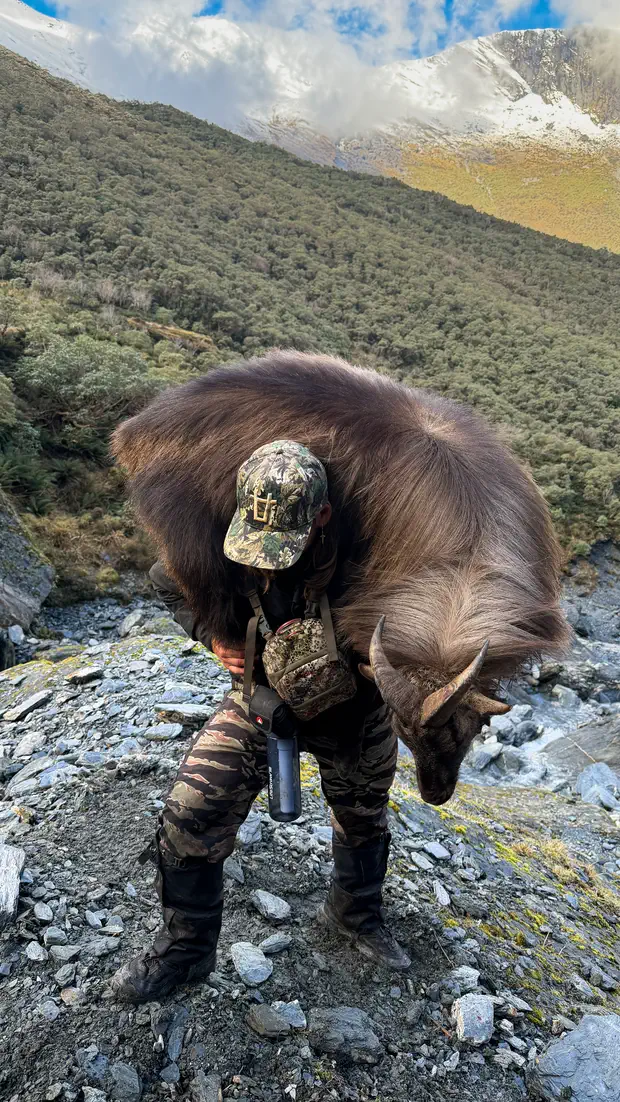
The cape and skull stay with a New Zealand taxidermist, who finishes the mount and ships it. A finished mount, fully tanned with a boiled skull, needs no import permit, just an inspection. It won't be ready on a five-day trip, so get written quotes for time and freight before you leave.
Salted cape, boiled skull
The raw cape needs a New Zealand government certificate. MPI issues it only after the hunt, once species, weights and package numbers are confirmed through its online game trophy declaration. Email MPI before you travel, then collect the certificate from its office near Auckland or Christchurch airport (Queenstown needs four working days' notice). NZ$50, or NZ$60 couriered, and nothing on public holidays.
Horns and a clean skull
A skull boiled clean, with no tissue, soil or seed, can come home with you if it meets the condition. Declare it on your Incoming Passenger Card and expect an inspection. If there's tissue on it, it's not clean.
Landing in Australia
On the Incoming Passenger Card, three answers change for a hunter. Question 8 covers animals, animal parts and animal products, so the trophy. Question 9 covers soil and things used in freshwater areas, shoes and gear included. Question 10 asks about contact with farms, farm animals, wilderness or freshwater in the last 30 days: after a park hunt, the answer is yes. Clean your boots and gear before you fly, and expect them to be checked.
A false declaration can mean an infringement notice of up to A$7,280, and items that don't meet the conditions are treated, sent back or destroyed at your cost. Because of foot-and-mouth risk, the Department of Agriculture asks returning hunters to stay off farms for seven days.
The paper trail
Every rule in this book has a place on the trip where it switches on. Step from your kitchen in Australia to the tops and back, and see what you need at each stop.
In your wallet so far
Decide how you'll shoot
Hunting under a licence holder's immediate supervision, with the guide's rifles and ammunition, needs no New Zealand licence. Get your own DOC hunting permit, and check with DOC how a supervised visitor applies.
Unsupervised, or with your own rifle, you need a visitor licence. Apply online at least four months ahead: NZ$25, a theory test, a fit and proper check and your Australian licence. A permit to import for the rifle and ammunition goes in the same application.
Arms Act 2026 ss 14, 16, 56 · DOC
Pack clean
Boots, gaiters, packs and tent pegs cleaned of soil and seed. No rifle, ammunition or suppressor in your bags.
Gear cleaned of soil and seed. The rifle goes as checked baggage, declared to the airline, with ammunition under 5 kg, securely packed. Export paperwork for the way home sorted before you leave Australia.
Arms Act 2026 s 56 · CAA · MPI
The traveller declaration
Everyone entering New Zealand completes the New Zealand Traveller Declaration, babies and New Zealanders included. It's free, done online or in the app from 24 hours before you travel, and covers customs, immigration and biosecurity.
NZ Customs · MPI
Declare the gear
Hunting and outdoor gear, boots and any animal products are biosecurity risk items. Declare them or bin them. A false declaration can earn a NZ$400 instant fine.
The same biosecurity declaration, plus every firearm, part and round declared to Customs. A police officer issues your visitor licence and import permit in the arrivals hall. Anything without a permit is detained.
Biosecurity Act 1993 · Arms Act 2026 s 207
Ammunition
A shop may only sell ammunition to a firearms licence holder, so the guide buys it. You hold rounds only while under their immediate supervision.
Your ammunition comes in on your import permit. Section 48 lets shops sell ammunition only to holders of a firearms licence, which in the Act is a different licence from yours, so check with FSE before you plan to buy any here. You can't buy a rifle to own here either (s 132).
Arms Act 2026 ss 30, 48, 132
Rifles disabled, operator's say-so
On a charter carrying only the hunting party, a firearm may ride if the operator permits it and it's disabled. In the national parks the helicopter lands only where the plan and its concession allow.
Civil Aviation Rule 91.9 · DOC
On the hill
The guide is present, within reach and not shooting while you are. Your DOC permit is on your phone. No loaded rifle from half an hour after sunset to half an hour before sunrise. At the hut, bolts out and ammunition apart.
You can hunt on your own, under your visitor licence's conditions and your DOC permit's. The darkness rule and the no-night-sights rule bind you exactly the same.
Arms Act 2026 ss 16, 128 · DOC permit conditions
Paper for the cape
Tahr and chamois aren't CITES-listed, and DOC will write you a letter that says so. A raw cape bound for Australia needs MPI's certificate, issued only after the hunt through its online game trophy declaration.
DOC · MPI · DAFF BICON
Declare it all
On the Incoming Passenger Card, a park hunt means yes to question 10, and the trophy and boots go under questions 8 and 9. Mounts and capes meet BICON's conditions or are treated, sent back or destroyed. Stay off farms for seven days.
All of that, plus the rifle. It leaves New Zealand on an export permit or notification, and it's declared at question 1 coming back into Australia. Sort Australia's side with Border Force and your state firearms registry before you go.
DAFF BICON · Arms Act 2026 · ABF
Do I need a New Zealand licence for a guided tahr hunt?
Not if you shoot only under a firearms licence holder's immediate supervision, with their rifle and ammunition (Arms Act 2026 ss 14, 16, 30). Hunt on your own, or bring your own rifle, and you need a visitor licence.
Can my guide supervise me and shoot at the same time?
No. FSE's test says the supervisor isn't using another firearm while supervising.
Is blaze orange compulsory?
Not in the rules. DOC advises contrasting clothing, and high-vis when carrying an animal out.
Can I take thermal binoculars?
On DOC land, hand-held thermal is allowed for finding animals in daylight. Thermal or night vision fitted to a firearm is banned, and so is any shooting in the dark.
Who pays if I'm hurt or rescued?
New Zealand's no-fault ACC scheme covers accident treatment in New Zealand for visitors too, but not getting home or treatment back in Australia, so travel insurance still matters. People who are rescued aren't expected to pay, though Police can lay charges and seek costs where there's evidence of recklessness.
Who do I ask when it matters?
Firearms: FSE, at firearmssafety.govt.nz or 0800 844 431. Permits and places: DOC. Biosecurity in and trophy certificates out: MPI. Bringing a trophy into Australia: the Department of Agriculture's BICON.
Check it yourself
This book is a plain-English field reference, current as of 5 October 2026, and not legal advice. The Arms Act 2026 is weeks old, FSE is rewriting the Firearms Safety Code to match, and some DOC pages still cite the 1983 Act. Australia's trophy conditions changed on 1 October 2026. Check anything that matters with the agency that runs it.