First Aid
A recording: episode 8 of Listen, the library read aloud
Bleeding, breaks, bites and cold. What to do when help is hours away.

The order of things
Help is a long way off on both trips. At Silent Grove there are a couple of spots on the property that scrape a bar of reception, and that's it. In the Southern Alps there's no reception at all, anyone badly hurt would leave by helicopter, and helicopters don't fly in cloud. Whatever happens, the first hour is yours.
Everything here follows the Australian and New Zealand Committee on Resuscitation, ANZCOR, whose guidelines both countries' first aid courses teach. Reading it is not the same as being trained. Do a course (Chapter VII), and treat this volume as the reminder.
When something goes wrong, the order is always the same, and it has a name you can remember with your heart pounding: DRSABCD.
Check for danger, to you first
Look for risks to yourself, everyone else and the person on the ground, and deal with them. On a hunt that means rifles first: unload and clear every rifle at the scene. Then loose rock, a snake still close, traffic, fire. One casualty is better than two.
Talk and touch
Give a simple command: "Open your eyes. Squeeze my hand. Let it go." Then grip their shoulders firmly. Anyone who doesn't respond, or only groans without opening their eyes, is treated as unconscious.
Call, or send someone to call
000 in Australia, 111 in New Zealand. Put the phone on speaker so the call-taker can coach you. With no reception, send someone to the spot that has a bar, or set off a beacon. Chapter VII has what to say.
Open the airway
Open the mouth. If there's anything in it, food, vomit or blood, roll them onto their side and let it drain out. Then, on their back, tilt the head back and lift the chin.
Look, listen and feel
Look for the lower chest and upper belly moving, listen for air at the mouth and nose, and feel for it on your cheek. Occasional gasps are not normal breathing. Breathing normally but unresponsive: onto their side in the recovery position, and keep checking.
Thirty and two, and don't stop
Heel of one hand on the centre of the chest, the lower half of the breastbone, the other hand on top. Push down a third of the depth of the chest, more than 5 cm in an adult, 100 to 120 times a minute, letting it come all the way back up. Thirty compressions, then two breaths if you're trained and willing. If not, keep pushing. Swap with someone every two minutes.
An AED, as soon as there is one
Attach an automated external defibrillator the moment one arrives and do what it says. Ask on day one whether there's one on the property. If there isn't, CPR is what you've got, and you keep going until they respond or breathe normally, someone qualified takes over, or you physically can't go on.
Fig. 1ANZCOR's first steps, from its Guideline 8. Step through them, or drag.
The recovery position
Unresponsive but breathing normally means the recovery position: on their side, not on their back and never slumped in a chair. It keeps the airway open and lets anything in the mouth drain out. Handle them gently, keep the head and neck in line as you roll them, and keep checking their breathing until help arrives.
Lore
ANZCOR uses the same 30 compressions to 2 breaths for everyone, from a baby to an eighty-year-old, so there's only one ratio to remember. It also says to start CPR on anyone unresponsive and not breathing normally without worrying about hurting someone who didn't need it. The risk of doing nothing is far greater.
Stop the bleed
Severe bleeding can kill faster than anything else in this book, and it's the one thing that jumps the queue. ANZCOR puts it plainly: with life-threatening bleeding, controlling it comes before airway and breathing. Lie them down, press, and get someone calling for help.
Bleeding counts as life-threatening when any of these are true.
- An arm or leg is cut off, or partly cut off, above the wrist or ankle.
- There's major trauma to any part of the body. ANZCOR's examples are shark attacks and propeller cuts. A bullet belongs on the list.
- Firm local pressure isn't controlling it.
- There are signs of shock: pale and sweaty, a pulse over 100, slow colour return when you press a fingernail, drowsiness or confusion.
Start at the top and only move down when the step above isn't working.
- Always first
Press, hard
Firm pressure on or around the wound, with your hand or a pad. Lie them down and keep the limb still. This alone stops most bleeding. Raising the limb isn't the fix: ANZCOR finds no evidence that elevation helps.
More pressure, not more pads
If it soaks through, add a second pad and a tighter bandage. Still bleeding? Check the pad is on the actual bleeding point. One or two pads pressed hard beat a pile of them.
Pack it if it's deep
A deep wound you can't stop from the surface can be packed: gauze or clean cloth pushed into the wound, then pressed hard. St John's instructions put the pad in or over the wound, and Europe's first aid guidelines teach packing. ANZCOR's guideline doesn't cover it, so learn it on a course.
- A limb, still pouring
Tourniquet
For life-threatening bleeding from an arm or leg that pressure isn't stopping. A commercial windlass tourniquet, put on as its maker says, or about 5 cm above the bleeding point. Not on a joint, not on the wound, never covered by clothing or a bandage. Tighten until the bleeding stops. It hurts, so tell them.
Write the time
On the tourniquet, or on their forehead in marker. ANZCOR says the time must be noted and passed on to the paramedics.
Still bleeding? A second one
Check the first one's position and tightness. Then put a second tourniquet on, above the first. A haemostatic dressing can go in alongside, if you're trained in it.
- Once it's on
Leave it on
It stays on until they reach specialist care. Don't loosen it to give the limb a rest. Get them out, fast.
Tourniquets and long waits
In July 2025 ANZCOR noted new evidence, mixed and mostly from military settings, of harm when tourniquets stay on for more than two hours, and an international review under way. Its advice to first aiders hasn't changed: use one only for life-threatening limb bleeding that pressure won't stop, and once it's on, leave it on. Being hours from hospital is exactly why one should never go on a limb that didn't need it.
A rifle wound is a bleeding wound first. Make every rifle at the scene safe, then work the same ladder: lie them down, press hard, and a tourniquet if it's a limb that won't stop. Call 000 or 111 early and say it's a gunshot wound. Every one goes to hospital however small it looks, by ambulance or helicopter.
Then check the other side. A bullet that passes through leaves a second wound, often bigger, and it's easy to miss under clothing and in the dark. Cut clothing away to look, and press on both.
Don't pull out anything stuck in a wound. It may be plugging it. Pad around it and press around it.
A wound to the chest is different. Europe's 2025 first aid guidelines say to leave an open chest wound uncovered, or to use a vented chest seal if you're trained. Don't tape plastic down over it on all sides.
Treat for shock while you wait: lying down, something under them and over them to keep them warm, nothing to eat or drink, and someone talking to them and watching them the whole time.
Lore
The tourniquet ANZCOR pictures in its own guideline is a military one, the Combat Application Tourniquet. Commercial windlass tourniquets like it beat improvised ones, but ANZCOR still says that in life-threatening bleeding an improvised one is likely better than none: a triangular bandage or a strip of clothing, as wide as you can make it, twisted tight with a stick.
The knife
On the weekend you'll gut, skin, hang and break down your own animal, some of it at night, all of it tired, with very sharp knives and hands slick with fat and blood. Nobody publishes a rate for butchering injuries, but of everything you'll do that weekend, it's the likeliest to put a hole in you. Almost every cut is avoidable.
Cut away from yourself
Blade moving away from your body and your other hand, every stroke. Never towards your thigh. Kneeling over an animal, your inner thigh is right under the knife, and the big artery runs down it.
Sharp, and let it work
A blunt knife needs force, and force is what slips. Sharpen it, then let the edge do the cutting.
A glove on the holding hand
The hand holding the meat is the one that gets cut. A cut-resistant glove on it is cheap insurance.
Room to work
One knife per side of a carcass. Say so before you reach across someone. Hang it at a height where you aren't bent double.
Put it down, don't pass it
Lay a knife down for the next person rather than handing it over, and never leave one blade-up on the bench or lost in a game bag.
Never catch a falling knife
Step back and let it land. Every instinct says grab it, and that's how hands get opened up.
Light and a dry grip
Head torch on, handles wiped. A greasy handle lets your hand slide down onto the blade.
Tired hands hand over
Late at night, after a long day, concentration goes first. If you can't hold the knife properly, give it to someone fresher.
Press
Firm pressure with a clean pad, straight away. A bad cut, deep in the thigh or arm and pouring, goes up the ladder in Chapter II, tourniquet and all.
Clean it
Once it's stopped, wash your hands, rinse the cut under clean running water, and cover it with a clean dressing. A carcass is not a clean place.
Know when it needs a doctor
A cut that gapes, keeps bleeding through pressure, or leaves a finger numb or weak needs proper care. So does anything deep from a dirty blade.
Tetanus
A deep or dirty wound is tetanus-prone. Australia's immunisation handbook recommends a booster for adults with one if their last dose was more than five years ago. Know when yours was before you go.
What comes in through a cut. Deer can carry diseases that pass to people: the national deer shooting procedure names Q fever, salmonellosis, toxoplasmosis and yersiniosis. NSW Health lists shooters and hunters as at risk of Q fever. Cover any cut with a waterproof dressing and gloves before you handle a carcass, and wash hands and skin afterwards.
Q fever usually shows up two to three weeks later as a severe flu: high fevers, drenching sweats, a bad headache behind the eyes, aching joints, exhaustion. If that happens after the trip, tell your doctor you've been butchering game. A vaccine exists, but it needs screening tests first, so it takes planning.
Lore
The word butcher probably began as a goat killer: Old French bochier, from bouc, a billy goat. That bouc comes from the same old Germanic word as buck. English borrowed the butcher around 1300. Before that, Old English made do with flesh-monger.
Snakes, spiders and ticks
October is spring, and spring is when snakes move: they warm up, feed, and the males roam looking for mates. NSW Health says most of the state's bites happen in the warmer months in regional areas. New Zealand has no native snakes, so this part of the book stays on the Australian side of the Tasman.
Fig. 4Records within 40 km of a point just west of Tenterfield, Atlas of Living Australia, October 2026. They count where people looked and reported, not how many snakes there are.
Red-bellied blacks are the snake you're most likely to see, often near water. Browns are the ones that matter most: across Australia they cause more than half of serious bites and over 60 per cent of deaths. Death adders sit still and ambush at night, so watch your feet with a torch. Tigers turn up around the town and the higher country to the east.
None of that changes what you do. Treat every snakebite as potentially deadly, whatever the snake. A bite can be painless and leave no mark at all.
Boots and long, heavy trousers stop a lot of bites, because brown snake fangs are short. If you corner a snake, stand still. Browns react to movement. And never try to catch or kill one: that's how people collect a second bite.
Most venom travels through the lymph vessels, which are pumped along by moving muscle. The pressure bandage with immobilisation squeezes those vessels and stops the muscles pumping. In the 1979 experiments behind it, pressure alone and splinting alone didn't slow the venom. Only both together did.
Still, calm, and call
Move away from the snake. Lie them down and keep them completely still: no walking, not even to the ute. Bring the vehicle to them. Call 000 for any suspected bite, and watch them the whole time.
A firm bandage over the bite
As soon as you can, a broad elastic bandage, 10 to 15 cm wide, straight over the bite, over clothing if they're wearing it. Elastic is better than crepe. As firm as for a sprained ankle: you shouldn't be able to slide a finger under it easily. No bandage? Tear up clothing.
Then the whole limb
A second bandage, starting at the fingers or toes and working up, covering as much of the limb as you can, the same firmness.
Splint it
Splint the limb so the joints either side of the bite can't move: a stout stick, a tent pole or a rolled sleeping mat, bandaged on. An arm goes in a sling.
Mark it, write it down
Mark the bite on the bandage with a pen, and write down when the bite happened and when the bandage went on. The doctors will want both.
Watch, and leave it on
Check the fingers or toes for colour and warmth. Don't take the bandage off before hospital. If it's a poor job, put a better one over the top. If they collapse and stop breathing normally, start CPR. There's no risk of venom to you.
Fig. 5The pressure bandage with immobilisation, from ANZCOR Guidelines 9.4.1 and 9.4.8.
- Cut or suck the bite.
- Put an arterial tourniquet on it.
- Let them walk, even a short way.
- Chase or kill the snake.
- Take the bandage off before hospital.
- Wash the bite.
Why not wash it?
Venom left on the skin used to be swabbed for a snake venom detection kit. NSW Health stopped recommending those kits in 2024, and Australian toxicologists now advise against them because they're unreliable. ANZCOR still says don't wash the bite, and the other reason stands: washing means moving the limb and delaying the bandage. So don't.
The first hour
The biggest killer is early collapse with cardiac arrest, 10 to 60 minutes after an envenoming bite, usually before hospital. Collapse or confusion that seems to get better after a brown snake bite still means venom. Antivenom exists for every Australian snake, but only in hospital, and doctors choose it from symptoms and blood tests, not from the snake. A photo is nice. Another bite isn't.
Funnel-webs. ANZCOR says a bite from a big dark spider, over 2 cm, in northern NSW or south-east Queensland should be treated as a funnel-web bite. Inland of Tenterfield sits between the two, and museum records put funnel-webs at Tenterfield itself and in the granite country west of it. Treat it exactly like a snakebite: pressure bandage, keep them still, call for help, CPR if they need it. Life-threatening effects can come within ten minutes.
Redbacks. Pain at the bite that grows and spreads, sweating, sometimes nausea. An ice pack or cold compress for no more than 20 minutes at a time, and medical care if the pain is severe. No pressure bandage: the venom acts slowly and pressure only makes the pain worse. Serious illness is unlikely within three hours. Redbacks have also turned up in parts of New Zealand.
Everything else. A cold pack for the pain. The white-tailed spider has a flesh-eating reputation, but ANZCOR says that, contrary to popular opinion, it has caused very few cases of severe damage.
The paralysis tick causes more than 95 per cent of human tick bites in eastern Australia. Its heartland is the wet coast, within about 20 km of the sea, with outliers well inland. Around Tenterfield the Atlas of Living Australia holds only a handful of records, all on the wetter country to the east. The risk out west is low, not nil. Wear light-coloured long clothes tucked in, use a DEET or picaridin repellent, and check your scalp, neck and behind the ears after each day.
The tweezers argument
Advice changed recently, and the sources don't all agree. ANZCOR's 2021 guideline still allows fine-tipped forceps in remote places without a freezing spray. The Australian Centre for Disease Control (2025) and the allergy body ASCIA (2024) now say levering a live tick out is unsafe, because squeezing it injects more saliva. Carry the spray and you never have to choose. Anyone with a known tick allergy carries their adrenaline autoinjector and has the tick removed by a doctor.
The hunter's allergy
A tick bite can make you allergic to alpha-gal, a sugar in the meat of nearly every mammal: venison, beef, lamb, pork and kangaroo, plus gelatin and meat stocks. Reactions usually start four to six hours after the meal, from gut upset and hives to anaphylaxis, and can first appear months or years after the bite. If red meat ever makes you sick in the middle of the night, tell a doctor about the ticks. Many people improve over a year or two without more bites, and another bite sets it back.
Lore
Australia has more tick-induced red meat allergy than anywhere else in the world, and it was Australian allergists who first linked the two. For a hunter, that's an allergy to the thing you came for.
Heat and cold
The weekend is spring an hour inland of Tenterfield, warm by day and cool at night, and carrying a deer out on a warm afternoon is plenty to cook someone. Five days later you're above the bushline in the Southern Alps, where October nights can freeze, the West Coast weather is wet, and wet cold is the kind that kills.
Heat exhaustion
Pale, sweating heavily, headache, nausea, dizziness, cramps, thirst. Stop, get them somewhere cool, strip off layers, cool them down and give them water.
Heat stroke
Confused, slurring, agitated, fitting or collapsed, skin hot whether dry or sweating. Call for help early and cool them hard: cold water immersion works best, or wet the skin and fan it, with cold packs at the neck, armpits and groin. Cool first, move second. Drinks only if they can swallow.
ANZCOR Guideline 9.3.4 and NSW Health
For dehydration from hard work, ANZCOR suggests a sports drink, something with 3 to 8 per cent carbohydrate and electrolytes. The thing to watch for is the change: the mate who goes quiet, starts stumbling, or gets the simplest thing wrong. Confusion, slurring or collapse means heat stroke, and that's an emergency.
Hypothermia means a core temperature below 35°C. Above that, a cold and shivering person is cold-stressed, not hypothermic, and should get dry and warm before they go further. It creeps up: people often insist they're fine while they fumble, stumble and make odd decisions.
Cold stress
Cold and shivering, but not hypothermic yet. This is the time to act: stop, get dry, add layers, block the wind, eat something. Shivering can raise your heat output three to five times, as long as you feed it.
Mild hypothermia
Shivering, pale and cool skin, clumsy, slurring, slow to answer but still responding. Shelter, dry clothes, insulation, and sweet food and drink.
Moderate hypothermia
Shivering stops, muscles stiffen, confusion sets in and responses fade, the pulse slows or goes irregular. The shivering stopping is not a good sign. Handle them gently, keep them lying flat, and warm them actively.
Severe hypothermia
Dangerous heart rhythms or cardiac arrest. They may look dead, with fixed pupils and a pulse too weak to find. If they're unresponsive and not breathing normally, start CPR and keep going until rescuers take over.
Fig. 6Core body temperature and the stages of hypothermia, from ANZCOR Guideline 9.3.3, September 2025.
Shelter, flat, still
Into the hut or out of the wind. Lie them down and keep them from exerting themselves.
Dry, then wrapped
Wet clothes off, dry ones on. Then insulation, a sleeping bag or blankets, with a vapour barrier around it: an emergency blanket or plastic.
Warm the trunk
Heat packs inside the wrapping, at the armpits, chest and back, insulated from the skin as the packet says. Or skin to skin, their back against a warm person's front. Do it even if they've stopped shivering.
Sugar, not booze
If they're responsive, sweet drinks and food. No alcohol, no caffeine, no cigarettes. No rubbing.
Frostbite
Fingers, toes, nose and ears go white or grey and numb. Take off rings, raise the part, and rewarm it straight away against warm skin: fingers in your own or a mate's armpit, a warm hand over a cheek or ear, feet on a mate's warm belly. Don't rub it, don't hold it to a fire or stove, don't break blisters, don't walk on frozen feet, and don't let it freeze again.
Lore
A hot drink barely warms your core, and can even damp your shivering for a while. ANZCOR's point is that the sugar matters more than the heat: it fuels the shivering that does the real warming.
On the West Coast
Wool or synthetics, never cotton, which stops insulating the moment it's wet. Spare layers, a proper shell, and one set of thermals kept dry in a dry bag. Watch your mates as well as yourself, and say something early. The cold person is usually the last to know.
Hard landings
In New Zealand, falls are what kill hunters most. From 2007 to 2016 they killed 11 of the 41 hunters who died, and the Mountain Safety Council found that 10 of the 11 alpine hunters who died over 16 years died in falls. The tahr country on the second trip is exactly that kind of ground.
Prevention is mostly route choice. Go down only ways you know, remember the meat on your back changes your balance, expect snow to ice up in the evening, keep back from crumbling bluff edges, and follow your guide's line. The Council recommends a helmet, crampons and an ice axe on alpine ground in winter and spring.
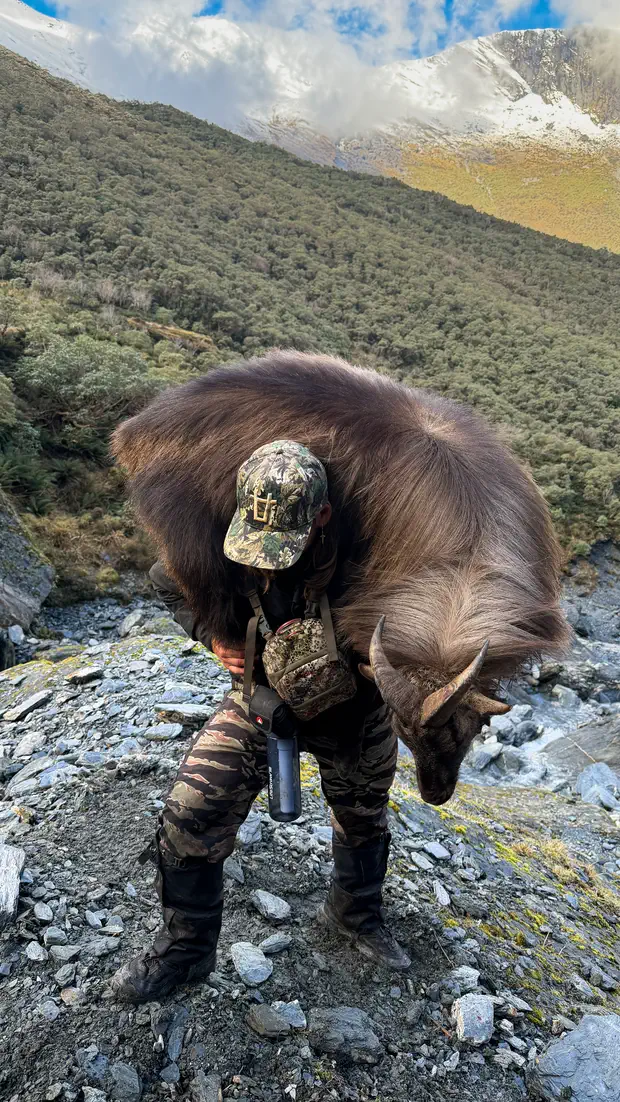
Still, padded, splinted
Keep them still and stop any bleeding first. Then pad and splint the limb so the joints above and below the break can't move: a sleeping mat, a branch, trekking poles, bandaged on firmly but not tightly. Check the fingers or toes for colour, warmth and feeling every 15 minutes. Never try to push a bone back in. Broken bones bleed inside, and a broken thigh can bleed a lot, so watch for shock.
Rest, ice, compression, raise it
Rest it, cold pack it for 20 minutes at a time, bandage it firmly and keep it raised. For the first few days avoid heat, alcohol, running and massage, which all make the swelling worse. A twisted ankle on a scree slope is also a reason to stop and reassess the route out, not to grit your teeth.
Stop, and watch them
Stop the activity and get them somewhere safe, moving the neck as little as you can. If they're unresponsive and not breathing normally, start CPR. Then look for the signs of a significant injury: vomiting, headache, poor balance, disturbed vision, weakness, slurred speech, confusion, drowsiness or a seizure. Being knocked out isn't the measure: a serious head injury can happen without it, and problems can take hours to show. Anyone with a significant knock doesn't go back to hunting until a health professional has checked them, and someone keeps watching them until then.
Hands, not collars
Suspect a neck injury after any fall with an injury above the shoulders. Ask a conscious person to keep still, and hold their head in line with your hands where you can. ANZCOR's new guideline says a soft collar only signals a possible injury and restricts movement less than hands do, and first aiders shouldn't rely on devices. If they're unconscious, the airway comes first: roll them onto their side with as little twisting as possible. CPR if they need it.
Something stuck in it
Never pull it out. Cover the eye lightly without pressing on it, and get them to medical care. No rubbing, no drops, no ointment.
A splash of something
Flush it with cool running water for 20 minutes, holding the eyelids open, then medical care.
A knock or a blow
A cold pack, lightly, and see a doctor if the vision changes or the pain doesn't settle.
Cool it for 20 minutes
Cool running water for at least 20 minutes, as soon as you can. It still helps up to three hours afterwards. Take off rings and watches before it swells.
Then cover it
A loose non-stick dressing, or cling film laid over it, not wrapped round a limb and never on the face. Keep the rest of them warm.
Never
No ice, no creams, butter or powders, don't break blisters, and don't peel off anything stuck to the skin. Call for help for anything bigger than a small patch, or on the face, hands or groin.
When help is hours away
On day one, find out four things: where the first aid kit is, where the beacon is and who's carrying it, where the nearest bar of reception is, and who in the group has done a first aid course. It takes two minutes, and in an emergency it saves the first ten.
On the second trip, the helicopter that drops you in is also the likeliest way out for anyone badly hurt, and it doesn't fly in cloud. Plan for help taking hours, and sometimes longer, to arrive.
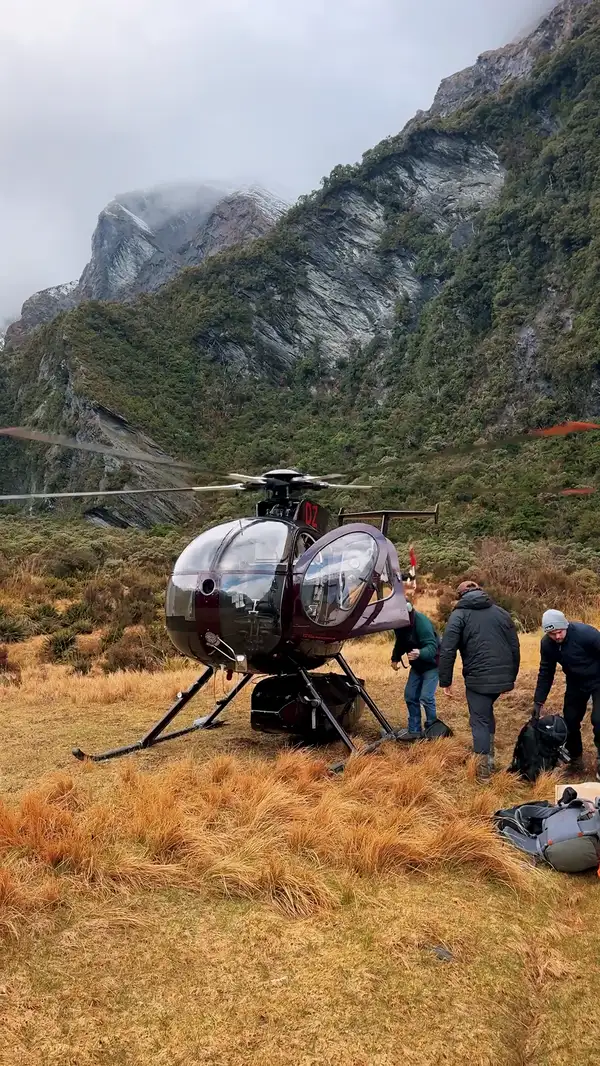
000 can't take a text. Since the 3G networks closed, phones need 4G emergency calling to reach it, and modern phones send your location to 000 automatically when you call. At Silent Grove, assume no signal except the couple of spots on the property that scrape a bar. Know where they are.
There is no reception at the hut, not a scraped bar. Apple's Emergency SOS by satellite has worked in both countries since 2023, and One NZ and Spark offer satellite texting. Treat them as a bonus. The beacon is the plan.
A PLB sends a distress signal on 406 MHz through satellites to a rescue centre, with your position, plus a homing signal rescuers can follow in. It needs no reception, no talking, no typing. In Australia the alert goes to AMSA. In New Zealand it goes to RCCNZ.
Register it. In Australia registration with AMSA is free, and since November 2024 it no longer expires: just keep your contacts and trip details current. An Australian-registered beacon still works in New Zealand. The rescue centre where it's picked up runs the rescue and gets your details from AMSA.
Only set it off in grave and imminent danger, when you can't get help any other way. Pull the antenna up, give it open sky, carry it on your body rather than in your pack, and stay where you are once it's on.
Set it off by accident in Australia
Switch it off and call AMSA on 1800 641 792. No penalty for an honest mistake.
Set it off by accident in New Zealand
The opposite: leave it on, and call RCCNZ on +64 4 577 8030 or 0508 472 269. It stays on until they tell you to turn it off, even if you can't reach them.
Satellite messengers, like the inReach, SPOT or Zoleo, do something a beacon can't: two-way text, so you can say what's wrong and get advice back. Their SOS goes through the maker's own response centre, which passes it on, and they aren't registered with RCCNZ. They're a fine addition to a beacon, not a replacement for one.
First"This is an emergency. I need an ambulance." Then answer their questions. They'll lead.
WhereThe property name and nearest town, the road in, and the latitude and longitude off Emergency+ or your phone.
WhatA gunshot wound to the thigh, a snakebite on the leg, a fall. When it happened.
WhoOne man, about 35. Any medical conditions or allergies you know of.
How they areAwake and talking, or not. Breathing normally, or not. Bleeding controlled, tourniquet on at 4:32 pm.
What we've donePressure bandage, CPR, warming. What you've got with you.
Getting to usWhere a helicopter could land, or where you'll meet the ambulance. The weather.
Your numberAnd how long you'll have reception. Then stay on the line until they tell you to hang up.
Write the location down on day one, the property name and the nearest road, on paper in the kit. In a panic, people forget the name of the place they're standing in.
New Zealand's Mountain Safety Council lists what rescuers want to know: what happened, where you are as a grid reference or GPS position, who you are and how to reach you, the weather, the injuries, and what supplies you have.
Before you leave home, give someone your trip plan: where you'll be, who with, and when you'll be out. For New Zealand, that's Thursday to Monday with no contact at all.
- Two or three broad elastic bandages10 to 15 cm wide, for a snakebite
- A marker penFor the bite site and the tourniquet time
- A commercial windlass tourniquetAnd practise putting it on, one-handed too
- Wound pads, gauze, tape and plasters
- Nitrile gloves
- Shears that cut through clothing
- A haemostatic dressingIf you've been trained to use it
- Saline and antiseptic
- Ether tick spray and permethrin cream
- An emergency blanket
- Your own medicinesAnd your adrenaline autoinjector, if you're prescribed one
- A registered PLB, carried on youNot in the pack, not in the hut
- Emergency+ on your phone
- A vapour barrierA second emergency blanket, or a big plastic bag
- Heat packs
- Spare insulating layersWool or synthetic, never cotton
- Sugary snacks and electrolyte sachets
Built from the NZ Firearms Safety Code's recommended trauma kit, Safe Work Australia's remote first aid module and ANZCOR. Ask the guides what the group kit carries, and don't double up on the bulky things.
This page is not a course
Do a nationally recognised course before the trip: HLTAID011 Provide First Aid, or better for these trips, HLTAID013 Provide First Aid in remote or isolated site, which is built for help being hours away. Safe Work Australia's code says to refresh CPR every year and first aid every three. On a course you put a tourniquet on a real arm, bandage a real leg and do CPR on a manikin until your arms ache. None of that comes from a book.
Lore
In New Zealand, search and rescue is free, and so is setting your beacon off by accident. Nobody gets a bill for calling for help. The worst outcome is the one where nobody calls.