Every firearm safety rule in the world was written backwards from an accident. That's why they all say much the same thing, and why none of them is optional. On these two trips you work under two sets: the eight fundamentals taught to NSW hunters, and the seven rules in New Zealand's Firearms Safety Code. Learn them as one list and you're covered on both sides of the Tasman.
They overlap on purpose. Muzzle control catches the shot that trigger discipline should have prevented. Identification stops the one that should never have been fired. A backstop catches the miss. For somebody to get hurt, several rules have to fail at once, and that is exactly how it happens: one bent out of habit, then another out of hurry.
The 8 fundamentals of firearms safety. NSW DPIRD's GunSmart program, with the NSW Police Force
Treat every firearm as though it is loaded.Check it yourself every time you pick one up or take one from someone, even if you just watched them unload it.
Always point a firearm in a safe direction.Somewhere a bullet would stop harmlessly, with nobody in the way. Chapter II.
Load a firearm only when ready to fire.A round goes into the chamber when you're about to shoot, not before.
Identify your target beyond all doubt and what is beyond it.The whole animal, then the country behind it. Chapters V and VI.
Keep your finger off the trigger until you are ready to fire.Straight along the side of the stock, outside the guard, until the sights are on the animal and you've decided.
Never rely on the firearms safety mechanism.Use it, always. Just don't trust it with anybody's life.
Store and transport firearms and ammunition separately and safely.Locked away, and apart from the ammunition. Chapter VII.
Never handle or use firearms when under the influence of alcohol or drugs.That includes prescription drugs that slow you down.
The 7 rules of firearm safety. Firearms Safety and Education New Zealand
Treat every firearm as loaded.A mindset as much as a rule. Every time you handle one, it's loaded until you've checked it yourself.
Always point firearms in a safe direction.Loaded or unloaded. Somewhere that will absorb a bullet, not a hard surface.
Chamber a cartridge only when ready to fire.When you've sighted game or expect to any second. If that changes, empty the chamber.
Identify your target beyond all doubt.Never fire at sound, shape, colour or movement alone. If in any doubt, don't shoot.
Check your firing zone.Before every shot, ask what happens if you miss. Never shoot at anything on the skyline.
Store and transport firearms and ammunition safely.Unloaded, made inoperable, out of sight, with the ammunition kept separately.
Avoid alcohol or drugs when handling firearms.The regulator says no amount of alcohol is safe before you handle a firearm.
The same ideas, numbered differently
Always loadedNSW 1NZ 1
Safe directionNSW 2NZ 2
Chamber only when readyNSW 3NZ 3
Know your targetNSW 4NZ 4
Know what's beyond itNSW 4NZ 5
Finger off the triggerNSW 5NZ code
Don't trust the safetyNSW 6NZ code
Store and carry safelyNSW 7NZ 6
No alcohol or drugsNSW 8NZ 7
"NZ code": not a numbered rule in New Zealand, but taught in the Firearms Safety Code
New law in New Zealand
New Zealand's Arms Act 2026 replaced the 1983 Act on 23 September 2026, and the regulator is now called Firearms Safety and Education New Zealand. It is updating the code to match the new Act and says the safety messages remain largely accurate. The seven rules above are the ones on its website in October 2026. Older copies of the code word some of them differently. The ideas haven't changed.
Think of the rules as slices, each with a hole or two in it from bad habits, tiredness, a hurry. A bullet only reaches a person when the holes line up in every slice at once. Keep any single rule and the line is broken.
That's why the good hunters you'll meet seem fussy about small things. They aren't fussy. They're keeping every slice whole so they never have to rely on the last one.
Fig. 1Layers. An accident needs a hole in every slice at once. One rule kept, and it stops.
Where it goes wrong
New Zealand's regulator says incidents cluster at three moments in a day's shooting.
i
Picking it up
The first handling, before the rifle has been used for anything. Out of the safe, out of the case, out of the ute.
ii
On the hunt
A hunter sees what they expect to see and shoots at it. Chapter V is about nothing else.
iii
Putting it away
The end of the day. Tired, cold, unloading beside the ute or at the safe, thinking about dinner.
Four things people believe
Lore
New Zealand's code records the sentence that commonly follows a careless shooting: "I didn't know it was loaded." Rule one exists so that nobody standing near you ever has to hear it.
II
Muzzles and arcs
Where the muzzle points
Muzzle control is the rule that does the most work. If the muzzle never points at a person, nothing else that goes wrong with a rifle can kill one: not a worn safety, not a slip, not a twig in the trigger guard. So the question to ask yourself is never whether it's loaded. It's where the muzzle is pointing, right now.
A safe direction is somewhere a bullet would stop harmlessly with nobody in the way. On open ground that's usually the dirt a few metres ahead, well clear of your boots. In a group it might be the sky. On the ute it's out past the cab. It is never a person, a vehicle, the hut, water or rock, and it changes with every step you take.
Know where your muzzle is without looking. If you have to check, you've already lost track of it. And never use the scope to look at something you haven't identified: whatever you look at through it, you're pointing a rifle at. That's what binoculars are for.
Arcs of fire
Walk with other hunters and each of you owns a slice of the country in front: your arc of fire. New Zealand's code describes it as the area your rifle covers from where you stand, with agreed left and right limits, and recommends no more than three shooters in a line. Hunter education in the United States teaches about 45 degrees straight ahead. Hold your arms out to the sides, thumbs up, and bring them forward until you can just see both thumbs without moving your eyes. That's your slice.
You shoot only into your own arc. If an animal runs out of it into a mate's, you let it go. If you lose sight of a mate, assume he's now in your arc, and stop hunting until you've found him.
SafeEvery arc is clear of people.
Fig. 2Arcs of fire, from above. Drag anyone to move them, or pick a hunter and turn their rifle. An arc goes red the moment it covers a person.
Moving as a group
i
In a line
Open country only, where everyone can see everyone, and no more than three shooters. The middle hunter keeps the muzzle forward or up. The two outside hunters point forward or out to their own side, away from the group.
ii
Single file
Only the front shooter is in a position to fire. Everyone behind has an empty chamber and carries slung or in two hands. The middle hunter's muzzle points out to the side, the back hunter's to the side or behind.
iii
Face to face
Meeting another hunter head on, any carry is fine except the trail carry or an elbow carry pointing forward. Both of those point straight at him.
Six ways to carry a rifle
How you carry depends on the ground, how soon you might shoot, and who's around you. Every carry is safe somewhere and dangerous somewhere else. The drawings are from above, so you can see where each muzzle points. The red wedge shows which way the muzzle points, and the tag says whether it's raised or lowered.
Ready carry
Across your body, both hands on it, muzzle up or down to suit the ground. The most control of any carry, and the one New Zealand's code recommends for most situations.
Safe whenMost of the time, and on rough ground.
Never whenThe muzzle would cross someone beside you.
Sling carry
Over the shoulder, muzzle up, a thumb hooked under the sling so it can't slide off. Chamber empty.
Safe whenOpen country, when you don't expect to see an animal.
Never whenThick scrub, which can knock it off your shoulder.
Cradle carry
Across the front of your body, resting in the crook of one arm. Comfortable on a long walk.
Safe whenNobody is walking on the side the muzzle points to.
Never whenSomeone is beside you on that side.
Trail carry
One hand around the balance point, arm hanging, muzzle forward and down. Leaves a hand free.
Safe whenYou're at the front, or alone.
Never whenSomeone is in front of you, or in snow and scrub, where the muzzle picks up dirt.
Elbow carry
Over the crook of your arm, muzzle pointing at the ground ahead. Comfortable, but it gives the least control of the muzzle.
Safe whenNobody is in front of you.
Never whenAnyone is ahead, or you're pushing through scrub, where it snags.
Shoulder carry
On the shoulder, a hand on the grip or butt in front, muzzle up and behind you.
Safe whenWalking beside others, or behind them.
Never whenAnyone is walking behind you.
Fig. 3The six carries, seen from above, walking up the page. A right-handed shooter. Left-handers mirror them.
Three rules for every carry
Muzzle in a safe direction and under control. Safety on until you're about to shoot. Finger outside the trigger guard. Whatever the carry, if you can't keep all three, change it.
Choose by who's around you. Someone ahead rules out the trail and elbow carries. Someone behind rules out the shoulder carry. Someone beside you rules out a cradle pointing their way.
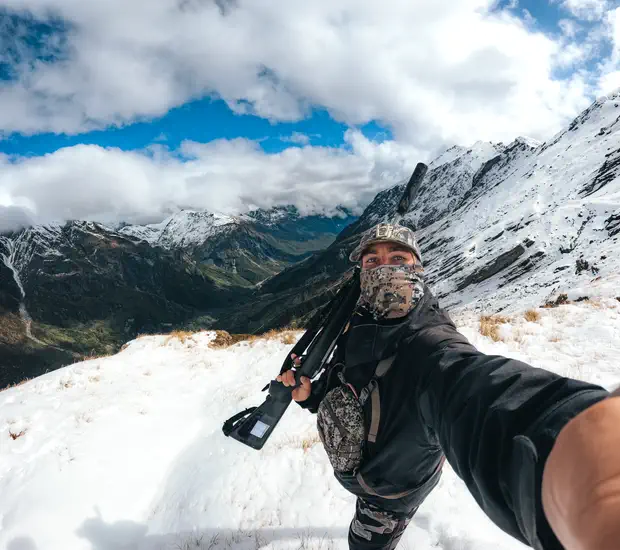
Plate IOn the tops in New Zealand, the muzzle up and away from the camera.
III
Loading and faults
Proving it clear
A rifle is always in one of four states, and you should be able to say which one without looking. Then you look anyway. New Zealand's code calls them LOAD, ACTION, INSTANT and UNLOAD. They're worth borrowing on both trips, because a shared word for each state means everyone knows what your rifle is doing.
The bolt, the chamber and the magazine are the three parts that matter here. Drag through Fig. 4 to see each state.
Unload
Empty, and proved empty
Bolt open, magazine empty or out, chamber checked by eye and finger, a chamber flag in if you have one. This is how a rifle travels, gets handed over, crosses a fence and comes near the hut.
Load
Magazine full, chamber empty
Rounds in the magazine, bolt closed on an empty chamber, safety on. Only once you're in the hunting area where a rifle can be fired safely and legally. Never on a moving vehicle.
Action
A round in the chamber
Only when you've sighted game or are about to fire. Safety on, two hands on the rifle, finger outside the guard, never slung. In a group, only the front shooter is ever in this state.
Instant
Safety off
The decision to fire, at a target you've identified beyond all doubt, with your sights on it. If you decide not to shoot, the safety goes straight back on, and if the animal's gone, you go back to Load or Unload.
Fig. 4The four states of readiness, from New Zealand's Firearms Safety Code, on a bolt-action rifle.
Proving it clear
Any time you pick a rifle up, take one from someone, put one away or bring one near the hut, you prove it's empty. Not glance at it. Prove it, with your eyes and a finger. NSW's training puts it simply: when passing a firearm or picking one up, open the action and look inside the chamber.
Point it somewhere safe
Before anything else. Finger straight along the side of the stock, outside the trigger guard.
Safety on
Some rifles lock the bolt while the safety is on. If yours does, keep the muzzle safe, take the safety off just long enough to open the bolt, then put it back on.
Empty the magazine
A detachable magazine comes out. A hinged floorplate drops open. A blind magazine has to be worked out through the bolt, one round at a time, muzzle safe the whole way.
Bolt fully back
All the way, and leave it there.
Look, then feel
Look into the chamber and the magazine well. Then put a finger in. New Zealand's code says check twice. In the dark, use a torch.
Flag it, or pull the bolt
A chamber flag tells everyone at a glance. A bolt in your pocket does the same job.
Handing it over
Unload it, lock the bolt back, show the empty chamber, and hand it across with the bolt still open. The person taking it checks it again for themselves. Two people, two checks, every time. New Zealand's code says never hand over or accept a firearm that isn't unloaded.
Right rifle, right round
Read the calibre stamped on the barrel and the headstamp on the base of the cartridge, and make sure they match, every time you load. With several calibres on the rack, it matters.
Fences, creeks and steep ground
Hunters have been killed climbing a fence with a round in the chamber: they slip, the rifle falls, it goes off. Use a gate if there's one. If there isn't, unload first, every time, even if the fence is knee high.
On your own, the drawing shows the method. With a mate, one of you unloads, shows the other it's empty, hands it over and crosses with empty hands. The other passes it over the fence, then does the same with his own.
The same goes for creeks, ditches, steep banks and climbing up into the tray. Anywhere you might need a hand, or might fall, the chamber is empty.
Fig. 5Crossing a fence alone, from above. Unload, pass it through and lay it down with the muzzle pointing away, climb over at the butt end, then pick it up.
Falls and a blocked barrel
If you trip, look after the muzzle first: away from people, out of the dirt, finger clear of the trigger. Then stop and unload before you go on, because mud, snow or a twig in the muzzle can burst a barrel when the next shot goes. Check the bore is clear before you shoot again, by looking through it with the bolt out or running a cleaning rod down it. It's also why a muzzle never goes into the ground, not to lean on, not to rest it.
Click, no bang
Every so often a cartridge doesn't fire when the pin falls. Usually it's a dud, a misfire. Occasionally it's a hang fire: the primer has been struck, something is burning slowly inside, and the shot goes off late, anywhere from a split second to 30 seconds or more afterwards. You can't tell the two apart from outside, so every click gets treated as a hang fire.
A squib is different: a pop instead of a bang, hardly any recoil, often no hole in the target. The bullet may be stuck in the barrel. Stop, unload, and check the bore. Firing another round into a blocked barrel can wreck the rifle and the person holding it.
Keep the muzzle on the target, or somewhere just as safe.
Don't open the bolt. A late shot with the action open goes off in your face.
Wait 30 to 60 seconds. That's New Zealand's code. Take the full minute.
Then unload and look at the primer.
Set that round aside for proper disposal. Don't try it again.
If it happens again, stop using that batch of ammunition.
IV
Vehicles and lights
The ute at night
Most of the weekend's shooting happens off the back of the ute after dark. It's the easiest hunting there is, and the most crowded: rifles, a spotlight and up to three people in a tray not much bigger than a double bed, a driver in front, all moving through country you can only see in a beam.
No NSW law bans shooting deer from a vehicle on private land with the owner's permission. On NSW public land, hunting from a vehicle and spotlighting from one are both banned. The NSW and national codes for shooting deer agree on two things: never from a moving vehicle, and agree the safety procedure before anyone loads. This is the procedure.
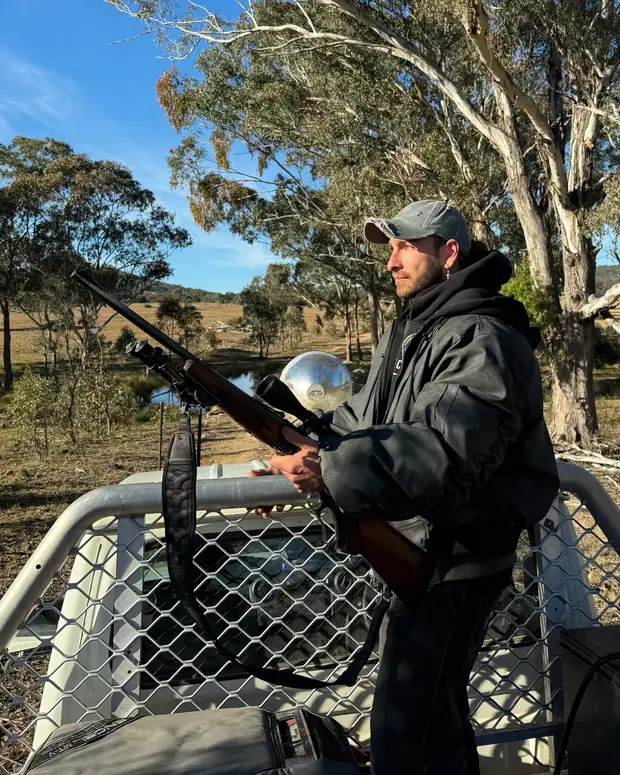
Plate IIDaylight on the tray. The muzzle up and out past the cab, and nobody in front of it.
The ute rules
Wheels turning
Moving means empty
No round in any chamber while the ute moves, not even to the next tree. Rifles ride upright, muzzles to the sky, never across the cab or anyone's head.
Ute stopped
One voice calls it
The guide on the light says who shoots and at what. Nobody chambers a round until the ute has stopped and the guide has said your name.
One shooter
Everyone else stands behind the shooter's shoulders, chambers empty, ear plugs in. Never beside the muzzle and never in front of it.
Rest it and reach
Rifle rested on the bar or the roof, the muzzle forward and clear of the cab, never over or behind anyone. Bullets can glance off a vehicle body.
Feet stay in the tray
Nobody climbs down or walks in front of the ute while a rifle on it is loaded.
Before it moves
Shot or no shot, unload
The shooter unloads and says "clear" out loud. Only then does the ute move.
Getting down
Unload, hand rifles down with the bolt open, never by the muzzle, and never lean one against the ute. Rifles slide, fall and fire.
Fig. 6Who does what on the ute. Tap each person, the muzzle and the beam.
Tap the drawing
1 · The shooter
The only round in a chamber
Loads only once the ute has stopped and the guide has called it. Rifle rested, two hands, finger off the trigger until the sights are on an animal you've identified. Unloads before the ute moves, and says "clear".
2 · The guide
Runs the light, calls the shot
Picks the animal, says who shoots, and can stop it at any moment. One voice, so nobody is guessing. If the guide says no, it's no.
3 · Everyone else
Behind the shooter's shoulders
Chamber empty, rifle upright, plugs in. Watch the beam and the country around it, and say so if you see anything that isn't a deer.
4 · The driver
Stopped means stopped
Stops the ute, keeps it still while the shooter is up, and only moves when the shooter has called clear.
5 · The muzzle
Forward, and clear of everything
Out over the front of the cab, never over or behind anyone, never close to the cab or the spotlight. A bullet can glance off a vehicle body.
6 · The beam
It lights the animal, not what's behind it
You can't check your firing zone in the dark. Learn the ground by daylight, and shoot only where the guide says it's clear.
What the light doesn't show
A spotlight lights the animal, not the country behind it, and night does nothing to shorten how far a bullet goes. Eyes in the beam are not an identification either. New Zealand's code records that reflections from headlamps have been mistaken for animal eyes, and people have been killed. See the whole animal, standing still, with nothing behind it, or there's no shot. NSW's deer shooting procedure says the same: only stationary, clearly seen animals within range, from a rest.
V
Identification
Beyond all doubt
New Zealand counts its hunting deaths carefully, and the numbers are blunt. Of the 41 hunters who died there from 2007 to 2016, nine were shot by someone who thought they were an animal. Falls killed eleven, and the other two big causes were shooting yourself and drowning. The Mountain Safety Council put misidentification at 38 per cent of big-game hunting deaths.
The details are worse. In 80 per cent of these shootings the shooter and the victim were in the same party. In 92 per cent they were less than 75 metres apart. Most happened in daylight, and the shooters were mostly experienced hunters. These aren't strangers mistaking each other across a valley at dusk. They're mates, close, in good light.
80%Same hunting party
92%Closer than 75 m
91%In daylight
9of 41NZ hunting deaths, 2007–2016
Misidentification shootings in New Zealand. A Hunter's Tale, NZ Mountain Safety Council, 2017, and the Firearms Safety Code. Australia keeps no national count of hunting shootings, so there's no equivalent figure here.
Why good hunters do it
Your brain doesn't so much record what's in front of you as guess at it, and it guesses from what it expects. Where you've seen deer before, it's primed for a deer, not a person. In poor light, or with the target half hidden, it fills the gaps with what it wants.
Add adrenaline and you get what hunters call buck fever. New Zealand's code breaks it into three effects, and every one of them hides the person standing in the wrong place.
Tunnel vision
The world narrows to the animal, and everything around it goes blurry or dark.
Target fixation
You're so locked onto the animal that you stop noticing people, vehicles or buildings in your firing zone.
Auditory exclusion
Under stress you can stop hearing. A mate shouting at you may simply not register.
In the beamIn daylight
Fig. 7Two lights in the dark. Slide left to see what was standing behind each one. New Zealand's code records head torch reflections being mistaken for eyes.
Never on one clue
Before every shot
Slow down. Take a couple of breaths.
Break the tunnel. Move your head and eyes. Look left, right and past the animal.
Look through binoculars, not the scope.
Could this be a person? Could your mate have moved into this patch?
Is it definitely the animal you're after? Species, sex, size, the whole thing.
Does it look right, standing the way an animal stands?
Are you in control, or in a hurry?
Adapted from the safer process in New Zealand's Firearms Safety Code
No meat or no trophy is better than no mate.
New Zealand Firearms Safety Code
Blaze orange
Blaze orange makes you obvious to other people. In NSW it's compulsory on declared public land: an item on your upper body, visible from all sides, whenever you're hunting. On private land like Silent Grove it isn't required, and New Zealand's code recommends it rather than requiring it. It's still wise at first and last light, whenever the group splits up, and anywhere other hunters might be.
New Zealand's code adds the fine print. A small patch isn't enough if a tree or a fold of ground hides it, so wear it where it shows from every side, and more of it in bush. Replace it when it fades, because old, washed-out orange can look a lot like deer hide. Carrying an animal out through scrub, drape something bright over it.
Does it cost you anything with the deer? Deer see colour with two kinds of cone rather than our three, and a 1994 study measured it in fallow. That suggests orange stands out far less to them than to the bloke behind you. Blaze orange and blue are the two hi-vis colours New Zealand's code mentions.
Studies from American states that made orange compulsory found fewer hunters mistaken for game afterwards. The studies are old and observational, and orange is no substitute for rule four. It just gives the bloke behind the rifle one more chance to get it right.
Lore
Most people picture these shootings at night. In New Zealand, 91 per cent of misidentification shootings happened in daylight, usually between members of the same party, usually with an experienced hunter on the trigger. Good light and experience make people confident. That's the trap.
VI
Backstops and range
Past the target
Every shot has two destinations: the animal you aim at, and whatever stops the bullet. Before you fire you should be able to point at the second one. If you can't, there's no shot.
The best backstop is a steep bank of soft earth rising behind the animal. A hillside will do. What won't do is anything a bullet can glance off, or anything you can't see past: a skyline, a fence line in the dark, a dip in the ground that could hide a car or a house. New Zealand's code gives the order to check them in: background, then target, then sights.
The skyline
A steep bank
Across the dam
Granite behind
Fig. 8Four deer, four backdrops. Which one can you shoot? Tap each to see where a miss would go.
Tap a deer
No shot
On the skyline
There's nothing behind it but air, and you can't see what's over the ridge: a track, a mate, a house. A miss, or a bullet that passes through, carries on for kilometres. Never shoot anything on the skyline.
This is the shot
In front of a steep bank
A bank of soft earth rising behind the animal catches the bullet whether you hit or miss. Before you squeeze, you know exactly where it will stop.
No shot
Across the dam
Water hit at a low angle behaves like a slab of rock. A low miss skips off it like a stone and carries on, somewhere nobody predicted.
No shot
Granite behind it
Rock throws bullets and fragments sideways and back towards you. The granite country inland of Tenterfield is full of slabs and boulders. Wait for the animal to move off them.
Ricochet
A ricochet is a bullet changing direction off something it hits. Hard and flat surfaces do it best: rock, water, steel, trees, logs, ice, concrete and vehicles. At a shallow enough angle even flat dirt and sand will throw one. Ricochets can keep enough energy to kill, go where nobody predicted, and break into fragments that fly 100 metres or more. Some come straight back at the shooter.
Steel is on that list too, which is why you shoot the plates and the gong only from where you're put, with safety glasses on.
How far a bullet goes
The distance that matters for safety isn't how far you can shoot well. It's how far the bullet can travel. Fired at the worst angle, about 30 degrees up, a .308 bullet can come down about 4 km away, according to New Zealand's code.
You'd never fire at 30 degrees on purpose. You don't need to. Lift the muzzle a degree or two, at a deer on a rise or a shape on a ridge, and a miss carries more than a kilometre. Drag through Fig. 9.
Level
About 450 metres
Fired dead level from a ute tray, about 2 m up, the bullet comes down roughly 450 m away, in under a second. Meeting flat ground at that shallow angle, it may well skip and keep going.
1 degree up
About 1 km
One degree is roughly the width of your little finger held at arm's length. That's all it takes to double the distance.
2 degrees up
About 1.3 km
Nearly four seconds in the air, and it peaks about 20 metres up. You'd never notice the muzzle was raised.
5 degrees up
About 2 km
A deer on a rise 200 m away and about 17 m above you is 5 degrees up. Miss it, and the bullet lands around 2 km off, over whatever's on the other side.
10 degrees up
About 2.7 km
Twelve seconds in the air, climbing nearly 200 metres before it starts down.
20 degrees up
About 3.4 km
Twenty seconds in the air, peaking more than 500 metres up.
34 degrees up
About 3.7 km, the furthest it goes
This model says 3.7 km. New Zealand's code, with a different bullet and assumptions, rounds it to about 4. Either way it climbs over a kilometre and spends nearly half a minute in the air.
Fig. 9Lift the muzzle. A 150 grain .308 soft point at 2,820 feet per second (Federal's published load), fired from 2 m up over flat ground with no wind, worked out with a standard ballistic model. Drawn to scale. Real ground is never flat.
Maximum range, at the worst angle
.22 LR2.5 km
.223 Remabout 3.5 km
.308 Winabout 4 km
6.5 Creedmoorabout 5 km
Fig. 10The .22 LR, .223 and .308 figures are New Zealand's code. The 6.5 Creedmoor is worked out from Federal's published 140 grain load with the same model as Fig. 9, which puts the .308 at 3.7 km against the code's 4. Sleek long-range bullets in the 6.5 carry further still.
Lore
Fired at about 34 degrees, a .308 bullet climbs higher than a kilometre, stays in the air for close to half a minute, and is still doing more than 400 km/h when it comes down nearly 4 km away. Somebody you'll never see could be standing there.
VII
The rest of it
Ears, eyes and a clear head
Some of this chapter keeps you alive, and some of it keeps you able to hear your grandkids. Both matter, and neither takes more than a minute before the first shot.
Hearing
Rifle shots are loud enough to damage hearing in one go. Australian workplace law treats 140 dB as a ceiling nobody should be exposed to even once, because sound that loud can damage hearing instantly. New Zealand's code puts an unsuppressed .308 at about 165 dB, and says every commonly used firearm sits in the range that causes permanent hearing loss. The damage adds up, it doesn't heal, and it often comes with tinnitus, a ringing that doesn't stop.
Ear plugs are supplied on the weekend. Wear them on the range and in the tray, because the people near the shooter take the blast too. For a long session on the steel, earmuffs over plugs are better again. Electronic muffs let you hear people talking and shut off when a shot goes.
In New Zealand both rifles are suppressed. Suppressors are legal and common there, and the regulator says a good one usually brings a shot below 140 dB. It still recommends hearing protection on top. In NSW a suppressor is a prohibited weapon, so on this side of the Tasman it's plugs and muffs.
Talking60 dB
Lawnmower100 dB
Chainsaw120 dB
Pain140 dB
.22 LR145 dB
12 gauge160 dB
.308165 dB
Fig. 11How loud. Figures from New Zealand's Firearms Safety Code, which notes they're averages that vary. Anything past 140 dB can damage hearing instantly.
Eyes
Safety glasses guard against the rare cartridge or rifle that fails, and the less rare splash and fragments that come back off steel and rock. Look for glasses marked to AS/NZS 1337.1, the Australian and New Zealand standard, or Z87+ under the American one. Glasses can be replaced. Eyes can't.
Why the rifles and the drinking never overlap
The main page puts it in a line: the rifles and the drinking never overlap. Here's the reasoning.
Alcohol slows your reactions and blunts your judgement and your balance. Every rule in this book runs on judgement: is that a deer, is that clear, where's my mate. New Zealand's regulator says no amount of alcohol is safe before you handle a firearm, and not to shoot with anyone who is drinking or has been. Some prescription medicines do the same, so check yours with your doctor.
In NSW it's also the law. Handling or using a firearm while under the influence of alcohol or a drug, or handing one to someone who is, carries up to five years in prison under section 64 of the Firearms Act 1996.
So the order is fixed
Spotlight run. Rifles unloaded and proved clear. Rifles and ammunition locked away. Then a drink, if you want one. Matt and Leif are both off it, so there's no pressure either way.
Storage and transport, briefly
In NSW, a bolt-action centrefire rifle is Category B. At home it lives in a locked steel or hardwood safe, fixed to the building if it weighs under 150 kg empty, with the ammunition locked in a separate container. In a vehicle it travels unloaded and out of sight, with every reasonable step taken against theft, and NSW Police say it shouldn't be left unattended in a vehicle except in narrow circumstances. New Zealand's rule six is much the same: unloaded, bolt out or locked, out of sight, ammunition separate. The details, and the changes NSW made to its firearms law in 2025 and 2026, are in The Law in NSW.
Before the first shot
Ear plugs inMuffs over the top for a long session on the steel
Safety glasses on
Which rifle, which calibreHeadstamp matches the barrel
Where's safe from hereThe direction you'd point it if anything went wrong
Who's calling the shotsOne voice, on the range and on the ute
Nothing to drinkAnd nothing that slows you down
Lore
New Zealand's code works out that a single gunshot at 163 dB delivers about as much noise to your ears as 40 hours at 90 dB. A working week in one bang.