Field to Freezer
A recording: episode 5 of Listen, the library read aloud
Everything between the shot and the freezer: the gralloch, the cooling, the hang, the skin, the break-down and the esky home.

The first ten minutes
The shot ends the hunt and starts the job. What you do in the next hour decides whether the meat comes out clean, mild and tender, or turns into something you quietly feed to the dog. None of it is hard. Most of it is doing the right things in the right order, without rushing and without dawdling.
Wait and watch first. A deer that drops can still be alive, and a kicking hind leg with a sharp hoof on the end will open your shin to the bone. Walk in from behind its back, away from the legs and the antlers, with the rifle still loaded in case it needs a second shot.
Then make sure. Watch the chest for breathing. Look at the eye, which on a dead animal stays open, glazed and still. Touch the surface of the eye with the end of a stick: no blink, no flicker, and it's dead. Only then unload, with the muzzle pointed somewhere safe. That's the order the NSW Hunter Education Handbook teaches, and it's the one we use.
Photos, with some respect
Take your photos now, before the gralloch, while the animal still looks like itself. Tuck the tongue in. Wipe the blood off the nose and the wound. Fold the legs under so it lies naturally, and sit or kneel behind it, never on it. Keep the rifle out of the frame or pointed somewhere safe.
Plenty of people who weren't there will see those photos. They should show that you respected the animal, because you should have. Then be quick about it. In hot sun an intact carcass can start to spoil inside fifteen minutes, sooner if the gut was hit. At 10°C or below you have about an hour (The Deer Initiative). A few photos, then the knife.
What's in your pocket
- A sharp knife, and a steel or a second knifeA blunt knife needs force, and force is how knives slip into the gut, or into you.
- Two or three pairs of glovesChange them after the bung, and whenever they're filthy.
- Cable ties or stringFor the gullet and the bung.
- Paper towel or a clean clothFor wiping, never scrubbing.
- Hand sanitiser and clean drinking waterNever creek or dam water anywhere near the meat.
- Clean bags for the heart and liverInto the shade, then cold.
- Game bags or a clean tarpBreathable cloth. Plastic traps heat.
- A head torch and spare batteriesMost of this weekend's work starts after dark.
Lore
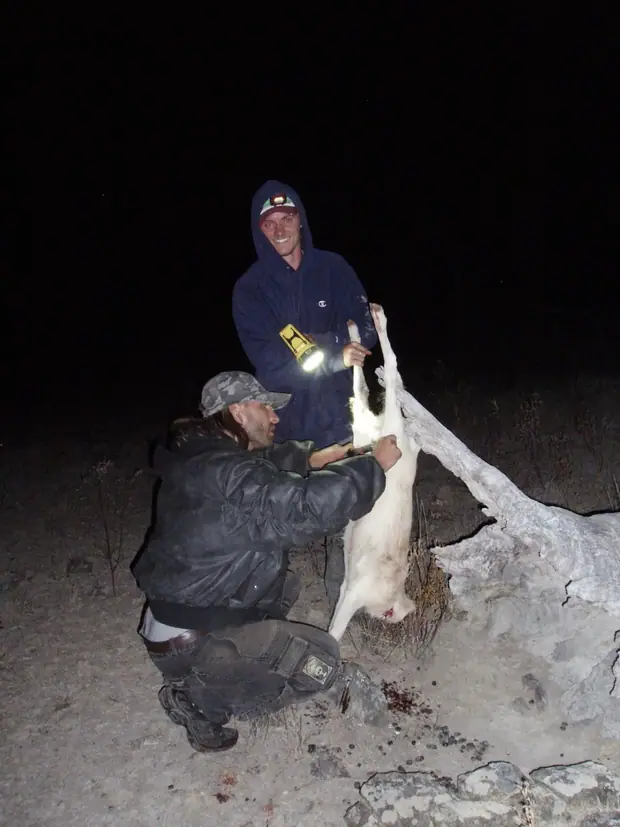
Gralloch is Scots, from the Scottish Gaelic grealach, the entrails. It names both the guts of a deer and the job of taking them out, and it's pronounced with the soft Scottish ch at the end, as in loch.
The gralloch
To gralloch a deer is to take out everything in its body cavity, in one piece, without opening the stomach, the bowel or the bladder. It's the single most important job in this book. Done quickly and cleanly, it gets the heat out and keeps the gut away from the meat. Done badly, it smears the inside of the carcass with the contents of a paunch, and no amount of cooking fixes that.
Two rules cover most of it. Keep the knife sharp and the blade shallow, so it only ever cuts what you mean it to. And wear gloves, changing them when they get dirty, because some of what lives in a deer can live in you. The steps below follow the Victorian Government's game meat guide, checked against the UK's Deer Initiative.
Set it up
Roll it onto its back, head a little uphill if you can, and wedge it with logs, rocks or your knees. Spread the hind legs. Gloves on. If anyone wants the head mounted, say so now: for a shoulder mount you never cut the throat, and you reach the gullet from inside the chest instead.
Tie off the gullet
Open the skin of the throat. Behind the hard, ridged windpipe is the gullet, soft and smooth. Separate the two, then tie the gullet off with a cable tie or a knot. That stops the paunch emptying itself out the front end when you roll the gut later.
Free the bung
Cut a deep ring around the anus, the bung, with the blade angled outwards so you never nick the bowel. Work it free of the pelvis with your fingers, push any pellets back up, and tie it off. Then change your gloves and wipe the knife. You've just handled the dirtiest part of the animal.
Open the belly
Pinch up the skin at the base of the breastbone and make a small nick. Slip two fingers in, spread them in a V, and run the blade between them, edge up, cutting from the inside out, back to the pelvis. Your fingers hold the paunch away from the edge. Go slowly. One slip into the gut and you'll be cutting green muck off the meat for the next hour.
Lift out the bladder
The bladder sits at the back of the cavity, against the pelvis. Pinch it shut at the neck, or tie it, and lift it out whole. If it bursts, rinse your gloves, wipe the knife and cut away any meat it wet. Urine is how leptospirosis travels.
Roll out the gut
Free the thin membranes holding the paunch and bowel with your fingers rather than the knife, and roll the whole lot out of the side of the cavity, drawing the tied bung through from the inside. Don't yank: a torn bowel contaminates everything near it. Look at the liver, spleen and kidneys as they come into view. Chapter III covers what you're looking for.
Then the chest
Chest last, because blood pools there. Cut the diaphragm close to the ribs all the way round. Reach up into the chest as far as you can, find the windpipe and the tied gullet, cut them, and draw out the pluck in one piece.
Drain it and keep it dry
Tip the carcass to drain the blood, then wipe the cavity with a clean cloth. Cut out anything dirty or bloodshot rather than washing it. Bag the heart and liver if they pass inspection, prop the cavity open with a stick, and get the carcass out of the sun and moving.
Work through the steps with the slider or the arrows. The drawing is a deer on its back seen from above, head at the top, and each step lights up what you're cutting.
The order matters more than the speed. The gullet and the bung are tied before the belly is opened, so nothing can leak out either end. The bladder comes out before the gut, so it can't burst under the weight of the paunch. And the chest comes last: you cut through the diaphragm and draw out the pluck, because that's where the blood has pooled.
If it was gut-shot
Gralloch it straight away. The NSW Hunter Education Handbook is blunt: any part of the carcass that touches gut contents should not be eaten. Cut it away generously, then change gloves and clean the knife before you touch clean meat again.
The no-gut method
There's a second way. Leave the cavity closed, skin one side, lift off the shoulder, haunch and backstrap, roll it and repeat, then reach in behind the last rib for the tenderloins. The NSW handbook calls the pieces quarters. It's how meat comes off animals that fall a long way from a vehicle, which on this weekend they mostly don't.
Four things people get wrong
Read the insides
Nobody inspects a wild deer for you. In an abattoir a meat inspector looks at every carcass. In the paddock that job is yours, and the gralloch is when you do it, because the organs are in your hands anyway. You are looking for one thing, really: anything that doesn't look like a healthy animal. The good news, as The Deer Initiative puts it, is that the great majority of deer carcasses are healthy and become food.
Start before the shot. A deer that was staggering, circling, drooling or strangely tame should not be eaten, whatever its insides look like. Then look at the outside: condition along the spine, sores, swellings, abscesses, and any blisters in the mouth or around the feet. Blisters are a phone call to the Emergency Animal Disease Watch Hotline on 1800 675 888, because they can be the first sign of a disease Australia doesn't have. Inside, you're learning what a healthy liver, heart and set of glands look like, so that a liver riddled with fluke or a gland full of pus jumps out at you.
Tap an organ
Tap any organ in the drawing
Lungs
- Healthy
- Pink and spongy, smooth on the surface, free of the ribs.
- Warning
- Lumps, hard patches, abscesses, clear fluid-filled cysts, or lungs stuck to the inside of the chest wall, a sign of pneumonia.
- Do
- Lungs aren't eaten. A problem confined to them means bin the lungs and look harder at everything else.
Heart
- Healthy
- Firm and dark red, with a cap of white fat at the top.
- Warning
- Cysts, pale streaks or spots, or cloudy fluid or pus in the sac around it.
- Do
- If it's clean, bag it and get it cold. It's the best piece of offal on the animal.
Liver
- Healthy
- Firm and smooth, an even deep red-brown, with sharp edges.
- Warning
- White spots, gritty tracks, flat leaf-shaped flukes, cysts, abscesses, an odd size or a blotchy colour.
- Do
- Bin a damaged liver. Fluke or cysts confined to the liver don't condemn the carcass (The Deer Initiative).
Spleen
- Healthy
- Flat, firm and dark, not much bigger than your hand on a fallow.
- Warning
- Swollen or enlarged. The spleen filters the blood and swells with infection.
- Do
- An enlarged spleen alongside other warning signs means the animal was sick. Don't eat it.
Kidneys
- Healthy
- Smooth and dark, in an envelope of white fat. The thickness of that fat is the best quick check of condition.
- Warning
- Spots, cysts, blisters, white scars, or a kidney stuck to its fat.
- Do
- Your call. The Victorian guide advises binning kidneys because leptospirosis is shed in urine. If you keep them, they must be clean and cooked right through.
Paunch and gut
- Healthy
- Smells of fermenting grass, nothing worse. No blood in the gut.
- Warning
- A foul smell, green discharge, black blood or clotted muscle. Penn State's advice is plain: don't eat that carcass.
- Do
- Lay the gut out and look along the chain of glands between the coils before it goes in the pit.
Lymph nodes
- Healthy
- Small bean-shaped glands, firm, grey to pinkish brown. They sit beside the windpipe, between the lungs, on the back face of the liver, on the paunch, along the gut and under the jaw.
- Warning
- Swollen, lumpy, or filled with pus. One bad node usually has a local cause, such as a wound.
- Do
- Look, don't cut. Swollen nodes all through the carcass mean disease: don't eat it.
Trim it, bin the part, or bin the lot
| What you find | What to do |
|---|---|
| Bloodshot meat around the wound | Cut it out, wide. Lead and copper fragments travel beyond what you can see, so don't feed the off-cuts to the dogs. |
| Hair, dirt or gut on the meat | Cut it back to clean meat. Don't wash it. |
| Fluke, spots or cysts in one organ | Bin that organ. If the rest looks normal, keep going. |
| One small abscess with a visible cause | Cut it out with a wide margin and keep looking. |
| Swollen nodes or abscesses all through | Don't eat it. That's disease, not a local problem. |
| Hot, swollen or pus-filled joints | Don't eat it. Septic joints mean infection in the blood. |
| Severe emaciation, fever signs, a sour or "sweated" carcass | Don't eat it. |
| Strange behaviour before the shot | Don't eat it, and report it. |
| Found dead, or bloody discharge from nose or anus | Don't touch it. Possible anthrax: call 1800 675 888. |
TableAfter The Deer Initiative's carcass inspection guide and the Victorian Government's game meat guide.
What a deer can give you
A zoonosis is a disease that crosses from animals to people. Gloves, covered cuts and a clean knife stop most of them. These are the ones that matter in New South Wales, for deer, roos and the odd pig.
Q fever
A bacterial infection that can lay you out for weeks, and leave some people unwell for years. Cattle, sheep and goats carry it, and so do kangaroos and wallabies. You catch it by breathing dust or droplets from birth fluids, urine or dung, or through broken skin while butchering. NSW Health lists animal shooters and hunters as an at-risk group.
There's a vaccine, Q-VAX, for people 15 and over, but you need a skin test and a blood test first to make sure you haven't already had it. That takes time, so if you're going to make a habit of this, talk to your GP well before the trip. Gloves, covered cuts, washed hands and a P2 mask for dusty work all help.
Leptospirosis
Bacteria carried in the kidneys of infected animals, including rats, mice, cattle, pigs and dogs, and shed in their urine. It gets into people through cuts and grazes, or the lining of the mouth, nose and eyes. NSW Health notes it's more common in warm, wet country such as north-eastern NSW.
This is why the bladder comes out whole, why some guides bin the kidneys, and why cuts on your hands get a waterproof dressing before you start.
Brucellosis
A pig disease first. It's widespread in Queensland's feral pigs and has been found in feral pigs in northern NSW. NSW Health says feral pig hunters are the people most at risk in Australia, and that pig-hunting dogs catch it too. It gets in through cuts and grazes, and from undercooked meat.
If a pig is on the ground: gloves and eye protection, cover every cut, and cook the meat right through. Freezing, smoking, drying and pickling don't kill it. Pregnant women should keep clear of feral pigs and pig dogs altogether.
Toxoplasmosis
A parasite that cats spread through the environment, and that lies in cysts in the muscle of deer, kangaroos and pigs. It's the reason rare game isn't risk-free. In 1995 an Australian outbreak of twelve cases was linked to rare kangaroo meat, and in 2018 six of ten hunters at one deer-hunting retreat in Illinois fell ill after eating undercooked venison.
Cooking whole cuts to 63°C kills it. Freezing helps a lot as well: in laboratory tests on pork, a few days at about -12°C left the cysts dead, so a week in a home freezer at -18°C cuts the risk a long way, although nobody calls it a guarantee. Pregnant women and anyone with a weak immune system should eat game well done.
Hydatids
A tapeworm of dogs, dingoes and foxes. Its larvae form clear, fluid-filled cysts in the liver and lungs of the animals that swallow its eggs: livestock, and in the wild mainly kangaroos and wallabies. The Victorian guide includes deer.
You don't catch it from the meat. People catch it from eggs in dog droppings, and dogs catch it from eating raw offal. So the rule is absolute: never feed raw offal to a dog, and keep working dogs wormed (NSW DPI suggests praziquantel every six weeks).
The rest
Sarcocystis, a muscle parasite, was recorded in Australian game deer and feral pigs for the first time in 2024. Cooking deals with it. Trichinella spiralis, the pork worm of the northern hemisphere, has never been found in Australian animals (Wildlife Health Australia). Chronic wasting disease, the deer prion disease of North America, South Korea and Scandinavia, has never been recorded in Australia. Anthrax turns up rarely in livestock: an animal found dead with blood at the nose or anus gets left alone and reported.
Lore
Look for the gall bladder on a deer's liver and you won't find one. Cattle, sheep and goats all have that little green bag. Deer don't have a gall bladder at all (The Deer Initiative), which is one less thing to burst on a good liver.
Get the heat out
On this weekend most animals are taken from the back of the ute, so the carry is short. Lift it onto the tray with two people, cavity propped open, and never pile warm carcasses on top of each other: a stack holds heat like a compost heap. Keep the tray clear of fuel and chemicals, and keep any head or cape away from the meat.
If you do have to drag one, drag it by the front legs or the antlers, head first, so the hair lies flat and the open cavity stays out of the dirt. Too far or too heavy, and it comes out in pieces: the four legs, both backstraps and both tenderloins, each in a game bag, carried in the shade.
Then the real enemy. Food bacteria grow fastest between 5 and 60°C, the danger zone, and some double every twenty minutes in it (Penn State Extension). A fallow runs at about 38 to 39°C right through. Your job for the next day is to get that heat out of the deepest muscle on the animal, which is the haunch, by the hip.
The benchmark comes from the commercial game trade. NSW Food Authority's rules for licensed harvesters want a carcass in a chiller within two hours of the kill, or two hours after sunrise for a night kill, and its deep muscle down to 7°C within 24 hours of going in. The NSW Hunter Education Handbook gives hunters the same target: 7°C or less within 24 hours. Nobody inspects your weekend, but that's the number to beat.
Here's the trap. A carcass can never get colder than the air around it, and Tenterfield's long-term average October minimum is 8°C, reached around dawn, before the day climbs back past 20 (Bureau of Meteorology). Night air on its own will never get a deer to 7°C. It buys you time. The cool room finishes the job. Play with the night below and watch what each choice does.
Fig. 3A model of a mid-size fallow, tuned to commercial chilling times, not a thermometer. A big buck's haunch cools slower, a small doe's faster. Night air follows Tenterfield's October averages.
What the model is telling you
The skin is a blanket
The NSW Hunter Education Handbook says it straight: the hide insulates, and taking it off while the carcass is warm speeds cooling. That's why, on this weekend, whatever's down is skinned and hung before anyone sleeps.
Air has to get all the way round
Lying on a tray or the ground, one whole side of the carcass is pressed against something that holds heat. Hung up, with the cavity propped open and nothing touching, it cools from every side.
The night only gets you halfway
An 8°C dawn can't make a 7°C haunch, and the next afternoon warms everything back up. The cool room is what gets you over the line.
Even fridges are slow
A commercial chiller with fans still takes about 12 to 22 hours to get the deepest muscle of a lamb carcass, roughly fallow-sized, down to 7°C (European Food Safety Authority, 2026). There are no shortcuts for the haunch.
Too cold, too soon
There is such a thing as chilling too hard, too early. In the first hours after death a muscle still has energy to contract. Chill it hard before rigor sets and it contracts and locks short and tough: cold shortening. Australian meat science guidance aims to keep muscle above about 12°C for the first ten hours, and says shortening is worst when rigor happens between 0 and 10°C (MLA and CSIRO).
The thin cuts suffer first, and the backstrap is the thin cut you care about most. So don't drop a hot backstrap into ice slurry or a freezer. On a frosty night, leave the skin on or the quarters in game bags until morning. You'll still make 7°C inside 24 hours.
On a warm day
Safety wins over tenderness. Get it into shade, skin off, cavity open, and into the cool room as soon as you can. When the air is above 5°C, Penn State's trick is sealed bags of ice tied into the cavity. Use breathable game bags, never plastic, which traps heat.
Lore
Two degrees is a long way in a cool room. CSIRO's chilling work for the meat industry found meat keeps about half as long at 4°C as it does at 2°C. Salmonella and E. coli barely grow below about 8°C, but the bacteria that spoil meat keep working right down to freezing.
Let it hang
Hanging isn't storage. It's when the meat turns from tough to tender, and it happens by itself if you keep it cold, keep it dry and leave it alone.
In the hours after death the muscles run out of energy and lock solid. That's rigor, and meat is at its toughest around a day after the kill. Then enzymes in the meat itself, chiefly the calpains, start cutting the proteins that hold the muscle fibres together, and it softens (NDSU Extension). The colder the room, the slower they work.
Here's the good news for fallow. Venison is naturally tender, and a review by Wiklund and colleagues found fallow rarely needs more than one to three days of ageing. Red deer gain a bit more from longer. Shot on Friday or Saturday night, hung, then into the cool room and broken down on Sunday: that's one to two days, right in the window a young fallow needs.
Soft, then stiff
Warm and limp for a few hours, then rigor locks the muscles. Cut a steak now and it'll be as tough as it ever gets.
Rigor passing
The muscles start to relax and the enzymes get to work. Sunday's break-down falls here or at day two.
The steep part
Tenderness climbs fastest now. For a young fallow, this is already good eating.
Most of the way there
Wiklund's review puts the useful limit for fallow at about here. Beyond this, a young animal has little left to gain.
A dark crust
Hung in moving cold air, the outside dries into a dark crust, the pellicle. It protects the meat underneath, and you trim it off. Penn State suggests five to seven days below 4°C.
Diminishing returns
Worth it for an older buck. For a young fallow you're mostly losing weight to the drying surface.
Only in a real chiller
BASC in the UK talks of about ten days at 7°C or colder. That's for a controlled chiller, not a farm cool room that gets opened all day.
The long hang
NDSU Extension gives 10 to 14 days at 1 to 3°C, hide on. Tenderness has long since flattened out for a fallow, and the trim keeps growing.
When it goes wrong
Too warm
Above about 4°C, ageing turns into spoiling: slime, a sour smell and a green tinge. Anything you can't hold that cold, break down and get into the fridge instead of hanging it.
Too wet
A washed or dripping carcass grows slime and mould. Hang it dry, spaced so air moves between carcasses, never touching.
Bone sour
Deep in a thick haunch, by the hip, meat that cooled too slowly turns sour against the bone. It smells of it when you open the joint. Bin it.
The wrong carcass
Don't age a gut-shot, dirty or warm-handled carcass, or an animal that ran hard. Stressed meat is dark and sticky and spoils sooner (Wiklund). Break it down and use it.
How long, by whom
| Source | Temperature | Time |
|---|---|---|
| Wiklund et al. | Cold | 1 to 3 days for fallow |
| Penn State | Below 4°C | 5 to 7 days |
| BASC (UK) | 7°C or colder | About 10 days |
| NDSU | 1 to 3°C, hide on | 10 to 14 days |
| This weekend | Cool room | 1 to 2 days |
Want more at home?
Hung in moving cold air, the outside of a carcass dries to a dark crust, the pellicle, which you trim off. Or age whole pieces in vacuum bags in the fridge, which is called wet ageing and grows no crust. Some cooks keep venison like that for a week or more at about 2°C. It's optional for a young fallow. Never bother ageing mince or sausage meat.
Lore
How you hang it matters. An Australian trial on farmed red and fallow deer found venison from carcasses hung by the pelvis was measurably more tender than from carcasses hung by the Achilles tendon, the usual gambrel method, and consumers preferred it too (Hutchison and colleagues, 2010 and 2014). Hanging by the pelvis keeps the haunch muscles stretched while rigor sets.
Skin it, break it down
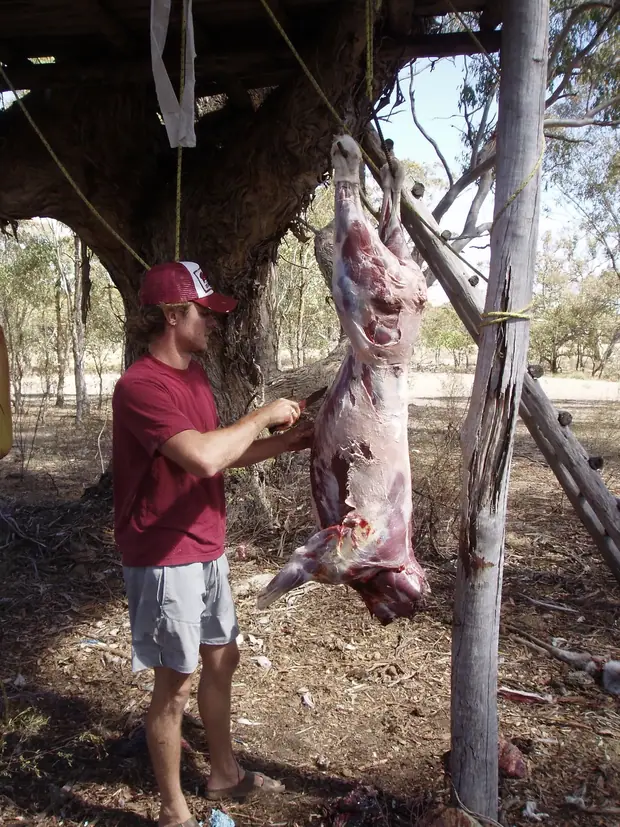
Skinning is mostly fists. The rule that matters is that hair on the meat is the enemy, and every knife stroke from the outside of the hide drags hair onto it. So cut from the inside out, with the blade under the skin and the edge facing up, and use the knife only where the hide is stuck. Keep the peeled hide falling away from the carcass, hair side out, never flopping back against the meat.
The carcass hangs head down from a gambrel, its ends through slits behind the big tendon above each hock. Gravity does half the work.
Hang it by the hocks
Cut a slit between the bone and the big tendon above each hock, slide the gambrel ends through, and hoist it until it hangs clear of the floor. Check it's secure before you lean on it with a knife.
Ring and split the hind legs
Cut around each leg just below the hock. Then, blade under the skin and edge up, open the hide up the inside of each leg to the belly opening.
Peel the hams, free the tail
Work the hide off the haunches with your fingers and fists, using the knife only where it sticks. Cut through the tailbone so the tail comes away with the hide.
Pull it down
Now it's mostly weight and fists. Pull the hide down the back and sides, pushing your knuckles between hide and meat. Keep it falling away from the carcass, hair side out.
The front legs
Ring each front leg at the knee, split the hide up the inside of the leg to the brisket, and peel it off over the shoulders.
Head off, hide off
Skin down the neck as far as the head. Then find the joint where the skull meets the first neck bone, cut through it, and the head and hide come away together. Anyone keeping a cape for a mount does this part differently: see Trophy Care.
Trim it, then hang it
Pick off any hair, cut away bloodshot and dirt, wipe it dry, and take the lower front legs off at the knee. Then hang it in the coolest, cleanest, most fly-free air you have, not touching anything else.
Knives
Most of the cuts on a butcher's hands come from the knife sliding off a joint or out of a slippery grip. Cut away from yourself and your mates. Keep the blade sharp so it needs no force. Put the knife down flat when you're using both hands, never in your pocket or your teeth.
Breaking it down
On Sunday everything comes out of the cool room and onto the bench. The first job is to take the carcass apart into its primals, the big pieces, following the natural seams between muscles instead of sawing across them. Tap a number for the order we take them off in. The Cuts takes each one apart.
- 1TenderloinsTwo small fillets inside the cavity, under the spine. Most butchers take them out first, because they dry and darken quickly on a hanging carcass.
- 2ShouldersA deer's front leg isn't joined to the ribcage by any joint, only muscle. Lift the leg, cut along the seam against the ribs, and it comes off without a saw.
- 3BackstrapsThe long loin either side of the spine, from the neck to the hip. Run the knife down along the spine, then around the ribs.
- 4HaunchesThe hind legs. Cut in along the pelvis to the ball-and-socket joint at the hip, pop it, and the haunch is free.
- 5NeckOff at the shoulders. Whole on the bone for a slow braise, or boned for mince.
- 6Ribs and flankRibs whole on the bandsaw, or boned with the flank for mince.
- 7ShanksThe lower legs, cut off at the knee and hock joints. The best braise on the animal.
Bag it, ice it, take it home
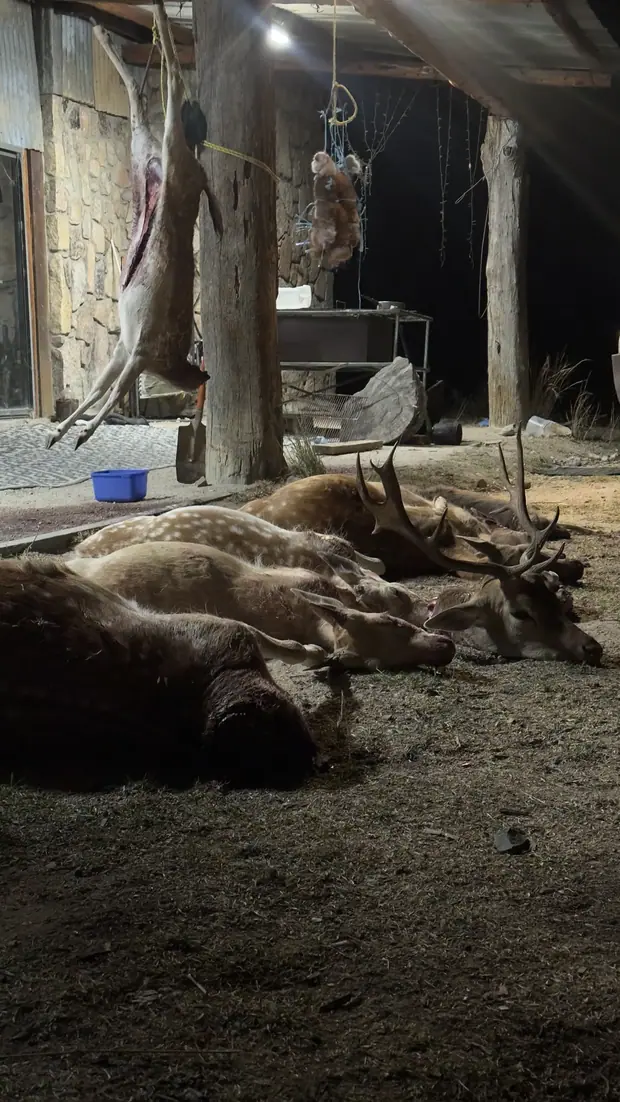
Everything worth keeping gets sealed. A vacuum sealer, still called a cryovac after the brand, pulls the air out and heat-seals the bag. No air means no freezer burn and no drying, and the meat keeps for far longer. We've got one machine and a second halves the Sunday queue, so bring yours if you own one.
Cut, seal and label as you go, while everything's cold. Keep the top of the bag clean and dry, because blood in the seal means it leaks. Pack in meal sizes, laid flat, so they freeze fast and thaw evenly. Then write on every bag: the cut, the date and the animal. In four months you won't remember which bag held the backstrap.
The esky, before you drive
- Meat cold when it goes inStraight from the cool room or the fridge, never warm.
- Every piece sealed or baggedDry meat stays clean. Wet meat in melt water doesn't.
- Ice under the meat, and over itBagged ice, ice bricks or frozen bottles.
- Flat packs in layers, gaps filledAir pockets warm up first.
- Heads, capes and hides kept outThey travel separately, away from the meat.
- Lid shut, esky in the shadeIn the cab beats the tray in the sun.
- Melt water drained at every stopMeat sits on ice, never in water.
- Freezer cleared at home before you leaveIt all goes in the night you get back.
The meat goes home chilled, not frozen, and that's fine. Cold meat on plenty of ice, in a shut esky out of the sun, should stay below 5°C for the drive home. Ice on top matters as much as ice underneath, because cold air sinks through the load.
The one thing to watch is the melt water. Meat sitting in a puddle at the bottom of an esky goes grey and soft, and if a bag has leaked it's sitting in its own juice. Drain it every time you stop, as the Victorian game meat guide says, or sit the meat on frozen bottles that can't melt into a pool.
At home, it all goes into the freezer that night, at -18°C or colder, in single flat layers so it freezes fast, then stacked once it's hard. Properly handled game keeps up to about a year frozen (Penn State), longer vacuum sealed. Freezer burn hurts the quality, not the safety. Thaw it in the fridge, never on the bench or in a sink of water (Food Safety Information Council).
How much is in it?
Less than people think. Once the gut, skin, head, feet and bone are gone, a fallow gives you roughly 35 to 40% of its live weight as meat you can bag, less if the shot smashed a shoulder or a buck is run thin after the rut. Slide the live weight and see what comes home.
Carcass figures from farmed and wild fallow studies in Australia, Poland and South Africa. A gut shot, a smashed shoulder or a buck run thin by the rut takes it lower.
Lore
Venison once meant the meat of any big game, boar as well as deer. The word came into English about 1300, through Old French, from the Latin venatio, the hunt. Only later did it narrow down to deer.