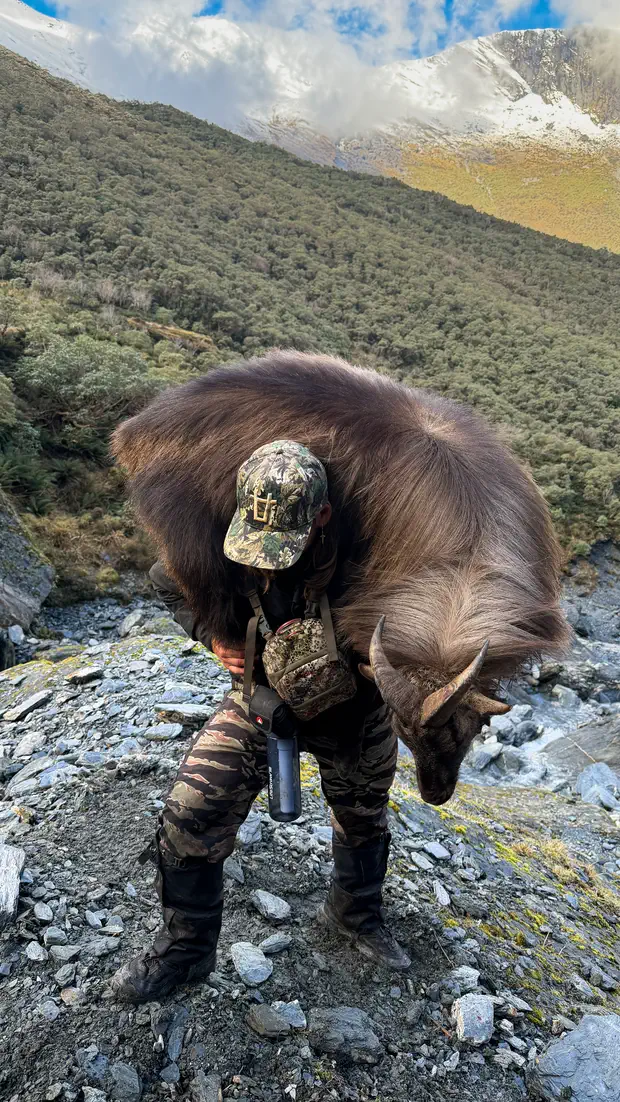
Tahr
A recording: episode 6 of Listen, the library read aloud
Himalayan tahr: where they came from, how to read a bull's age off his horns, and why the mane matters.

Seventeen tahr and a duke
Hemitragus jemlahicus. A wild goat of the central Himalaya, from the mountains of India and Nepal. The species name comes from the Jemla hills of Nepal. At home it is listed as Near Threatened. Here, the problem has always run the other way.
In 1904 the Duke of Bedford gave the New Zealand Government six tahr from the herd he kept at Woburn in England. One bull was lost on the voyage out, and the other five were let go near the Hermitage at Aoraki/Mount Cook. In 1909 he sent eight more, six males and two females, and they went out in the same country. Four from Wellington Zoo followed in 1919. Small releases near Rotorua and Franz Josef never took, so every wild tahr in New Zealand comes from fewer than twenty animals.
The idea, from the government's Tourist Department, was sport, and overseas hunters with money to spend. The tahr were fully protected. With no snow leopards and nobody allowed to shoot them, they did what anything does with nothing chasing it.
By 1913 they were on the Sealy Range in numbers and by 1918 on the main range. By 1929 tahr and chamois had both crossed the Main Divide to the West Coast over the Copland Pass, and by the 1960s tahr ran in an unbroken band from the Hopkins Valley north to the Wilberforce. In 1963 the ecologist Graeme Caughley worked out how fast nine introduced hoofed animals had spread from where they were let go. Tahr averaged about 1.1 miles (1.8 km) a year. Only chamois were quicker.
Five tahr at the Hermitage
The Duke of Bedford sends six from Woburn. One bull is lost on the way, and five are let go near the Hermitage at Aoraki/Mount Cook. They are fully protected. DOC and most histories say 1904. The Game Animal Council gives 1905.
Eight more, then four
Six males and two females go out in the same country in 1909, and four from Wellington Zoo in 1919, by which time there are close to a hundred.
The first legal tahr
Under a special warrant, a tahr and two chamois are shot behind the Hermitage for the Tourist Department's display at the Dunedin Exhibition. They are the first of either animal shot legally in New Zealand.
Protection comes off
Tahr lose their protection because of the damage to alpine plants. The first open season that May offers three licences of two animals each. One hunting group dates the end of protection to 1937, the year the culling began.
The government starts shooting
The first official operation kills 2,765 tahr. By 1964 government shooters have killed more than 24,500, and the range keeps growing anyway. Poison is tried from 1960.
The helicopter years
Helicopter crews shooting tahr for the game meat trade take the herd from about 50,000 to about 2,000 by 1983.
A moratorium
With the herd close to wiped out, the government stops commercial hunting of tahr. Recreational hunters and guides carry on, and the numbers climb again.
The control plan
The Himalayan Thar Control Plan caps the herd at 10,000 across all land in the tahr range and splits that range into seven management units and two exclusion zones. It was meant to be reviewed after five years. It still governs.
Control in earnest
Helicopter surveys from 2016 to 2019 put about 34,500 tahr on public land alone. DOC's control steps up, and the known tally inside the management units for the year to June 2020 is 11,389.
Where it stands
The 2026/27 plan funds 230 to 260 hours of official control, fewer than recent years. DOC says numbers are probably falling but still above the plan, and a new survey is due. The argument about how many tahr New Zealand should carry is very much alive.
Lore
Thar or tahr? The 1993 plan spells it thar, and plenty of official papers did before it. In 1962 the hunting writer Bruce Banwell made the case that tahr was correct. It took a while, but his spelling won.
Bull, nanny, kid
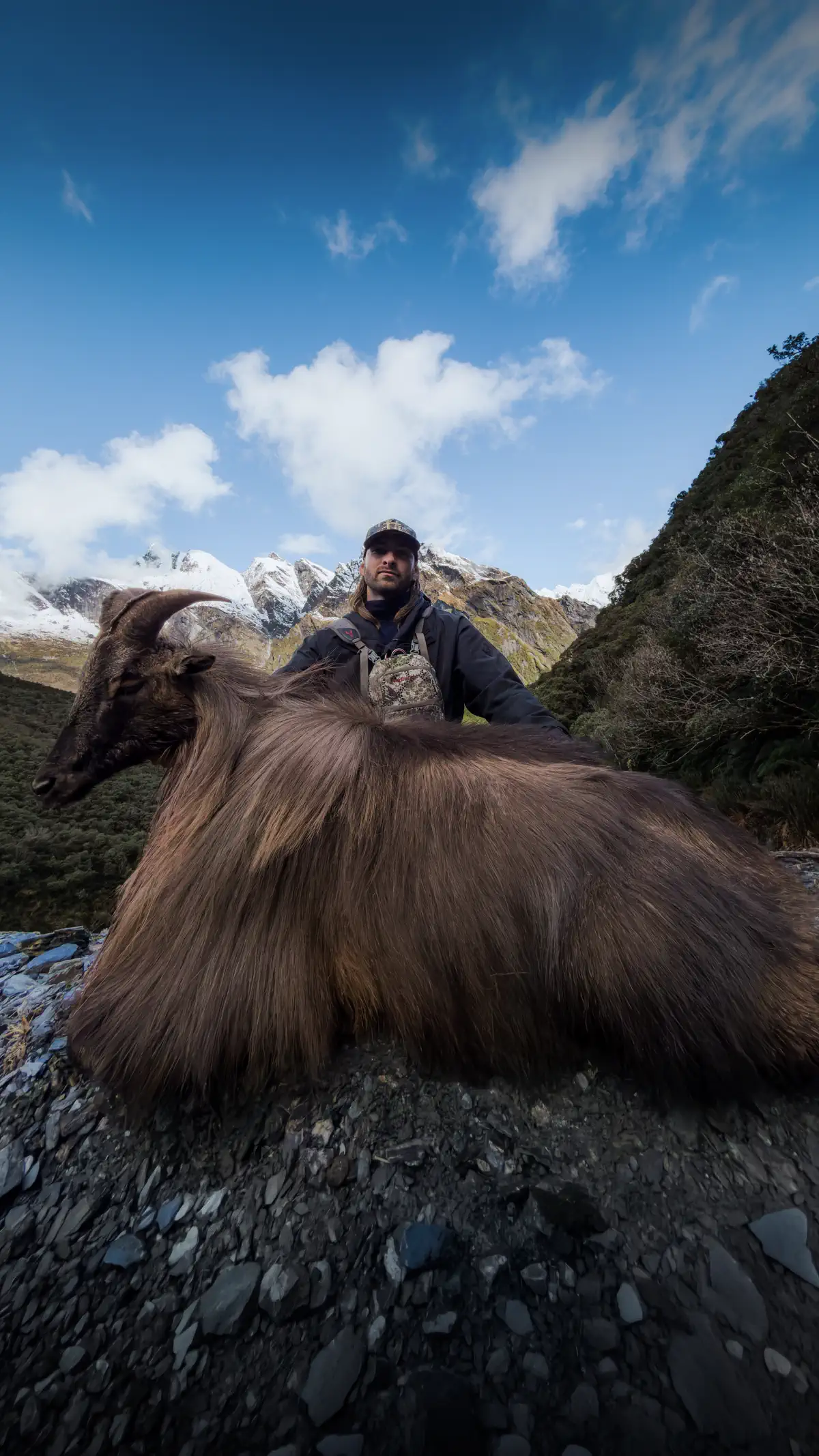
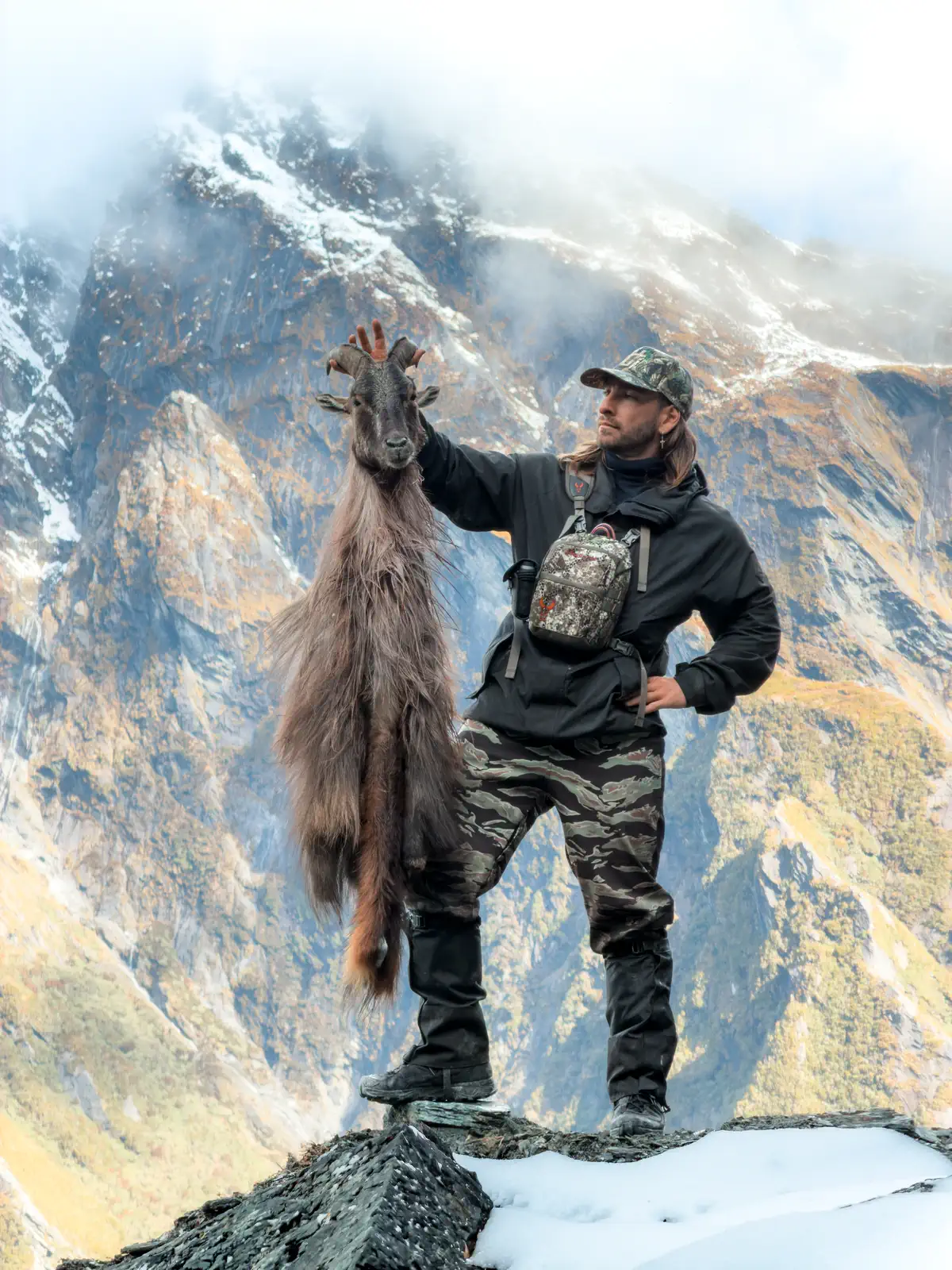
Both sexes carry horns, which catches people out. What separates them at a glance is size and hair. A mature bull is a heavy, deep-chested animal on short legs, and in winter he wears a mane of long hair over his neck, shoulders and chest that hangs almost to his knees. A nanny is half his weight, with a short coat like a farm goat and no mane at all.
- 1HornsBoth sexes. A bull's are up to twice the length of a nanny's, heavy at the base and swept back with a sharp front edge. Never shed.
- 2FaceShort hair. Near black on a mature bull, lighter on young ones.
- 3ManeBulls only, heaviest in winter. Often paler than the body by the end of winter. He can puff it out or lay it flat.
- 4Kidney stripesTwo pale lines either side of the spine, from the back of the mane to the rump, on mature bulls.
- 5HindquartersShort, dark coat on a mature bull, almost black in winter. Young bulls are lighter and all one colour.
- 6KneesBare, callused pads on the knees, and often on the chest.
- 7HoovesA soft, slightly domed pad inside a hard rim. It grips smooth rock like a climbing shoe.

The one you want
Mature bulls spend most of the year in bachelor groups, apart from the nannies, and travel a long way in summer. Around April and May they drift towards the nanny groups, and the rut runs from late May to mid-July. Rivals posture far more than they fight. A mature bull is one and a half to two times the size of a nanny and should look heavy on his feet.
The engine of the herd
Nannies, kids and young animals run together. Medium brown in summer, dark brown in winter, with a short coat and slim horns. Nannies are the breeding engine of the herd, which is why most of DOC's control outside the national parks takes nannies and young animals and leaves identifiable bulls for hunters.
One at a time
A nanny has a single kid after about seven months. The median birth date is the last day of November. Kids are paler and greyer than adults and on their feet almost at once, which on that country is not optional. A 1961 study reckoned four in five died before the end of their third winter.
Leave him to grow
Narrow, light and all one colour, with anything from a scruffy neck to a small pale mane. Young bulls hang about the nanny groups, often harassing them, but in a natural herd they don't get to breed. Their horns can already be 9 to 12 inches, which is why horn length alone fools people.

Lore
Tahr are almost silent. The one sound you're likely to hear is a sharp, high whistle, and they keep it for alarm. If you hear it, so did everything else on the face.
Age a bull
A tahr's horn is a diary. It grows from the base, not the tip, so the tip is the oldest part. Every winter growth stops for a while and leaves a ring, called an annulus. No ring forms in a kid's first winter. Tahr are born around the start of December, so at the winter rut a bull is two and a half, five and a half, and so on.
Put that together and the rule is simple: count the rings and add one and a half for his age at the rut. A new ring starts to show at the base between September and November, so by our October trip a bull may carry one more than he did in winter. It is close enough to tell a young bull from a mature one, which is what matters.
Why bother? Because the hunting groups ask you to take mature bulls and leave young ones to grow, and outside the national parks DOC leaves identifiable bulls for hunters. Drag through his life below.
Two and a half
Narrow, light and all one colour, with a scruffy neck rather than a mane. His horns are still putting on about 30 mm a year. Leave him.
Three and a half
A small, pale mane is starting. The rings are well apart and the horns run straight back off the skull with no stacking at the base. Often seen hanging about the nannies.
Four and a half
Some bulls this age already carry 12 inches, which is why length alone fools people. The body is still narrow and the colour still even. Another year or two makes all the difference.
Five and a half
Into his prime. Full mane, dark hindquarters and a near-black face, with pale kidney stripes either side of the spine. One and a half to two times a nanny. His horn growth has slowed sharply.
Six and a half
From here his horns add only a little each year, so his age shows in his body, his bases and the spacing of his rings more than in length.
Seven and a half
The rings nearest the skull are crowding together. That stacking at the base is one of the surest signs of age, whatever the horn length.
Eight and a half
On the edge of old. Most bulls with horns of 13 inches or more are about this age or older.
Nine and a half
Wide across the back, especially seen from behind. Tips often broken or broomed and the ridges worn. In the rut an old bull often keeps to himself with a single nanny.
Ten and a half and older
In the 1970s sample the oldest bulls averaged slightly shorter horns than the nine-year-olds, and old bulls often have broken or worn tips. What gives him away is the stack of tight rings at the base. The New Zealand record bull, taken in 2024, was ten.
The tape goes from the base to the tip along the outside of the curve, and around the base. New Zealand's system, the Douglas Score, takes the shorter horn and the thinner base and doubles them, so a matched pair beats a lopsided one. There is no spread measurement for tahr.
The NZ Deerstalkers' Association's record book takes a tahr with a horn over 13 inches, or a Douglas Score of 40. Thirteen has replaced twelve as the usual mark of a good bull.
Inches for the book
The record-book line, or a Douglas Score of 40. Most bulls never reach it.
Bulls in 1,695
In the 1970s sample, 15 bulls had horns of 13 inches or more. Every one was at least five. That is under one in a hundred.
The record
Inches of horn on the New Zealand record, a ten-year-old taken in June 2024 that scored 50½.
- Mane full and hanging well down the front legsA scruffy neck or a small pale mane says young.
- Dark hindquarters and a near-black faceYoung bulls are light and all one colour.
- Heavy body, wide across the backAnd remember he can puff the mane up.
- Rings stacked tight at the baseSpaced-out rings and light bases say young.
- Tips broken or broomedA sign of an old bull.
- Seen side on and from behindHorns always look bigger from behind.
- Still in doubt? Get closer, or let him goThe more young bulls you pass, the better your odds of an old one.
Lore
Patience pays. The Tahr Foundation has seen bulls of twelve to fourteen with horns over 14 inches that had carried only 11½ to 12 at five or six. An average young bull can grow into a big old one, but only if someone lets him.
Bluffs and basins
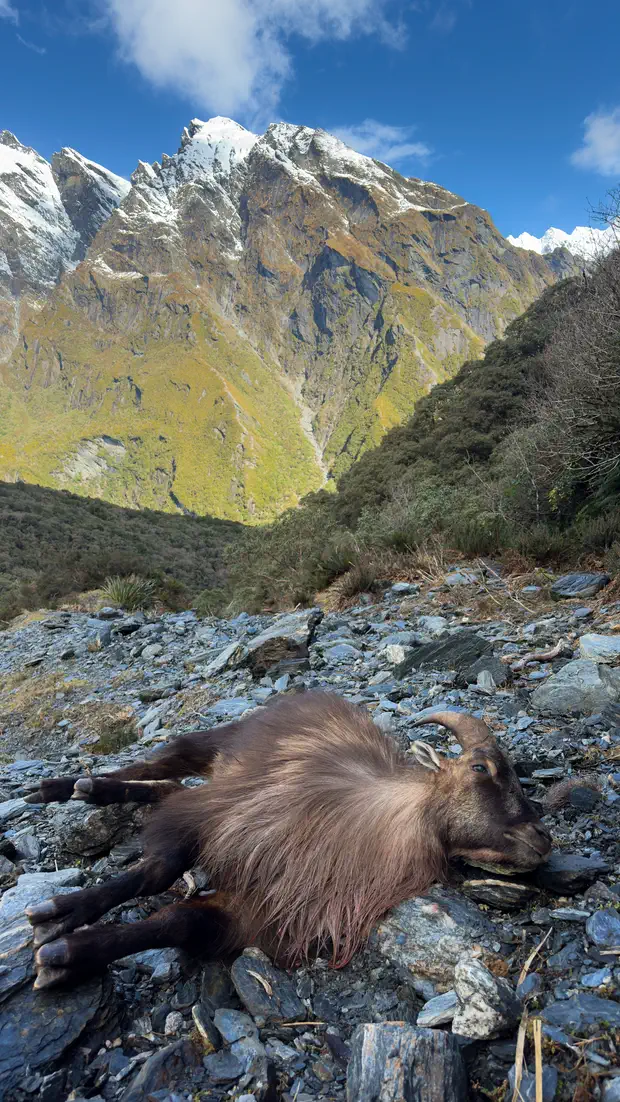
Tahr country is the steep subalpine and alpine zone around and above the bushline, where rock bluffs break up faces of snow tussock and scrub. The bluffs are the point. They are the escape route, the bed and the lookout, and tahr are never far from them.
Snow tussock is the staple, about 30 per cent of what they eat and most of all in winter. Summer brings other grasses and sedges, and they also take Dracophyllum, mountain daisies, speargrass and the Mount Cook lily. After the rut, snow decides where they are: they come down and shelter among rocky outcrops in bad weather, then work back up to the summer grazing through spring.
They keep a timetable. In a two-year study on the eastern side of the Divide, a nanny herd fed low at dawn, climbed through the morning, bedded high among the bluffs at midday and fed back down in the afternoon, a climb of 400 to 450 metres a day in summer and 150 to 200 in winter. On the West Coast, where the scrub is thick and the helicopters are regular, DOC finds they often flip it.
Low and feeding
They spend the night low on the face, and at first light are feeding close to where they were at dusk.
Climbing
They feed their way up through the morning, heading for the rock.
Bedded in the bluffs
Resting high, often above the last of the vegetation. This is when you glass for them: still shapes on ledges and in the shade of the rock.
Coming down
Usually directly and quickly, feeding more as the afternoon goes on. Feeding peaks late in the day.
Low again
Feeding hard as the light goes. In spring they often climb a little before dark.
Out on the tussock
Still feeding on the tussock and open slips above the bush, and starting to drift back down.
Back into cover
Where the scrub is thick and helicopters are regular, tahr shelter below the bushline, not above it.
Gone
Resting in the scrub and bush, where you won't see them, however hard you glass.
Still hidden
Still in the scrub and out of sight. This is the long wait.
Up onto the slips
Feeding up onto the tussock and slips. On the West Coast the evening is the time to be behind the glass, watching the bush edges.
- April and May
The groups gather
Three kinds of group come together: nannies with kids and young animals, mature bulls over four, and young bulls of two or three.
- Late May to mid-July
The rut
Mature bulls join the nannies. Bulls are in their best coats and burn their fat reserves.
- July to September
Winter
Snow decides where they are, and they shelter among rocky outcrops in bad weather. They feed least in August and September.
- September to November
Spring, and our trip
Winter coats coming out, so they look much paler, and the herds come down to low and middle altitudes for the new growth. Nannies are heavily pregnant. The bulls are past their best pelt.
- Late November and December
Kidding
One kid each. DOC stops its aerial control by mid-November to keep clear of the kid drop.
- Summer
The bulls wander
Bulls travel long distances away from the nanny groups, and the daily climb is at its biggest.
Lore
The Mount Cook lily isn't a lily at all. It is the largest buttercup in the world, it grows only in New Zealand, and tahr eat it. It is one of the plants DOC points to when it explains why it controls them.
Ten thousand
Tahr are managed under a statutory plan written in 1993 under the Wild Animal Control Act 1977. It sets a ceiling of 10,000 tahr across 706,000 hectares of public, leased and private land, splits the range into seven management units, and keeps two exclusion zones, north and south, where every tahr is removed so the range can't creep. Each year DOC writes an operational plan with Ngāi Tahu and a liaison group of hunting, conservation, recreation and farming organisations.
It was meant as a start. The Minister of Conservation who approved it called it partly experimental and precautionary: where the information was thin, the decisions leaned towards protecting nature. It was to run for an initial five years and be changed as the evidence came in.
| Unit | Ceiling |
|---|---|
| 1. South Rakaia and Rangitata | 2.5 per km², 2,000 |
| 2. South Whitcombe, Wanganui and Whataroa | 2 per km², 1,500 |
| 3. Gammack and Two Thumb | 2 per km², 3,000 |
| 4. Westland Tai Poutini and Aoraki/Mount Cook National Parks | Under 1 per km², under 500, aiming for zero |
| 5. Ben Ohau | 2.5 per km², 1,800 |
| 6. Landsborough | 1.5 per km², 900 |
| 7. Wills, Makarora and Hunter | Under 1 per km², under 100 |
Helicopter surveys of public conservation land only, so private land and leases come on top. Both counts are rough: the likely range was 26,522 to 44,821 in 2016 to 2019, and 22,100 to 40,150 in 2023.
Year to 30 June 2025, from DOC's report to the Conservation Authority. Most recreational hunting isn't counted.
New Zealand's plants never met a goat
New Zealand's alpine plants grew up without large browsing mammals, and many have no spines or poisons to put one off. A big group of tahr eats and tramples, and can turn tall tussock and shrubland into turf or bare ground. Kea, rock wren and the threatened alpine scree wētā lose food and shelter.
DOC has measured plots since the early 1990s. Tussock height fell where tahr activity rose between 1990 and 2023, and the last measurements, taken a few years into heavy control, showed no recovery yet. The National Parks Act 1980 says introduced animals in parks are to be exterminated as far as possible. Forest & Bird's position is 10,000 overall and none in the parks, and in 2020 the High Court found nothing that required DOC to spare bulls inside them.
A game animal, not just a pest
The 10,000 figure was a best guess in 1993. The plan called itself experimental and was meant to be reviewed after five years. It never has been, and the Game Animal Council says today's monitoring can't show whether the targets are right or being met. The sector wants tahr managed for both hunting and conservation under the Game Animal Council Act 2013.
Hunters point out that they do a lot of the control. Organised hunter operations have removed nearly 1,400 tahr in South Westland since 2022, mostly mature nannies from forest where helicopters struggle. In 2020 the NZ Tahr Foundation won a judicial review: the High Court found DOC hadn't consulted properly before its 2020/21 plan, though the cull itself, park bulls included, was lawful. One Deerstalkers' writer cited modelling that a herd held at 10,000 would produce only about 200 trophy bulls of six and older a year, against roughly 1,100 tahr trophies exported a year before Covid.
October 2026
DOC's plan for 1 July 2026 to 30 June 2027 funds 230 to 260 hours of official control, fewer than recent years because monitoring and running costs are up about 17 per cent, plus 8 to 10 hunter-led operations by the NZ Tahr Foundation. Outside the national parks DOC doesn't target identifiable bulls on its 425,000 hectares inside the range, and it spares white tahr. Every trophy taken by aerially assisted hunting on public land obliges the operator to kill five nannies or juveniles.
In July 2026 sika and Fiordland wapiti became Herds of Special Interest, managed as game animals under the Game Animal Council Act, and the Tahr Foundation has formally asked for the same for tahr. Nothing is decided. A new population survey is planned this year.
Inside Unit 4
The country inland of Fox Glacier is Westland Tai Poutini National Park, in Management Unit 4 with Aoraki/Mount Cook. The ceiling there is under one tahr per square kilometre, and DOC's aim is as close to zero as practicable. In the parks, every tahr DOC's shooters meet is shot, bulls included. In 2024/25 DOC-led control removed 1,931 tahr from the two parks.
This year's plan held aerial control off the more accessible parts of the parks until 3 August and has it finishing across the range by 13 November. So a bull still standing in mid-October has come through most of a season of it. Nobody can promise you one, and a mature bull alive in a national park in spring has earned his place on the wall.
Lore
In the 1970s helicopter crews shot so many tahr for the game meat trade that the herd fell from about 50,000 to about 2,000, and in 1983 the government stopped commercial hunting to save it. Forty years on, hunters and DOC are arguing about the opposite problem.
Hunting them
Most of a tahr hunt is sitting still. You find somewhere that looks over a lot of country and glass it, slowly, then glass it again. DOC's advice is exactly that: look, leave it a while, look again, because animals bedded in shade or behind rock the first time often aren't the second. In spring the paler coats help, and on the West Coast the bush edges and slips come alive late in the day.
Once you've found a bull, the spotter does the work. Twenty to sixty power on a tripod, turned down in poor light or heat shimmer. Run the checklist from Chapter III: mane, colour, body, bases, tips, then the rings if you're close enough. Try to see him side on and from behind. Your guide has looked at hundreds of bulls. Ask.
Then the stalk. Tahr smell, hear and see well, so move into the wind and use every bit of cover. Watch the air too: as a rule, scent sinks downhill at first light and as faces go into shade, and rises once the sun is on them, unless a westerly front overrides the lot. Where the ground allows, finish level with him or above. You can see down into broken country, the shot is easier to judge, and a hit animal falls away from you where you can watch it. Never shoot a bull from directly below: in one account published by the Mountain Safety Council, a bull shot about 200 metres upslope rolled and brought rocks down onto the hunters.
Gravity pulls a bullet down over the horizontal part of the distance, not the length of the slope. A rangefinder that reads 400 metres up a 30 degree face is a 346 metre shot as far as drop goes. Hold for 400 and you'll go high, uphill or downhill, because the bullet drops less than you allowed for.
In a worked example with a .270 and a 200 metre zero, a 400 metre shot at 30 degrees held for level range hits about 16 cm high, and at 45 degrees about 36 cm high. Dial the clicks for the horizontal distance instead, the old rifleman's rule, and the same shots land only a few centimetres low. Use a rangefinder that reads angle-compensated distance, or better still, get closer. Shot Placement covers where the bullet should go.
Before the safety comes off, look past the animal. If you hit him well, where does he go? Bull tahr are hard to stop when disturbed or poorly hit, so assume a few steps and a roll. If the answer is over a bluff, down a gut or into a river, the shot is off, however easy it looks. It costs you the horns and the cape, and the retrieval is a fall waiting to happen.
The mane makes his chest look much deeper than it is. Judge the heart and lungs off the front leg and the elbow, not the outline of the hair, and be ready for a quick follow-up.
A: on the bench
Hit on the bench, he rolls a few metres into the tussock basin and stops. You can walk to him, and the horns and cape come through it.
Leave himB: above the bluff
Hit or not, a bull standing on a ledge goes over the bluff. That's broken horns, a wrecked cape and a retrieval nobody should attempt.
WaitC: beside the gut
Hit here, he slides into the snow gut and down into the gorge. Give him time to feed out onto better ground, or let him go.
Watch him down
Keep the scope on him until he stops, and fix the spot against something you can find again: a rock, a patch of snow. A photo through the spotter helps.
Reload and wait
A few minutes. If he gets up, you want to be where you are, ready.
Plan the route with the guide
The straight line is rarely the safe one. Pick the way you'd be happy to come back with a heavy pack.
Come in from above or the side
Never from directly below a body that could still roll. Make sure he's dead before you touch him.
Make him safe
Wedge or tie him off before photos or caping, so he can't slide.
Then the work
Photos, the cape, and the walk out. Trophy Care covers the cape.
The fall is what kills people
In the 16 years to 2025, ten of the eleven alpine hunters who died in New Zealand died in falls (Mountain Safety Council). Frozen snow, wet tussock and loose rock on the way to an animal, or carrying one out, are where it happens.
No bull is worth it. If the guide says the retrieval is off, it's off.