The Cuts
A recording: chapter 6 of episode 5, Field to freezer
What comes off a fallow, what each piece weighs, and how to cook it so none of it goes to waste.

Every cut on the animal
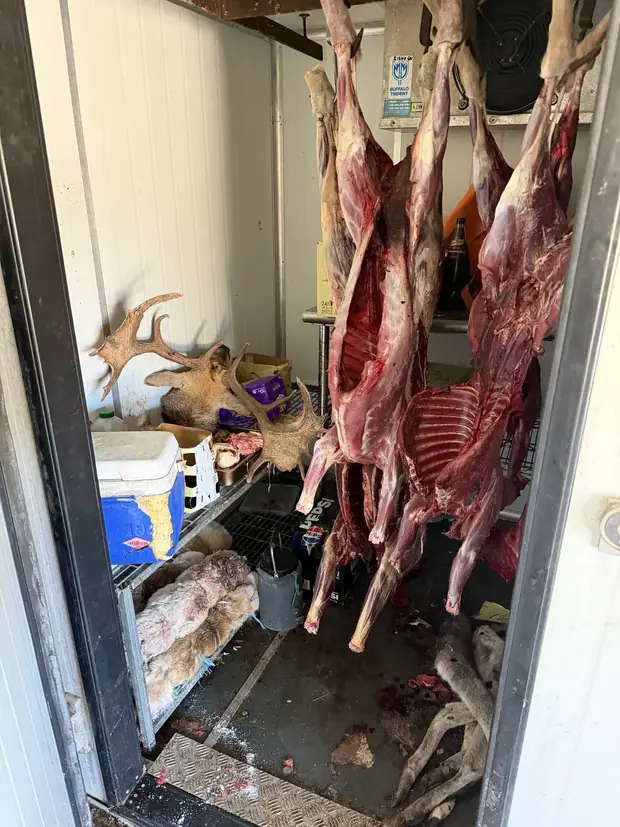
On Sunday every carcass comes out of the cool room and onto the bench, and you take it apart yourself, naming each cut as it comes off. This is the map for that. Every piece of a fallow has a name, a place and a right way to cook it, and once you know which is which, nothing needs to go in the bin.
The single rule behind all of it: muscles that did little work in life are tender and want quick, hot cooking. Muscles that worked all day, like the neck and the legs, are full of connective tissue and want hours of low, moist heat. Tap any part of the deer to see what it is.
Tap the deer or a name. The two dashed cuts lie on the inside.
Backstrap
Along each side of the spine, from behind the shoulder to the hip.
The prime steak on the deer, and the one everyone wants. Strip the silverskin off, then sear it hard and rest it, whole or in thick medallions. Take it off the heat while it's still pink: there's no fat to forgive you.
ServeSeared whole over coals, rested, sliced thick across the grain with flaky salt.
Tenderloin
Two small fillets inside the body cavity, tucked under the spine in front of the hips. You can't see them from outside.
The most tender muscle on the animal, and the smallest. A very hot pan, a minute or two a side, then a short rest.
ServeSeared in foaming butter with garlic and thyme, sliced and eaten straight away.
Rump
On top of the hip, at the head of each haunch.
Steaks or a small roast, cooked pink, with more flavour than the backstrap. On a small fallow it can be sinewy, and then it's better diced for a braise.
ServeRump steaks off the coals with chimichurri.
Topside
The inside face of the haunch: the big muscle you see when you lay the leg down inside up. Dashed here because it's on the far side.
Lean, fine-grained and tender. Roast it whole or cut steaks and keep them pink, or slice it thin across the grain for a fast stir-fry.
ServeRoasted whole to pink, rested, carved paper-thin into rolls with horseradish.
Silverside
The outside and back of the haunch, the biggest muscle on the leg, with the cylinder of eye round along its back edge.
A thick band of silverskin runs down one side: trim it. Slice thin across the grain for schnitzel or jerky, or braise it. The eye round, separated along its seam, roasts pink and makes the best jerky on the animal.
ServeSliced thin, bashed flat, crumbed and fried as schnitzel.
Knuckle
The front of the haunch: a football-shaped bundle wrapped around the front of the thigh bone, above the kneecap.
It splits into a few smaller muscles along its seams. Trim the silverskin on the outside and cook it as steaks or a small roast.
ServeRoasted whole, sliced thin over beetroot, rocket and goat's cheese.
Shoulder
The front leg above the elbow, held to the ribs by muscle alone.
Too much connective tissue for steaks. Braise it whole on the bone until the meat lifts off the blade. The one exception is the flat iron, a small tender muscle on the blade, which you cook hot and fast.
ServeBraised on the bone in stout for five hours, pulled into soft rolls.
Shanks
The lower legs: between the elbow and the knee at the front, the knee and the hock at the back.
The toughest cut on the animal and the best braise. Cut them into rounds or leave them whole, brown them, then braise three to four hours until the collagen melts and the meat falls off.
ServeOsso buco on soft polenta with lemon gremolata.
Neck
From behind the head back to the shoulders.
Full of collagen and flavour, and the cut most often wasted. Braise it whole on the bone, then shred it, or bone it out for mince.
ServeBraised whole and shredded into a ragu over pappardelle.
Ribs
The rib cage below the backstrap.
Thin on a fallow. Braise or smoke them low and slow, or bone them out for mince. Left on the bone with the backstrap, the front ribs make a frenched rack you roast hot.
ServeSmoked low with a sticky glaze, then charred over coals.
Flank
The thin belly wall behind the ribs.
Thin, sinewy and laced with silverskin. Trim it and send it to the mince pile.
ServeThrough the mincer with 15% pork fat, for burgers.
Trim
The edges and off-cuts of every other cut, plus the neck, ribs, flank and brisket if you don't cook them whole.
Neck, ribs, flank and brisket hold nearly a third of a fallow carcass (Zmijewski and colleagues, 2020). Most of that ends up as mince, which is why it adds up to the biggest pile on the bench.
ServeSausages: 20 to 30% pork back fat, 2% salt, everything kept near freezing.
Weights are for a mid-size fallow with a carcass of about 25 kg, from measured wild and farmed fallow (Fitzhenry 2016, Stanisz 2023, Zmijewski 2020). Rump, knuckle and shank are our estimates from what's left of the measured haunch. A big buck runs heavier.
Lore
Lean venison leg carries about twice the iron of lean beef rump: 4.1 mg against 2.1 mg in every 100 g, by Food Standards Australia New Zealand's own food database. It has about half the fat as well.
Taking a haunch apart
A haunch looks like one lump of meat. It's really half a dozen muscles held together by thin sheets of connective tissue, the seams. Find a seam, push your fingers into it, and the muscles part almost by themselves. Use the knife tip only where they're stuck.
Doing it this way gives you whole, clean muscles, each one a single cut with a single grain, instead of the cross-sawn steaks that mix tough meat with tender. It's slower the first time and quicker every time after.
There's no single right order, and butchers argue about it. This is ours, and it suits a haunch taken off at the hip joint. Step through it on the drawing, which shows a left haunch from the inside.
Silverskin: when to bother
The tough, shiny silverskin on the outside of a muscle never softens in a hot pan, so trim it off anything you cook fast. Leave it on necks, shoulders and shanks: in a long braise it turns to gelatine and gives the sauce its body.
Find the seams
Lay the haunch inside up on a clean bench. Trim any dried surface, hair or bloodshot first. Then look for the faint silvery lines between muscles: those are the seams you'll follow.
Shank off at the knee
Bend the leg, find the gap in the knee joint and cut through it. The shank is a braise on its own, whole or sawn into rounds.
Topside off the inside
The big muscle facing you. Push your fingers into the seam along its edge and lift it away from the bone, cutting only where it clings. It comes off in one clean piece.
Knuckle off the front
Roll the leg over. The knuckle wraps the front of the thigh bone above the kneecap. Cut around the kneecap, then work along the bone to free it.
Silverside and eye round
What's left on the back of the bone is the silverside, with the eye round along its edge. Take them off together, then split the eye round away along the seam between them.
Rump off the top
The rump sits over the ball of the hip joint. Cut it away from the bone, and with it goes the last of the meat. The thigh bone is free.
Bone out, then trim
The bone goes to the stock pot. Trim the silverskin off everything you'll cook fast, bag the scraps for mince, and name every cut as it goes on the tray.
Lore
The same muscle answers to different names depending on who's cutting it. An Australian butcher says silverside, topside and knuckle. An American says bottom round, top round and sirloin tip, and NZ Venison's own cut list mixes both. It keeps the arguments at the bench going for hours.
Hot and fast, low and slow
Every cut on a deer sits somewhere between two extremes. At one end are the lazy muscles along the spine, the backstrap and tenderloin, with long fine fibres and almost no connective tissue. At the other are the muscles that carried the animal all day, the neck, shoulders and shanks, wrapped and laced in tough collagen.
Heat does opposite things to them. The lean fibres tighten and squeeze out their juice the longer they cook, so the tender cuts want fierce heat and a short time. Collagen only gives up after hours of moist heat, when it melts into gelatine and the meat falls apart. Cook a backstrap for four hours and you have leather. Sear a shank and you have rubber.
Venison adds one more problem. It has almost no fat in the muscle, about 1.5 g in 100 g of lean leg (FSANZ food database), so there's nothing to keep a fast cut moist once it's past medium. Stop early, and rest it.
Fig. 1A shank in cross-section. Drag to see what four hours of braising does to the collagen.
Which is which
- Hot and fast
Sear, grill, roast pink - Backstrap, tenderloin, rump, topside, knuckle, the flat iron off the shoulder blade, the frenched rack, the heart and the liver.
- Low and slow
Braise, stew, smoke - Neck, shoulder, shanks, ribs and brisket. Leave the silverskin on these: it melts.
- Either
Depends on the knife - Silverside and eye round. Sliced paper-thin across the grain they cook in seconds. Left whole, they braise.
- Mince
With added fat - Flank, brisket, trim, and anything too sinewy to bother with. Chapter V has the ratios.
How far to cook it
Use a probe thermometer in the middle of the thickest part. Colour lies, especially by firelight.
Cooks and food safety agencies use the same words for different temperatures, which causes no end of confusion. Cooks call a steak medium-rare at about 54 to 57°C. Australia's food safety advice, from the Food Safety Information Council and the NSW Food Authority, puts the safe minimum for a whole cut of red meat, venison and kangaroo included, at 63°C with a rest of three to five minutes.
Most people who cook venison pull a backstrap well below 63°C, and that's a choice with a known risk, mainly the toxoplasma parasite that lives in the muscle. Freezing it for a week first cuts that risk a long way. Pregnant women, small children, older people and anyone with a weakened immune system should have their venison cooked through.
Mince, sausages and offal are different: mincing carries surface bacteria into the middle, so they get cooked right through, to 75°C.
Barely warm
Deep red and cool in the middle. A cook's term, not an official one: below every food safety line.
Where most cooks stop
Red-pink and warm right through, still juicy. Pull it a couple of degrees early, because it keeps climbing while it rests.
Pink and firmer
The fibres are tightening and the juice is starting to go. The far edge of good for a backstrap.
Safe for a whole cut
Australia's food safety minimum for a whole cut of red meat, venison and kangaroo included, with a three to five minute rest. On lean venison it's light pink to brown, and noticeably drier.
For mince, not steak
Grey-brown right through. The right temperature for mince, sausages and offal. On a backstrap, it's dry, tight and livery.
Lore
Most of what people call gamey isn't the meat at all. Strong flavours sit mainly in the fat, and deer fat is hard and waxy, so it sets on a cold plate. Trim the fat, serve fatty dishes piping hot (NDSU Extension), and a well-handled fallow tastes mild and clean.
Heart, liver and kidneys
The offal is the first meat off any animal and, for plenty of hunters, the best. It's also where disease shows first, so it only gets eaten if it passed the inspection in Field to Freezer: firm, evenly coloured, smelling clean, no spots, cysts or flukes.
Bag it clean, get it cold fast and cook it within a day or two. Offal doesn't keep or age the way muscle does.
One safety point first. Australia's food safety advice is to cook offal through, to 75°C (Food Safety Information Council). Plenty of cooks serve heart and liver pink. That's your call to make, with the same caveats as rare venison: not for anyone pregnant, very young, elderly or unwell.
Measured on wild two-year-old fallow does of about 41 kg (Stanisz and colleagues, 2023)
The heart
The best piece of offal on the animal: dense, mild and fine-grained, more like a lean steak than anything livery. Trim off the fat cap, the valves and the tubes at the top. Then slice it into steaks, or butterfly it open and cook it fast over high heat.
Or stuff it and braise it slowly, which suits a big buck's heart.
The liver
Only a perfect one: firm, smooth, deep red-brown, no white spots or gritty tracks. Peel off the outer membrane and slice it about 5 mm thick. Some cooks soak it for a few hours in lemony water in the fridge first. Fry it fast in hot fat, a couple of minutes a side, with onions done separately and slowly.
The kidneys
Your choice. The Victorian Government's game meat guide advises throwing them out, because leptospirosis is shed in urine. If you keep them, they must look perfect. Peel off the fat and membrane, halve them, cut out the white core, and cook them right through.
The tongue
Simmer it for a couple of hours until tender, peel off the tough skin while it's warm, then slice and fry it, or press and serve it cold.
Never to the dogs, raw
Raw offal is how dogs pick up hydatid tapeworm, and dogs are how people catch it. Whatever offal you don't cook goes in the pit or gets cooked first. No exceptions for the pig dogs either: raw feral pig carries brucellosis.
Mince and sausages
Mince is where the neck, flank, brisket and every off-cut end up, and on a fallow it's the biggest pile on the bench. Made well, it's the most useful meat you'll take home. Made badly, it's dry, crumbly and grey.
The difference is fat. Beef mince carries six times the fat of lean venison, and a sausage needs fat for juice and to hold together. Pure venison sausages come out dry and fall apart in the pan. So you add fat, and pork back fat is the one to use: it's soft, mild and white, where beef suet is hard and strong (Danielle Prewett). Deer fat is worse again: waxy, strong-tasting and best trimmed off.
The working ratios are well agreed. Penn State and North Dakota State extension services use one part pork fat to three or four parts venison, which is 20 to 25%. Danielle Prewett, who writes on wild game cooking for MeatEater, treats 20% as the minimum and 30% as her standard, and uses 10 to 20% for burgers.
Fat in 100 g, raw
Fig. 2From FSANZ's Australian Food Composition Database. Beef mince is the regular-fat kind.
Sausage maths
- Cold
Keep everything near freezing
Meat, fat, the mincer plates and the bowl. Warm fat smears instead of cutting cleanly, and the sausage turns out greasy and crumbly. Mince the meat and fat part-frozen.
- Bind
Salt, then mix until it's tacky
Salt at about 2% of the total weight draws out the proteins that glue a sausage together. Mix until the mince goes sticky and stringy, and stop there.
- Test
Fry a test patty
Before you fill a single casing, fry a spoonful and taste it. Fix the salt and spice now, not after twenty sausages.
- Cook
Right through, every time
Mince and sausages go to 75°C in the middle. Mincing spreads surface bacteria all through the meat, which is why rare is fine for a steak and never for a sausage.
Lore
NDSU Extension's advice is not to bother ageing anything headed for the mincer. The mincer does the tenderising for you. Mince it fresh and freeze it flat, in thin bags that thaw fast.
Bones, stock and the dogs
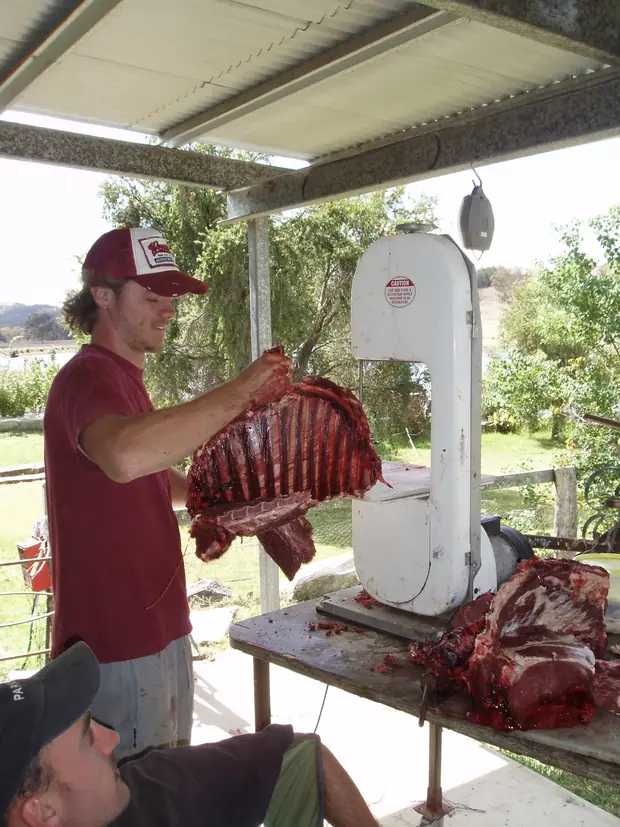
The bones are the last thing to come off the bench and they're worth a pot of their own. Venison stock is dark, rich and almost free of fat, and it's what turns a braise or a pan sauce from good into something people ask about. On this weekend the bandsaw makes short work of the big bones.
Cut them small
Saw the thigh bones, neck and ribs into short lengths, so the marrow and the connective tissue can get out.
Roast them hard
A hot oven until they're deep brown all over. The browning is the flavour. Pale bones make pale stock.
Cover and barely simmer
Cold water, onion, carrot, celery, bay and pepper, no salt. Hold it just below a simmer for six hours or more, skimming the scum. A rolling boil makes it cloudy and greasy.
Strain, chill, reduce
Strain it, chill it, lift off the little fat that sets on top, then reduce it. A good stock sets to a jelly in the fridge: that's the collagen.
The dogs
Every hunting camp has a dog looking hopeful at the bench. Some of what's on it is fine for them and some of it can kill them, or you. The RSPCA's position is that raw meat and bones aren't recommended for dogs at all. If you do give a bone, it must be raw, human-grade and introduced gradually. These four are not negotiable.
No cooked bones
Cooking makes bone brittle enough to splinter. The RSPCA lists cooked bones, with fatty trimmings and small pieces of raw bone, among the things never to feed a dog.
No raw offal
Hydatid cysts in raw liver and lungs infect the dog, and the dog's eggs infect people. Keep working dogs wormed for tapeworm.
Nothing from the wound
Bullet fragments travel well beyond the bloodshot meat you cut out. The trimmings from the wound channel go in the pit, not the dog.
No raw feral pig
Pig dogs catch brucellosis from feral pigs and from raw feral pig meat, and can pass it on (NSW Health).
Lore
The jelly in a properly made stock is gelatine, the same stuff sold as powder in a packet. It comes from the collagen in bones, joints and sinew, the very thing that makes a shank tough before it's braised. A stock that sets in the fridge has done its job.
Kangaroo
Some of what goes home in the esky will be kangaroo. It's a different animal to butcher: almost all the meat is in the huge hind legs, the long muscles either side of the spine and the tail, and the front end is barely worth the effort.
It's also the leanest red meat you'll ever cook. A kangaroo loin fillet carries under 1 g of fat in 100 g (FSANZ food database), less even than venison, so it cooks fast and dries out faster. Oil the meat, not the pan, sear it hard, take it off early and rest it.
Handle roos with the same care as deer. They carry Q fever, so gloves and covered cuts, and the Australian Immunisation Handbook lists people who cull or process kangaroos among those who should be vaccinated. The rules on taking them are their own subject, in The Law in NSW.
The fillet
Kangaroo's version of the backstrap: the long loin either side of the spine, and the best piece on the animal. Sear it hard, a few minutes a side, and rest it as long as it cooked. It's at its best pink.
Rump and topside
The big muscles of the hind leg, separated along their seams just like a deer's haunch. Steaks cooked pink, or sliced thin across the grain for a stir-fry or a marinade.
The tail
Cut between the joints into rounds, browned, then braised for hours like oxtail, until the meat comes away from the bone and the sauce is thick with gelatine.
Mince
Even leaner than venison mince, so it needs fat added for burgers, meatballs or sausages, and cooking right through to 75°C like any mince.
Rare roo, and who shouldn't
Kangaroos carry the toxoplasma parasite, and in 1995 an Australian outbreak of twelve cases was linked to rare kangaroo meat. Surveys find it more often in female roos than males. The official line for a whole cut is the same as venison, 63°C and a rest, and freezing for a week first cuts the risk. Anyone pregnant or with a weakened immune system should eat it well done.
Lore
Australia's first cookbook, The English and Australian Cookery Book, published in 1864 by the Tasmanian Edward Abbott, has a prize recipe for kangaroo ham: a leg rubbed with salt, brown sugar and allspice and pickled for a fortnight. It also offers advice on roasting a wombat.