The Animal
A recording: episode 1 of Listen, the library read aloud
Fallow deer: how to tell one at a glance, the four coats, the five other deer it gets mistaken for, and how it got here.

Know it at a glance
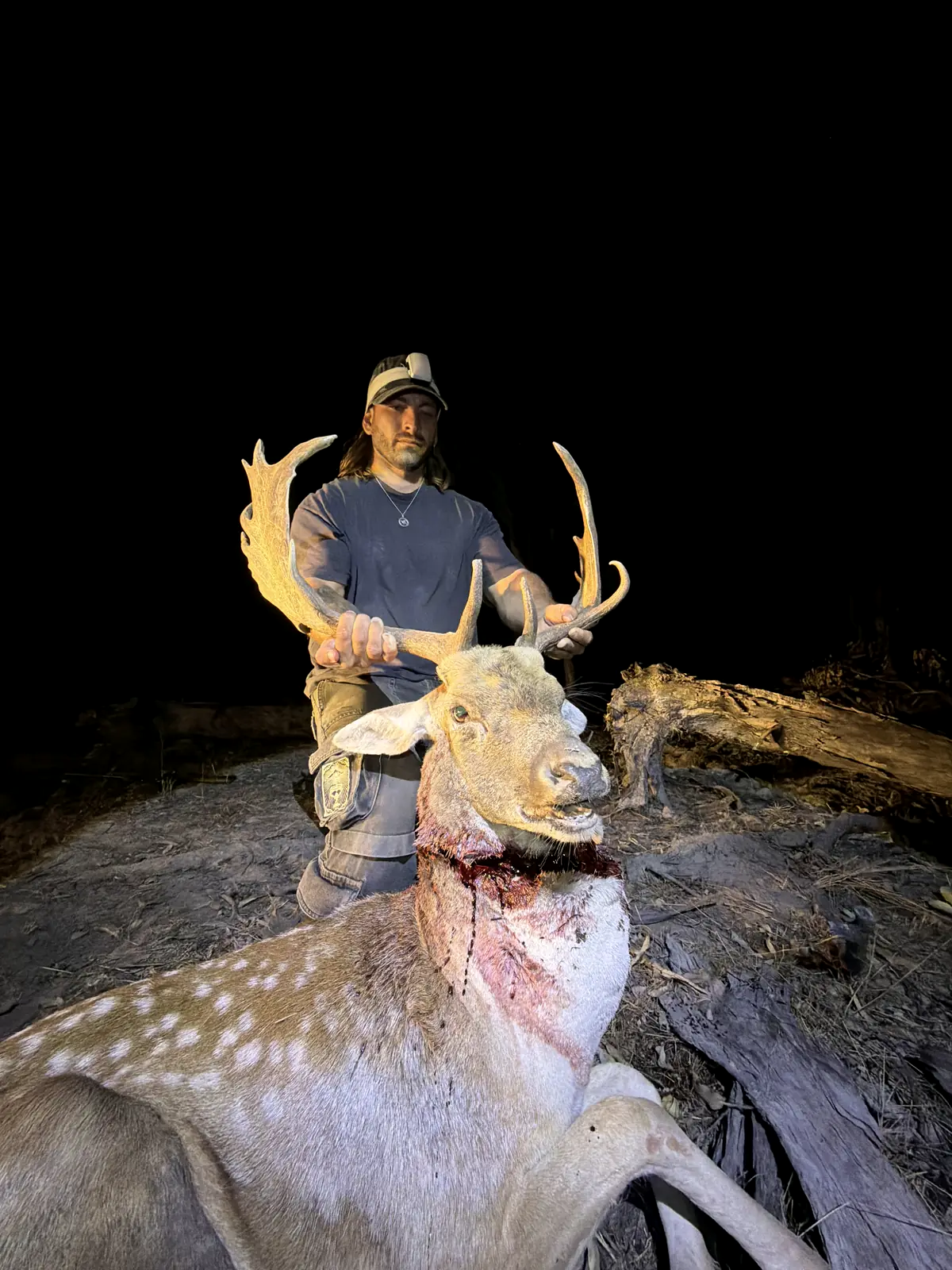
Dama dama. The fastest way to name one is the top of the antler. If it broadens into a flat shovel, it is a fallow. No other wild deer in Australia carries a palm, so on a buck in hard antler the question answers itself.
In poor light the antlers get lost against the scrub, but the back end rarely does. Both sexes carry a white rump edged by a black horseshoe, and a long tail, black on top and white underneath, which a feeding fallow flicks almost constantly. Often that flicking patch of white is the only thing you see. It is enough.
- 1PalmThe flat top of the antler. The fallow signature, and the fastest call you will ever make.
- 2SpotsWhite on chestnut through summer on the common coat. Menil keep theirs all year.
- 3Dorsal stripeA dark line down the spine that runs into the tail. Common coat only.
- 4Rump patchWhite, edged by a black horseshoe, on bucks and does alike.
- 5TailLong, black on top and white below, and flicked almost nonstop while the deer feeds.
- 6BrushThe tuft of hair under a buck's belly. Still there after he casts, and visible even on buck fawns.
- 7ThroatA mature buck's larynx sticks out like an Adam's apple, and his neck swells in the rut.
Buck or doe
Most of the year the antlers settle it, hard or in velvet. In the weeks after a buck casts, from September into November, look under the belly for the brush, and at the throat and neck, which on a mature buck are heavier than any doe's. A doe looks lighter and smoother all over, and stands a touch higher at the hip than at the shoulder.
Lore
Fallow is a colour before it is a deer. The Old English fealu meant a pale reddish or yellowish brown, the colour of withered grass. The farmer's fallow paddock is a different word that merged with it centuries ago, which is why people assume the deer has something to do with resting land. It does not.
Four coats, one animal
No deer varies in colour like a fallow. There are four main coats, and all four can turn up in the same mob, which is why people regularly report "a different kind of deer" that turns out to be a black or a white fallow. On top of that, the common coat changes with the seasons. Tap a coat and a season to see the same buck in each.
Common, in summer
Rusty chestnut to tan, with rows of white spots along the flanks, a dark stripe down the spine into the tail, a pale belly, and the white rump in its black horseshoe. The one everybody pictures.
Common, in winter
The spots fade almost to nothing and the coat goes a dull, two-tone grey-brown, darker on top. Plenty of people take a winter common fallow for another animal altogether. The rump and horseshoe stay, so check the back end.
Menil, in summer
Paler and brighter, with bold white spots. The horseshoe round the rump and the tail markings are caramel brown instead of black, and there is no dark stripe down the back.
Menil, in winter
Menil keep their spots all year. Most deer lose their spots as they grow up, so a spotted deer in winter is either a menil fallow or a chital, and a chital has no palm.
Black, in summer
Melanistic: almost black, or a very dark chocolate. The spots are faint or gone and the rump is dark too. Under a spotlight the body disappears and you get the eyes and not much else.
Black, in winter
Much the same all year round. Black fallow hold nearly the same coat summer and winter, if anything a little duller in the cold months.
White, in summer
White to pale sandy, getting whiter with age. Not an albino: the eyes are dark and the hooves are pigmented. A white buck at night is unsettling the first time you see one.
White, in winter
White all year. White fallow start out a pale sandy colour and whiten with age, so an old white buck is the whitest thing on the hill.
Fallow moult twice a year, into the spotted coat in spring and the dull winter coat in autumn. The spring change gets going around October, so a deer seen on this trip may look scruffy and patchy, halfway between the two. Nothing is wrong with it.
Colour is no guide to age, sex or quality. A black buck and a white buck from the same paddock are the same animal in different paint.
Lore
Two genes explain all four coats. A 2024 study of 998 fallow tied black to one gene and white and menil to variants of another. White is recessive, and in a German sample about one in seven ordinary-coloured deer carried the white variant without showing it. So two chestnut parents can throw a white fawn.
Not every deer is a fallow
Eighteen kinds of deer were let go in Australia through the 1800s and 1900s. Six took: fallow, red, sambar, rusa, chital and hog deer. On this block you will almost certainly be looking at fallow, but red and rusa turn up in pockets of northern NSW, and chital are establishing along the Queensland border. Knowing the other five is how you stay sure of the one in front of you.
Each is drawn below to scale against a 175cm man and a fallow buck. Pick one. Fallow shows you a doe beside the buck.
Fallow
Dama damaMedium-sized, with the most variable coat of any deer: chestnut and spotted, menil, black or white, often all in one mob. Likes open woodland next to grass, and the edges of farmland.
Every state and the ACT, with only small pockets in WA. The most widespread deer in Australia, and the one you will see here.
Red deer
Cervus elaphusA big, upstanding deer, reddish in summer and grey-brown in winter, with a large pale rump patch and a short, stubby tail. Stags roar in the autumn rut instead of croaking.
The main herd is in the Brisbane and Mary river valleys of south-east Queensland, with others in Victoria's Grampians, on private land in NSW and in south-east SA.
Sambar
Rusa unicolorThe biggest deer in Australia. Dark brown all over, coarse-haired, with big rounded ears about half the length of the head. Usually alone or in twos, in tall wet forest, and mostly out at night.
Eastern Victoria and the high country, southern NSW and the ACT, with a few in South Australia.
Rusa
Rusa timorensisBuilt like a lighter sambar, with a coarse coat, reddish-brown in summer and greyer in winter. Stags often grow a thick mane.
The NSW coast, from the Illawarra and Royal National Park south of Sydney up to the north coast, plus Queensland and its northern islands, SA and isolated spots in Victoria.
Chital
Axis axisElegant and reddish, spotted white all year, with a striking white throat patch and a dark stripe down the back. Gives a high-pitched alarm call.
Mostly north Queensland, from the release on Maryvale station near the Burdekin, with herds scattered elsewhere and new ones establishing along the NSW and Queensland border.
Hog deer
Axis porcinusThe smallest, a low, stocky deer, yellowish to red-brown in summer and dark brown in winter, sometimes with pale spots. The tail is white underneath and at the tip.
Mostly the coastal swamps and scrub of Gippsland in Victoria, including its islands. Some reserves there are hunted by ballot.
Buck, doe and fawn
A fallow male is a buck, a female a doe and the young a fawn. Stag, hind and calf belong to red deer, and using them for fallow marks you as new to it.
The old hunting books went further and named a buck by every year of his life. The list is in the Boke of St Albans, printed in 1486, and Turbervile's hunting book repeated it almost word for word in 1576. Stalkers today use the names loosely, going by the head a buck carries rather than his birthday.
Lore
To the medieval huntsman a great buck was not an age but a head: two palmed antlers with four avauncers (forward tines) and twenty-four espelers, the points down the back of the palm. Hunters still call those points spellers.
If you play the field games, these old names are the ranks in your logbook.
| Name | Year of life | What he looks like |
|---|---|---|
| Fawn | First | Spotted, at foot with the doe. A buck fawn already shows his brush. |
| Pricket | Second | His first antlers: plain spikes or knobs. Slim, long in the leg. |
| Sorrel | Third | Brow and trez tines usually show. The palm may start, or may not. |
| Sore | Fourth | Palms appear with the third or fourth head. Still leggy, neck still thin. |
| Buck of the first headlater called a bare buck | Fifth | His first proper palmed head. Filling out through the chest. |
| Buck | Sixth | A mature buck. Later glossaries put great buck here. |
| Great buck | Any age | By the old reckoning a head, not an age: two palmed antlers, four avauncers and twenty-four espelers. |
Antlers are a poor clock. They depend on feed, condition and genes as much as age, they peak in a buck's prime and then "go back" as he gets old. Body shape tells you more. No single feature is reliable on its own, so read them together.
Young
Thin neck, head held high, long legs and a straight back. Every part of him looks separate, like a teenager who has not grown into himself. Pedicles high, palms narrow if he has any.
Prime
The neck is thick and blends into the shoulder, the barrel is deep and the legs look short underneath it. Palms wider and heavier, pedicles lower and thicker.
Old
Sagging brisket and belly, a back that dips in the middle, a heavy head often carried low. The antlers go back: sunken pedicles, odd shapes, shrinking palms.
A doe carries her fawn for about 230 days, roughly seven and a half months. With the rut in April that puts fawns on the ground from late November into January, most of them in December, so in October the does here are heavily pregnant. One fawn is usual and twins are uncommon. Farmed fawns weigh about 3.5 to 4.8kg at birth.
For its first weeks the fawn lies hidden in cover while the doe feeds, and she comes back to suckle it. A fawn on its own is usually not abandoned. Leave it where it is. Does can breed at 16 months. Young bucks can breed as well, but the older bucks do most of it.
After the shot: read the jaw
Teeth confirm what the body suggested. A young deer has a milk tooth, the third premolar in the lower jaw, with three cusps instead of two. Any jaw still carrying it is not adult. In fallow all the permanent teeth are in by about 26 months, and after that it is wear: the more the cusps are ground flat, the older the deer.
How a fallow lives
Undisturbed, fallow feed at dawn and dusk and lie up to chew the cud in between, in cycles of a few hours. When researchers GPS-collared 68 fallow on three NSW grazing properties, the deer moved most around sunrise and sunset at every site. Hunt them hard and they shift to feeding at night and bedding in thick cover through the day. Drag the clock round.
Out on the feed, if they have been pushed
Pressured deer do most of their feeding in the dark and are back in cover by first light. Bright moonlight brings more movement. This is when the spotlight finds them, and when the eyes are often all you see.
The best hour of the day
Deer are still out on the paddock edges, feeding and drifting back toward the timber. Be in position before it gets light, glassing, with the wind in your face.
Back into the timber
As the sun gets up they move into cover. The older animals are first to go. A deer that stops to look back from the treeline is checking on you.
Lying up
Bedded in shade, chewing the cud, getting up to feed for a short while every few hours. Hard to find, and easy to bump. A good time to walk the creeks for sign.
Stirring
Deer start moving toward the feed. Get into position early and let them come out to you instead of walking into them.
The other best hour
Back out on the edges. The older the deer, the later it shows and the earlier it leaves, so the big buck often turns up in the last few minutes of light.
For most of the year bucks and does live apart. The does run in mobs with the year's fawns and the yearlings, often led by an older doe. Young bucks leave at about a year old and join bachelor groups. On open farmland the sexes mix more, and big mobs form on good feed.
The same NSW collars showed how far they range. A buck's median yearly range was 1,848 hectares, nearly three times a doe's 646, and both covered about two and a half kilometres a day. They are faithful to their patch, with the odd excursion of up to ten kilometres and a week away.
Mainly grazers of grass and herbs, with leaves, twigs, shoots, fallen fruit and the odd fungus on the side. They browse more in autumn and winter when the grass goes off. In the 2018 drought in north-west NSW, browse including eucalypt leaves helped fallow hold on at high numbers through the dry.
Median yearly range, 68 collared fallow, three NSW properties, 2020 to 2024.
In autumn the bucks go to pieces. The rut peaks in early to mid April, and the frenzy lasts two or three weeks. A mature buck takes up a stand, paws out scrapes, thrashes saplings with his antlers and groans. Where bucks crowd together the stands bunch into a lek, and the does come to them. Elsewhere bucks just go looking for does.
The groan is the sound of the season, a deep, belching croak repeated over and over. Australian hunters describe it as a pig grunting crossed with a chainsaw starting. A rutting buck barely eats and runs himself into the ground: one long Irish study found mature bucks spent up to a third of the rut groaning, and in another no buck under three groaned at all.
Lore
A buck groans through his nose and mouth at once, and he can pull his larynx down his throat as he calls, which drops the pitch and makes him sound bigger than he is. Red deer stags do the same trick when they roar.
Nose first
Smell is probably their main sense, good for human scent over hundreds of metres. Their ears turn independently and pick out a single odd sound. Their eyes catch the smallest movement but struggle with a still shape. Wind decides everything else.
No red
Fallow eyes have a blue cone and a green cone and no red one, so reds and oranges fall into the browns and greens. Blaze orange looks dull to them. Movement and outline give you away, not colour.
The bounce
Spooked, a fallow often goes off in stiff bounds with all four feet leaving the ground at once, tail up. It looks absurd, and it tells every other deer in sight that something is wrong.
A short life
Bucks generally live 8 to 10 years and can reach 16. The rut wears them out early, and most wild fallow die before they are 12.
Where they came from
They are not, as most people assume, an English animal. The English just had the most to do with getting them here. Fallow have been carried around the world by people for thousands of years, and they now live on every continent except Antarctica. Drag through 130,000 years.
All over Europe
In the last warm spell between ice ages, fallow lived across Europe as far north as Britain.
Squeezed south
The last glaciation pushed them back into refuges in the south, and DNA points to two: Anatolia, in modern Turkey, and the Balkans. They never walked north again.
Carried to the islands
Early farmers took fallow by boat to Aegean islands, including Rhodes, Chios, Lesvos, Lemnos and Crete. The Rhodes herd is still there.
Rome
Fishbourne Roman Palace in southern England, built soon after the invasion of 43 CE, holds the earliest fallow found outside the Mediterranean. By the 300s they were established more widely in Britain. When Rome left, they died out.
Britain again
They came back before the Norman Conquest, from stock related to Anatolian deer: bones from Goltho, in Lincolnshire, show a herd there by about the year 1000. Fallow became the deer of the park, a status symbol behind a wall, and escapes from failed parks founded Britain's wild herds.
Tasmania
The Australian Government's account gives a release at Campbell Town, in the Midlands, in 1834. Other accounts of the first arrivals run from 1829 to 1836.
The mainland
The Acclimatisation Society of Victoria brought fallow over from Tasmania in 1863, and fallow were let go at Albury, on the NSW side of the Murray, in 1884. Some new herds were protected from hunting for decades to get them established.
The most widespread deer in the country
Fallow live in every state and the ACT. Deer farming boomed in the 1970s and 80s and crashed in the 90s, and a lot of farmed deer were let go or got out. In NSW the fallow range grew by 60% between 2016 and 2020, and Australia now holds an estimated one to two million wild deer of all six species.
Lore
For centuries the story was that the Normans brought fallow to England from Sicily after 1066. A 2024 study of ancient and modern DNA, with bones dated from a Lincolnshire site, says otherwise: a population was already established by about the year 1000, and its nearest relatives were the deer of Anatolia.
Lore
The first deer in Australia were not fallow but chital, brought out around 1800 by Dr John Harris of the NSW Corps. Tasmania's fallow then sat almost still for well over a century before spotlight counts rose about 40-fold between 1985 and 2019.
Pest or game
It depends where you stand. In NSW, feral deer are a priority pest species in all 11 Local Land Services regions, and since September 2019 you need no game licence to hunt them on private land with the owner's permission. Public land needs an R-Licence. Victoria and Tasmania still manage fallow as game, with Tasmania treating them as partly protected wildlife. The Law in NSW volume has the detail.
The numbers
Size
A medium deer. A mature buck is about 90kg, and you will absolutely know about it when you drag one to the ute. A doe averages less than half that.
Meat
Count on about 35 to 40% of live weight as meat: roughly 12 to 20kg from a doe and 21 to 40kg from a buck, less after a bad shot or a hard rut.
That 39%
It gets quoted as "39% of Australia's deer". It was 39% of the known wild herds in the last national herd survey, around 2000, when the whole country held about 200,000 deer. There are far more now.