Shot Placement
A recording: episode 2 of Listen, the library read aloud
Where the bullet goes, and why we hold higher than the old books told you.

Where the vitals are
The heart and lungs sit in the front third of the deer, inside the ribs, just behind the front leg. Hunters call them the vitals. Put a bullet through them and blood pressure falls away fast, which is the whole job. Miss them by a hand and you are into the shoulder bones, the liver or the gut, and that is the start of a long night.
The figure below is drawn to standard deer anatomy over the outline of the Silent Grove buck from Volume I. Nobody has published an organ-by-organ map of a fallow, so treat the shapes as the shape of a deer rather than a survey of this one. The relationships are what matter, and they don't change from deer to deer.
Tap a part of the drawing to name it
Lungs
They fill the chest from just under the spine down to the heart, and back to the diaphragm. A bullet through both collapses them and floods the chest with blood. Most well-shot deer are lung-shot deer.
Heart
Tucked low between the front legs, right behind the elbow, and partly hidden from the side by the shoulder blade and upper leg bone. Its top, where the big vessels leave it, sits only a little below the middle of the chest.
Diaphragm
The sheet of muscle between the chest and the gut. It slants: low and forward under the heart, high and back near the spine. A shot that lands behind it is no longer a chest shot.
Liver
Right behind the diaphragm, and mostly on the deer's right side. A liver hit kills, but it can take hours. It is where a low heart shot ends up when it drifts a hand too far back.
Paunch
The rumen, the first and biggest of a deer's four stomachs, fills most of the left side behind the liver. A hit here kills very slowly, spills gut into the meat and leaves a poor trail to follow.
Shoulder blade
It slopes from the top of the back down to the point of the shoulder, over the front of the lungs. Bone and thick muscle: a light bullet can break up on it before it reaches anything that matters.
Upper leg bone
It runs back and down from the point of the shoulder to the elbow. With the shoulder blade, it covers much of the heart from the side, which is why the aim goes just behind it.
Spine
The vertebrae run well below the line of the back, with tall bony spines rising off them over the shoulders. In the neck the spine drops low towards the chest. A hit here drops the animal, but it is not a point of aim.
Why higher
This is where the line on the shelf comes from. A lot of hunting education still teaches you to aim a third of the way up from the bottom of the chest, tight behind the front leg. That is the heart shot, and the heart is a fine thing to hit. We hold higher, in the middle of the chest. So does the current Australian standard.
The national standard for ground shooting deer puts the chest shot at the centre of a line around the narrowest part of the chest, just behind the front legs, and a touch behind the shoulder blade, because the shoulder blade and upper leg partly shield the heart from the side. Scotland's best-practice guide says the same in fewer words: half way up the body, just behind the line of the foreleg.
The reasoning is about bone, and about how shots go wrong. From the side, the shoulder blade and upper leg partly cover the heart, so a heart-height shot tight behind the leg can meet bone first. Half way up and just behind the shoulder, the bullet goes through ribs and straight into both lungs, the biggest organ in the animal, with the top of the heart and the big vessels just below. Land a little high and you are still in lung. A little low is heart. A little back is still lung.
The shots that go badly wrong from the old aim are the low ones: under the chest, through the brisket or into a leg. The UK's best-practice follow-up guide lists that low heart and brisket hit among the ones that can run more than a hundred metres on a fading trail.
Even American hunter education, which still teaches the lower aim, says the double-lung shot is preferred over the heart, because the target is bigger and it doesn't mean breaking the shoulder. None of this makes the heart a bad target. Hit it and the animal dies. It is just the wrong thing to centre your aim on.
Be clear about what this is. Nobody has run a field trial of a third up against half way up. The shift is about a hand's width, and both points sit inside the vital zone. Go higher than the middle and you swap one problem for another: a deer hit high in the lungs can run further, and from the middle up to the spine is only about a hand. The middle is the sensible centre, not a magic spot.
Two kinds of higher
This is about where on the animal the crosshair sits, not holding over for distance. Holdover is in The Rifle.
And it is not the high shoulder shot, which aims at bone on purpose. That is a different decision with a different cost, and Chapter III deals with it.
How big it is
On a grown buck, the zone you can count on is a circle about 20 cm across. Nobody has measured a fallow for it, so that figure comes from the shape of the chest in Fig. 1, and it matches what American hunter education gives the white-tailed deer, an animal of much the same size: a double-lung target about the size of a volleyball. It is smaller on a doe or a yearling. It does not get any bigger with distance.
Everything later in this book about range, rests and wind comes back to that circle. If you can't keep every shot inside it from the position you are actually in, the shot is too far.
Lore
Deer have no gall bladder. Cattle and sheep do. You will see it for yourself at the gralloch, and someone at the fire will still argue the point.
The angle decides
A deer is not a target board. The vitals are a lump inside a barrel, and a bullet is a straight line. Whether the line finds them depends on which way the animal is standing, and the spot on the hide where you aim moves as it turns.
Turn the deer below. The top view shows the line from your rifle to the middle of the vitals, and what it passes through on the way. The other panel shows the same deer as you would see it, with the spot where that line goes in. Broadside is when the animal stands side-on to you. Quartering away and quartering on are the angles in between.





Broadside
Take it- In
- just behind the near shoulder
- Through
- both lungs and the top of the heart
- Out
- behind the far shoulder
Fig. 4The same lungs and heart from every angle. Drag the slider or pick an angle.
Up and down the hill
On flat ground the line through a broadside deer runs level. On a hill it doesn't. Shoot down at an animal below you and the bullet goes in high on the near side and comes out low on the far side. Shoot up and it is the other way round. Put the crosshair on the usual spot and the line can run under the lungs and out through the brisket.
So think about where the bullet comes out, not just where it goes in. Australia's national deer standard says the same: shooting from above or below changes the bullet's path through the body, and the aim on the outside has to move to keep that path through the heart and lungs.
Steep angles do one more thing, to the bullet's drop rather than its path through the animal. That one matters most on the tops, so it is in Chapter V.
Fig. 5A slice through the chest, seen along the hill. Drawn on a chest about 30 cm wide.
Lore
American hunters call a shot up the backside of a going-away animal the Texas heart shot. It is meant as a joke. Nobody who has followed one up thinks it is funny.
What the bullet does
A hunting bullet is built to open up. It hits, the nose peels back and it mushrooms to about double its width, and that is the point: a wider front cuts a wider channel. It has to hold together long enough to get through hide and ribs, then open far enough to do real damage once it is inside. A varmint bullet built to burst on a fox does the first half badly, which is why it has no place in a deer.
CT scans of shot deer and boar show what happens inside. The wound channel through the lung was about 1 cm wide at the entry and about 7 cm across ten centimetres in. Around it the tissue is stretched and torn, and modelling suggests the zone that actually bleeds in a living, inflated lung is about twice what you can see afterwards. Air gets into the chest and the lungs collapse.
Death in a chest-shot animal comes from blood loss. The heart can't hold pressure, the brain runs short of oxygen and the animal goes down. That is fast but not instant: the NSW deer standard puts it at seconds to over a minute, and a lung-shot deer often runs before it drops. Only a brain shot is instant, and the brain is too small a target for hunting deer. A slightly slower death in exchange for a far bigger target: that trade is why the chest is the standard everywhere.
Through the hide
The bullet arrives at several hundred metres a second. For the first few centimetres the hole is about as wide as the bullet itself.
It mushrooms
The nose peels back and the bullet opens to about double its width. The channel widens as it does, and the tissue around it is thrown outwards and stretched.
The channel widens
About 7 cm across by ten centimetres in, in the CT studies, with torn, bleeding lung around it. Air rushes into the chest and both lungs collapse.
Out the far side
An exit hole lets blood out and leaves a trail to follow. By then the damage that kills is done.
Where it hits changes how far it goes
German records of roe deer, a smaller deer than fallow, show the pattern. Most well-shot animals still ran a little. The difference is in the long tail.
Fig. 7How far shot roe deer ran before they dropped. Chest here includes head shots. Elsewhere means a leg, the gut, the haunch or the neck. Martin and others, 2017.
The shots that go wrong
Liver
Fatal, slowly. The liver bleeds hard but an animal can live for hours. It usually walks off hunched and beds down nearby with its head up. Leave it longer than you want to: the common advice is two to four hours before following up, some say longer, unless you can see it and finish it.
Gut
Fatal, very slowly, and it spoils meat. Thin, watery blood with green or brown matter at the spot it was standing. The deer hunches, walks off stiffly and lies up. Most guides say wait four to eight hours or overnight. UK best practice is to have a tracking dog on hand for exactly this.
Leg
Usually not fatal, which is the problem. A deer with a broken leg can run almost normally, and dies later of the injury, or not at all. Short hair and bone splinters where it stood, and a trail that thins out fast. This one gets followed up straight away, ideally with a dog.
Brisket
A shot low on the heart can clip the bottom of the chest and miss everything that matters. Lots of hair, bright blood at first, and a deer that can run well over a hundred metres. The low miss is the one the middle-of-the-chest aim protects you from.
Shoulder and high shoulder
A different decision, not a better aim. A bullet through the shoulder blade on its way into the lungs often drops an animal on the spot, which is the appeal in steep country where a deer that runs can run off a bluff. The high shoulder shot goes further: it is aimed high on the shoulder, just under the spine, to break bone and drop the animal where it stands. Its fans say a low miss is still lung.
The costs are real. Both shoulders are bloodshot, the bullet has to be built for bone, and a hit a little too high clips the bony spines on top of the back and can knock a deer flat for a moment before it gets up and goes. The national standard deliberately aims just behind the shoulder blade, and so do we.
Spine
Drops an animal like a switch, but a spine hit can leave it down and still conscious, and a near miss over the top of the spine can knock it flat for a moment before it gets up and goes. Not a point of aim. If a deer drops on the spot, be ready to shoot again.
Neck
Discouraged by every standard we could find. Most of the neck is muscle, windpipe and food pipe around a spine that is smaller and lower than it looks. Not every neck shot breaks the spine, and a deer can run off with a wound it won't survive and you won't find.
Head
Instant if it lands, which is why it is the standard for roos and for finishing a downed animal at close range. On a deer at hunting range the brain is a small target on a head that moves, and a near miss can take the jaw off. NSW hunter education does not recommend it for hunting.
Four myths
Kangaroos
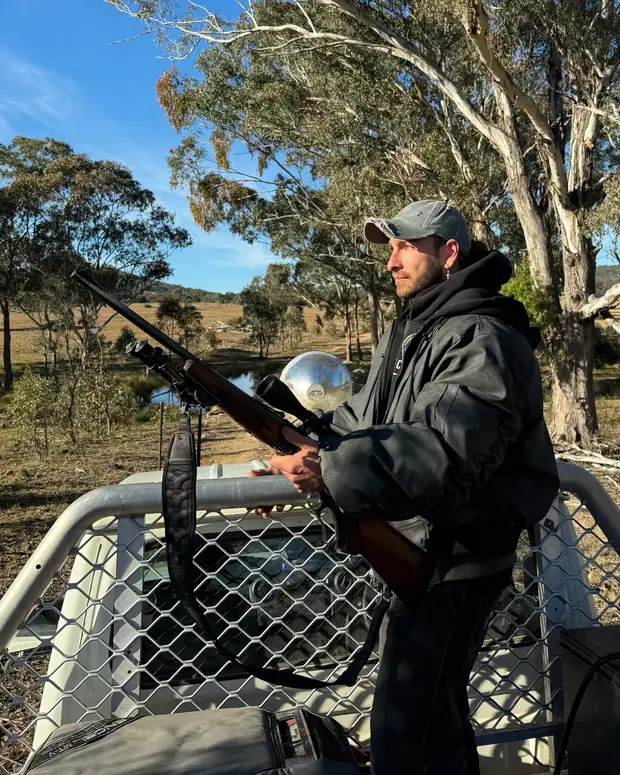
Roos are shot differently, and not as a matter of taste. Silent Grove culls them under a licence, and in NSW non-commercial roo shooting is held to the National Code of Practice for the Humane Shooting of Kangaroos and Wallabies for Non-Commercial Purposes. The edition in force is still the first, from November 2008. It is short, and the shot placement part is shorter: with a rifle, you shoot for the brain.
The code's goal is an instant loss of consciousness and a death the animal never wakes from. A brain shot does that, so a rifle may be aimed at the head and nowhere else. The heart shot is allowed only to put down an injured roo when a head shot is impractical or unsafe, and never from behind, where the spine is in the way and can turn the bullet.
The target is small. The code's diagram puts it in a little oval between the eye and the base of the ear, only a few centimetres across, on a head that moves. It is a precise shot from a good rest at 100 m. At 200 m, the most the code allows, it is a shot plenty of people should not take.

What the code asks
- Standing and still
- The roo must be standing, clearly visible and stationary for a rifle shot. Injured animals are the only exception.
- Inside range
- For a .222, .223, .22-250 or larger with a soft or hollow point, or a .204 Ruger, the maximum is 200 m. A ceiling, not a target.
- A scope, checked
- The rifle needs a telescopic sight, checked on a target before each day or night of shooting.
- The right rifle
- No self-loading rifles. No subsonic ammunition.
- Never from a moving vehicle
- The ute stops before anyone shoots.
- One at a time
- Make sure each roo is dead before you aim at another. If one is wounded, everything stops until it is found and finished.
- Females and young
- Avoid shooting a female with an obvious joey. If a female is shot, her pouch is checked straight away, and any young are dealt with as the code sets out. Matt or Leif will handle that part. It is not pleasant, and it is not optional.
The licence, too
In NSW the code is a condition of the landholder's licence to harm kangaroos: every roo, and every joey, has to be dealt with as the code says, and breaking a condition is an offence. Anyone shooting under the licence needs a current firearms licence and a Category A or B firearm, and the licence holder keeps a record of who they are.
Distance and rest
One MOA covers 2.9 cm at 100 m and 5.8 cm at 200 m. A rifle and shooter that group two MOA off a good rest keep their shots inside about 6 cm at 100 m and 12 cm at 200 m. On a target a few centimetres across, that is the whole argument for getting closer and getting steady.
Lore
The first national code for shooting kangaroos was written in 1985 and revised in 1990. The 2008 rewrite split it in two: one code for the commercial harvest, and the one you are reading about for everyone else.
On the tops
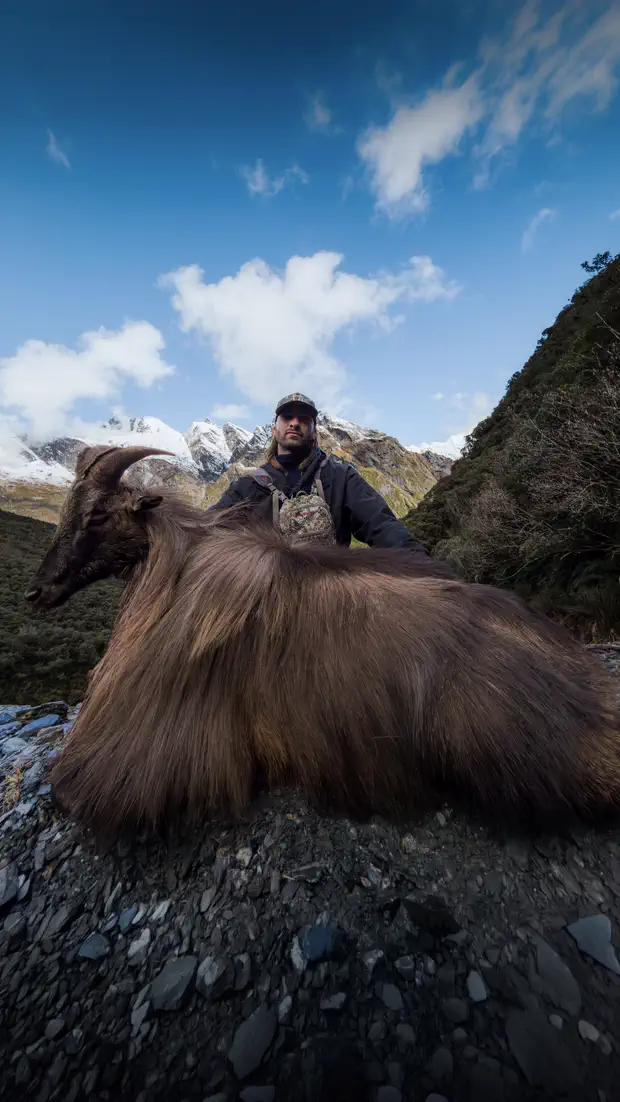
Same rules, harder country. Tahr and chamois carry their heart and lungs where a deer does, low in the chest and just behind the front leg. What changes on the tops is how the animal looks, the angle you shoot from, and what happens after the shot.
The mane
A bull tahr in winter wears a mane of long hair over his neck, shoulders and chest, hanging down past his elbows. It makes the front end look far deeper than it is and hides the line of the shoulder completely. Aim at the middle of all that hair and you can shoot clean over his back.
Ignore the hair. Find the front leg, follow its back edge up into the body, and hold in the middle of the animal underneath. Drag the line across the drawing to see where he really is.
 Under the hairAs you see him
Steep shots drop less
Chapter II covered the line through the animal on a slope. The other thing a steep angle changes is the bullet's drop. Gravity only pulls across the horizontal part of the distance, so a bullet fired steeply up or down drops less than the rangefinder's straight-line reading suggests, and a normal hold lands high. Uphill or downhill, it is high both ways.
The fix is the rifleman's rule: hold for the horizontal distance, which is the straight-line distance times the cosine of the angle. Worked through for a .270 with a 130 grain bullet zeroed at 200 m, a 400 m shot at 30 degrees lands about 16 cm high with a level hold. At 45 degrees it is about 36 cm high, more than the whole vital zone. Even the rule leaves you a few centimetres low on a shot that steep and that long, so it is a field fix, not a ballistic solution. Most rangefinders have an angle mode that does the sum. Use it, and on steep long shots, get closer.
Where it ends up
On the tops, the shot is often possible when the retrieval is not. A hit animal usually heads downhill, and a tahr shot on the lip of a bluff can finish somewhere nobody can reach, or bring someone down a chute after it. Before you shoot, look past the animal. Where will it go if it runs, and where will it land if it falls? If the answer is a waterfall, a slot gorge or a snow chute, the answer to the shot is no.
Chamois
Chamois are small. Grown bucks weigh 30 to 60 kg in Europe, and New Zealand animals run about a fifth lighter. Same anatomy, a smaller chest and a smaller circle to hit, and they live in steep, broken country and rarely stand still for long. Everything in Chapter VI about waiting for a standing, side-on animal goes double for chamois.
More in Tahr, Chamois and Alpine Craft.
Lore
Tahr were let go near Aoraki/Mount Cook in 1904. Chamois followed in 1907: eight animals, a gift from Emperor Franz Joseph of Austria, part of an exchange that sent New Zealand birds the other way, kea and kiwi among them.
When not to shoot
Most of good shooting is not shooting. The animal you pass on is still there tomorrow. The one you wound is not, and nobody gets to take that shot back. Every shot clears the same short list, and the list is the same for your first deer as for your fiftieth. One no is enough.
The checks
- Standing still
- A walking deer moves while the bullet is in the air. Wait for it to stop.
- Nothing in the way
- Twigs, grass and fence wire turn bullets and break them up. Never shoot through brush. Move, or wait.
- A backstop
- Earth behind the animal, never sky. Never shoot over a crest you can't see past. Under a spotlight, the beam shows you the animal, not what is behind it.
- Inside your range
- Your range is the distance at which you put your first shot inside a 20 cm circle, from the position you are in, every time. Not the rifle's range.
- Nothing behind it
- A bullet that passes through one animal can hit the next. Check behind and beside it.
- Sure what it is
- The species, the sex, and that it is an animal at all. Never shoot at a pair of eyes, a shape or a sound.
- Enough light
- To see the whole animal and what is behind it, and enough left over to follow up.
- A solid rest
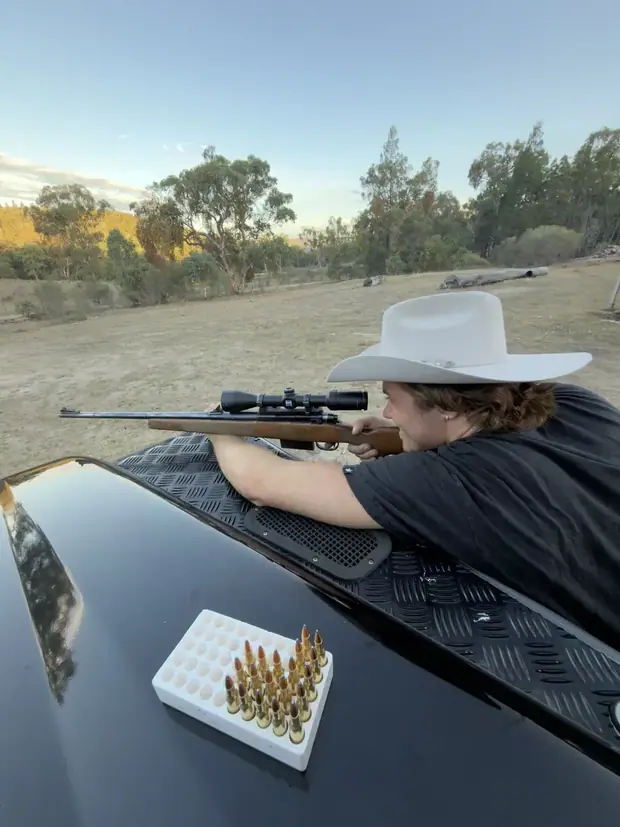
- A bipod, sticks, a pack, the bonnet. Pad the fore-end, and never rest the barrel itself on anything hard.
- The right angle
- Broadside or quartering away. Chapter II.
- You can get to it
- Where it lands if it falls, and where it goes if it runs. Chapter V.
What the numbers say
A UK study logged 2,281 first shots by 102 deer stalkers. The rest you shoot from, and the distance, both changed how often the first shot hit.
Fig. 10First-shot hit rates by rest and range. Aebischer and others, 2014.
Lore
In the same UK study, stalkers who practised at least once a month hit with 95% of their first shots. Those who practised less hit with 79%. Practice is the cheapest accuracy there is.
After the shot
The shot isn't the end of the job. What you do in the next minute decides whether a hit animal is found quickly, found late, or not found at all. Assume every animal you shoot at was hit, even if it runs off looking fine, and follow up every shot.
- The shot
Watch
Stay in the scope through the shot and watch the strike and the reaction. The impression lasts a second, and it is usually right.
- At once
Reload
Work the bolt without taking your eye off the animal. Be ready to shoot again if it stands or tries to go.
- Before you move
Mark
Where it stood, and the last place you saw it: a tree, a rock, a tussock. Mark where you shot from too. Everything looks different once you walk.
- Minutes, or longer
Wait
Down and still in sight: a few minutes, watching. Out of sight, or you're not sure of the hit: at least half an hour before you go to where it stood. A liver or gut hit needs hours, or a dog.
- Rifle ready
Go in
From behind and from the spine side, away from the legs. No breathing, and no blink when you touch the eye with a stick, means dead. Any doubt at all, shoot it again.
What the reaction tells you
| Likely hit | What you see | What to do |
|---|---|---|
| Heart and lungs | Kicks out behind, sprints head low, down inside about 50 m | Wait a few minutes, then go to it |
| High in the lungs | Same, but runs further, up to 150 m | Wait, then follow the blood |
| Low heart or brisket | Front legs leave the ground, runs over 100 m | Wait, follow carefully |
| Spine or top of the neck, clipped | Drops at once, then the head comes back up | Shoot again, now |
| Liver or gut | A dull thud, hunches, walks off stiffly, beds with head up | Leave it for hours, or get a dog |
| Probably a miss | Stands and stares, or runs and stops alert | Search properly anyway |
Fig. 11After the UK Deer Initiative's follow-up guide. Reactions vary, so treat them as a guide.
Lore
Green stuff at the spot where it stood is not always a gut shot. A clean heart and lung shot can cut the food pipe on its way through. Look at the blood and the hair before you decide.
Reading a trail is its own book: Tracking. When you're ready, try the field game.