Optics
A recording: chapter 5 of episode 4, Zeroing and your rifle
Binoculars, scopes and rangefinders. What the numbers mean, and how to use them to see the animal before it sees you.

Binoculars
Most hunting is looking. Hours of it, for every few seconds of shooting, and a decent pair of binoculars is the tool you will use most. The two numbers on them tell you nearly everything. In 8x42, the 8 is the magnification and the 42 is the width of each front lens, the objective, in millimetres.
Eight times means a deer at 400 m looks the way it would at 50 m with your bare eyes. Ten times brings it to 40 m. That sounds like an easy win for the 10x, but magnification comes with a bill: a narrower view, a dimmer picture at last light, and every shake of your hands magnified too.
The bigger the objective, the more light comes in and the heavier the glass. A 42 mm objective is the usual hunting compromise. Most hunters carry something close to 8x42 or 10x42.
Objective lenses
The front lenses, 42 mm across on an 8x42. They gather the light. Keep the caps on until you need them, and never wipe grit across them.
Prisms
Inside each barrel a set of prisms turns the upside-down image the right way up and folds the light path to keep the binoculars short. Straight barrels like these mean roof prisms. The older zigzag shape with offset barrels is a Porro prism design.
Hinge
Fold the barrels until you see one round picture, not two overlapping circles. Everyone's eyes are a different distance apart, typically somewhere in the 55 to 73 mm range a pair like this adjusts across.
Centre focus wheel
Focuses both sides together. You will turn it constantly, from a deer at 60 m to a face at 600 m, so learn which way is closer without looking.
Dioptre
A ring on one eyepiece, usually the right, that corrects for the difference between your two eyes. Set it once and leave it. The steps are in the next section.
Eyecups
Twist them up if you have bare eyes, down if you wear glasses, so your eye sits at the right distance from the lens and you see the full field without dark rings.
Strap lugs
On a long walk binoculars swinging from your neck are a nuisance. A chest harness holds them still, keeps them out of the rain and puts them in your hands in a second.
Hold binoculars at arm's length, point them at the sky, and you will see a small bright disc floating in each eyepiece. That is the exit pupil, and its width is the objective divided by the magnification: 42 ÷ 8 = 5.25 mm, 42 ÷ 10 = 4.2 mm.
It matters because your own pupil has to take that light in. In bright sun your pupil is small and any binocular is bright enough. At first and last light your pupil opens wide, and if the exit pupil is smaller than your pupil, the picture is dimmer than it could be. That is the hour deer move.
Your pupil also opens less as you get older. One study of dark-adapted eyes found an average of about 7.3 mm at 20 and 5.8 mm at 50. Past that size, extra exit pupil is light you cannot use.
Lore
The prism binocular is older than the motor car. The Italian optician Ignazio Porro patented his prism system for turning the image upright in 1854, but the glass of the day was not good enough to make it work well.
Forty years later, with better glass from Otto Schott and the design work of Ernst Abbe, the Carl Zeiss company began selling modern Porro prism binoculars in 1894. Roof-prism binoculars were long thought slightly less sharp, until phase-correction coatings arrived in 1988.
An 8x42 shows a wider slice of country and a bigger exit pupil, and it is easier to hold still. A popular 8x42 shows 131 m of width at 1,000 m. The 10x42 version of the same model shows 110 m. For fallow in timber at dusk, 8x is the better tool.
A 10x pulls more detail out of a distant face, which is why many alpine hunters carry one, but it pays off only when it is braced: elbows on knees, the glass on a pack, or best of all a tripod.
Some makers print a twilight factor: the square root of magnification times objective. An 8x42 scores 18.3, a 10x42 20.5 and an 8x56 21.2. It rewards magnification, so it says more about seeing detail in dull light than about seeing anything at all in near darkness. In real gloom, exit pupil wins.
Fold the hinge
Look at something distant and fold the barrels until you see a single round circle.
Left eye, centre wheel
Close your right eye, or cover the right objective, and focus the left side sharp with the centre wheel.
Right eye, dioptre
Now close your left eye and bring the right side sharp with the dioptre ring alone. Don't touch the centre wheel.
Both open
Open both eyes and check it is crisp. Note the dioptre setting, and from now on focus with the centre wheel only.
The riflescope
A riflescope is a small telescope with a crosshair in it, built to take recoil. The same two numbers describe it: a 3-9x40 zooms from 3x to 9x and has a 40 mm objective, so its exit pupil is a generous 13.3 mm at 3x and 4.4 mm at 9x. The crosshair is properly called the reticle.
Magnification is the trap. A shot on a fallow at 100 m in timber needs 3x or 4x: a wide picture that finds the deer fast. Cranked to 9x, the same scope shows you a patch of brown hair, a shaky crosshair and no idea which way the deer is facing. Keep the power low until a long, steady shot asks for more. At night, keep it low.
Objective
The front lens and the bell around it. Bigger gathers more light but sits the scope higher, adds weight and needs taller rings. 40 to 50 mm is normal for hunting.
Main tube
Usually 1 inch (25.4 mm) or 30 mm across. Inside it, the erector lenses move to zoom and to shift the crosshair when you turn the turrets. The rings clamp here.
Elevation turret
On top. Each click moves where the bullet lands up or down by a set angle, often a quarter of a minute of angle or a tenth of a milliradian. Capped turrets are set at the zero and left alone. Exposed ones are made to be dialled in the field.
Windage turret
On the right-hand side, so out of sight on the far side of this drawing. It moves the shot left and right. Set at zero and leave it: in the field most hunters hold off for wind rather than dial.
Side focus
Sets the parallax. Turn it until the animal is sharp and the crosshair stays put on it when you move your head slightly. Many hunting scopes have no knob and are fixed for one distance, often 100 yards.
Power ring
Zooms the magnification. Leave it low when you are walking, so the first view you get of an animal is a wide one. Turn up only for a steady, distant shot.
Eyepiece
Your eye goes 8 to 10 cm behind it: 84 mm on a Vortex Diamondback 3-9x40. The ring at the very end focuses the reticle for your eye. Set it once against a plain sky, so the crosshair is sharp the moment you look.
Inside a zoom scope the reticle can sit in one of two places. In front of the zoom lenses, in the first focal plane, it is magnified along with the animal: it grows as you zoom in and shrinks as you zoom out, so every mark on it always covers the same slice of the target. Behind them, in the second focal plane, it stays the same size to your eye at every power, so its marks only mean what the manual says at one magnification, usually the top one.
Neither is better. A second focal plane reticle stays bold at 3x in the bush. A first focal plane reticle can be measured at any power. Zoom the scope below and watch the difference.
Which do you have?
Zoom from low to high power looking at something with fine detail. If the crosshair seems to thicken and its marks spread apart, it is first focal plane. If it stays exactly the same while the world grows behind it, second. The Vortex Diamondback 3-9x40 is a second focal plane scope, and its Tactical 4-16x44 sibling is first.
If the animal's image is not focused in exactly the same plane as the reticle, the crosshair appears to slide across the animal as you move your head. That is parallax. Test it: rest the rifle so it cannot move, look through the scope, and shift your head slightly. If the crosshair wanders on the target, there is parallax at that distance.
Many hunting scopes are set at the factory to be parallax-free at one distance, often 100 yards. Scopes with a side focus or an adjustable objective let you set it for each shot. At normal hunting distances the error is small, as long as you keep your eye centred: a full, round picture with no dark crescent at the edge.
Eye relief and scope bite
Eye relief is the distance your eye sits behind the scope to see the whole picture: about 8 to 10 cm on most hunting scopes, 84 mm on the Diamondback 3-9x40 and 97 mm on its 4-16x44 sibling. Mount the scope so that is where your eye naturally lands with your cheek on the stock.
Creep closer, which happens shooting prone and uphill, and the recoil can drive the eyepiece into your eyebrow. The cut it leaves is called scope bite. See The Rifle.
Lore
Your binoculars want your eye 15 to 17 mm from the eyepiece: that is the published eye relief of a popular 8x42 and 10x42. The same maker's hunting riflescopes want it 84 to 97 mm away, five or six times further back. The glass is not the reason. A rifle kicks, and binoculars do not.
Clicks and marks
Turrets and reticles both measure angles, in one of two units. A minute of angle (MOA) is a sixtieth of a degree, 2.91 cm at 100 m. A milliradian (MIL or MRAD) is a thousandth of the distance, 10 cm at 100 m. Neither is better. What matters is that your turrets and your reticle speak the same one, so a miss you read in the reticle can be dialled straight onto the turret.
Most hunting scopes click in quarter MOA, which moves the shot 7.3 mm at 100 m and 2.2 cm at 300 m. MIL scopes click in tenths: exactly 1 cm at 100 m and 3 cm at 300 m. The Vortex Diamondback 3-9x40 moves 15 MOA for each full turn of its turret, 60 clicks. The Rifle volume has a sight-in simulator if you want to feel the difference.
How many clicks for your rifle?
The Dope app is an offline ballistic calculator. Give it your rifle, your load and your scope's clicks, and it tells you what to dial or hold at each distance, with no reception needed.
open the Dope appLore
A true milliradian splits a circle into about 6,283 parts, and that is what scope makers use. Armies round it off for compasses and artillery: NATO uses 6,400 mils to the circle, the old Warsaw Pact used 6,000, and Sweden used 6,300 until 2007.
The unit itself goes back to the mid-1800s and a Swiss engineer, Charles-Marc Dapples, who taught at the University of Lausanne.
Duplex
Thick posts from the edges that narrow to a fine crosshair in the middle. The posts lead your eye to the centre fast in poor light and the fine centre covers little of the animal. No holdover marks, so it suits a point-blank zero and shots inside it.
BDC
Extra marks down the vertical wire for set distances. The Diamondback 3-9x40's Dead-Hold BDC is one. They only land true with the load they were worked out for, and in a second focal plane scope only at the magnification the maker states, usually the top power. Shoot them at known distances before you trust them.
Hash marks and trees
Evenly spaced marks in MIL or MOA, sometimes a whole grid below the centre. You can hold for drop and wind, measure a miss, and estimate distance. Best in first focal plane, where the marks mean the same at every power.
Illuminated centre
A small lit dot or cross in the middle, for when a black crosshair disappears against a dark animal at dusk. Turn it down to the dimmest setting you can see. Too bright, and it flares and hides the animal.
- Hold
- Leave the turret at zero and aim higher, or into the wind, using a mark on the reticle. Fast, and the turret never goes astray. You need to know what each mark is worth at the power you are on.
- Dial
- Turn the turret for the distance and put the crosshair where you want the bullet. Better for slow, long shots. The classic mistake is forgetting to wind it back to zero for the next, close one.
If you know an object's size, the marks tell you its distance: distance in metres = size in metres × 1,000 ÷ size in MIL. A fallow buck stands about 90 cm at the withers. If he measures 4.5 MIL from hoof to withers, he is 0.9 × 1,000 ÷ 4.5 = 200 m away.
It is a backup, not a replacement for a rangefinder: animals vary, and half a mark of error at 4.5 MIL is 20 m. In a second focal plane scope it only works at the power the marks are calibrated for. Try it on the buck in Fig. 4.
How far is it?
A laser rangefinder fires a short pulse of invisible infrared light at the animal, catches the faint reflection, and times the trip. Light covers about 300 m in a millionth of a second, so the reflection from a deer 300 m away comes back two millionths of a second after it left. The unit halves the round trip and shows the distance. Hunting rangefinders are low-powered and rated eye-safe, though you should still never fire one into anyone's eyes.
Without one, people misjudge distance badly, especially across a valley where there is nothing in between to judge by. With one, the guesswork for drop and wind disappears. Range things you can see as you walk, before you need it, and the readings get quicker and your own estimates get better.
Rated maximums for the Vortex Ranger HD 3000 rangefinding binocular (3,000, 1,800 and 1,500 yd). A dark, wet animal, rain, snow or haze all cut them.
The beam spreads
By a few hundred metres the laser's footprint is wider than the animal, so it can return a reading off the grass in front or the hill behind. Hold steady on the biggest part of the body, and range it more than once.
First or last target
Many units let you choose. First target reports the nearest thing the beam hits, for an animal standing in front of trees. Last target reports the furthest, for an animal behind a screen of twigs or grass.
Weather eats range
Rain, snow, fog, dust and heat shimmer scatter the pulse. On a wet West Coast day expect much less than the box says, and a few blank readings.
Gravity only pulls a bullet down across the horizontal part of a shot. Shoot 400 m up or down a 30 degree face and gravity only gets the horizontal 346 m to work with, so the bullet drops less than it would on the flat. Hold for 400 m and you shoot high, uphill and downhill alike.
A rangefinder's angle mode (Vortex calls it HCD, others call it angle range or true ballistic range) measures the slope and gives you a distance to hold for. The simple version uses the horizontal distance, the old rifleman's rule. It is close on gentle slopes and short shots. On a steep face and a long shot, even the rule can leave you low. Use a unit or app that works out the whole trajectory, or close the distance.
| Hold for 400 m on the flat | |
| Hold for the horizontal distance | |
| Full trajectory on the slope |
Glassing
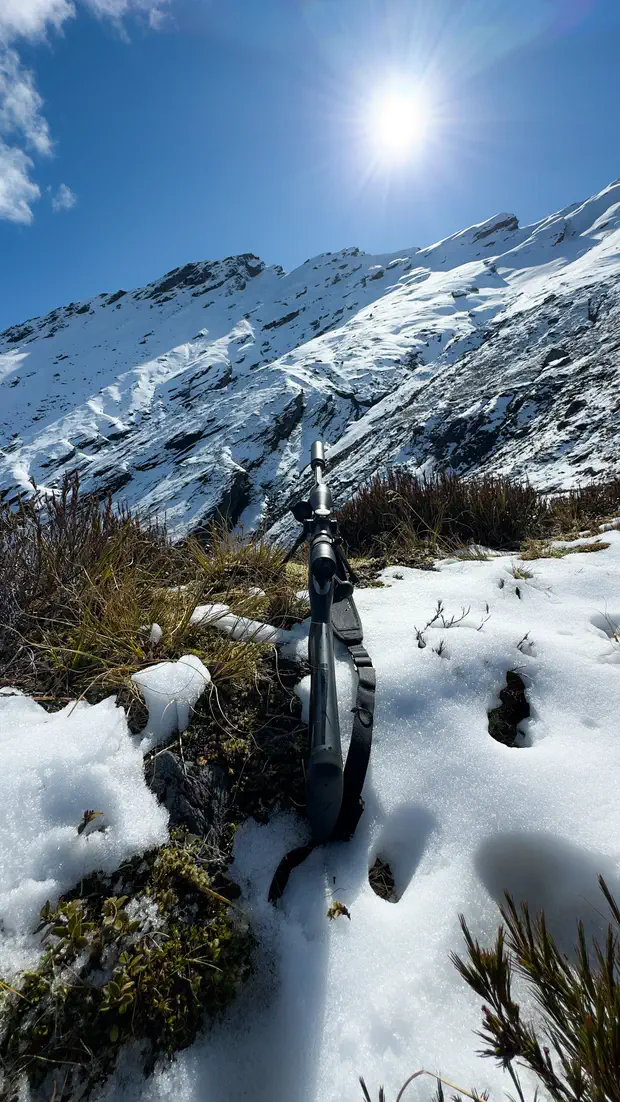
On the tops, most of a hunting day is spent sitting still and looking. Tahr live on faces a kilometre or two away, in country so big that a bull is a dark speck to the naked eye. Glassing is how you find him, decide if he is the one, and plan a way to him before you take a step.
The binoculars do the finding: wide, bright and quick. A spotting scope does the judging. Most run 20 to 60 power with a 60 to 85 mm objective, and on a tripod they can show you at a kilometre and a half what binoculars cannot show at five hundred metres.
The cost is light and steadiness. A 20-60x80 has a 4 mm exit pupil at 20x and only 1.3 mm at 60x, so the picture dims badly as you wind it up. In the afternoon, rising heat makes the air shimmer, and the more you magnify, the worse it gets. Find at low power, then turn up only as far as the light and the air allow.

This basin holds seven tahr, and from across the valley you will not see one. Glass it properly: tap a square to put the binoculars on it, work the grid in order, and tap each animal you find.
Sit and brace
Elbows on knees, glass on a pack, or binoculars on a tripod with an adapter. A braced 10x shows more than a wobbling 15x.
Grid it
Work the face in overlapping strips, near to far and left to right, holding each view still for a few seconds. Sweeping fast finds nothing.
Look for pieces
Not a whole animal: a horizontal back in vertical rock, a flicking ear, a pale patch, a leg under a bush, something that moved. Tahr bed on ledges and in shade.
Again, later
Glass the same ground again as the light changes. Animals stand up, feed out and move into view. First and last light are best.
Never glass with a riflescope
The NSW Hunter Education Handbook makes the point that whoever you look at through a riflescope is looking down your barrel. Find and identify with binoculars, and lift the rifle only to an animal you have already decided to shoot.
Judging a bull
Through a spotter you can see the mane, the body and the horns' rings well enough to age a bull: count the rings and add one and a half for his age at the winter rut. Horn length alone fools people. The Tahr volume shows you what to look for.
Rest your eyes
Glassing is tiring work. Glass in spells and lower the binoculars between them. A tired glasser starts sweeping, and a sweeping glasser misses animals.
After dark
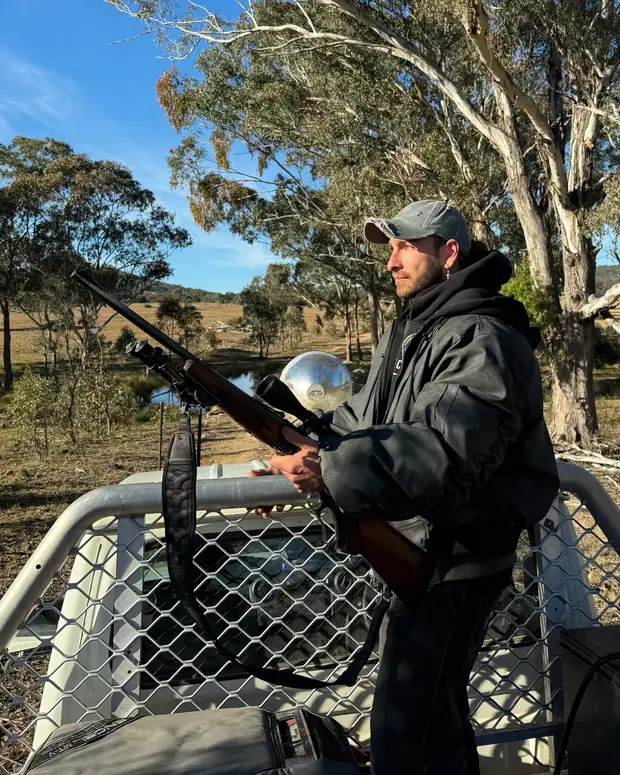
At Silent Grove the evenings are spent on the back of the ute with a spotlight, which is how most deer, roo and fox control in Australia gets done. Light and glass work differently at night, and the rules change with the country you are in.
Two numbers describe a spotlight. Lumens are the total light it puts out. Candela is how intense the beam is, and that is what reaches an animal 300 m away. Under the ANSI FL1 standard, a light's rated beam distance is where its light falls to 0.25 lux, about the light of a full moon on a clear night: a 1,000 candela torch reaches about 63 m, a 100,000 candela spotlight about 632 m.
Eyes are not a target
The beam lights up the animal and nothing behind it. Eyeshine tells you something is there, not what it is: a deer, a calf, a dog or a reflector on a gate. The NSW handbook's rule is never to fire at a pair of eyes or a reflection. See the whole animal, and know what lies behind it.
Turn the scope down
At night a scope on low power gives a bigger exit pupil, a brighter picture and a wider field to find the animal in the beam. An illuminated dot helps on a dark animal, turned right down.
Red or white
Fallow deer see in two colours, with cones most sensitive near 450 to 460 nm and 542 nm and no long-wave red cone. A red filter looks dim to them but not invisible. White light shows you more, and the NZ Mountain Safety Council says it is better for identifying what you are looking at.
A thermal imager sees heat, not light. Most work in long-wave infrared, wavelengths of 7 to 14 micrometres, so a warm animal glows against cooler ground even in total darkness or light scrub. That band behaves strangely: a thin plastic bag lets it through, while ordinary spectacle glass blocks it, so a person wearing glasses shows up with their eyes blanked out.
Night vision amplifies whatever faint light there is, or uses a sensor and an infrared lamp, and shows you a picture rather than a heat map.
Both are superb for finding animals, and for finding a wounded one quickly. Neither is good enough on its own to identify one. A thermal picture is low resolution, and a calf, a dog and a person can all look much alike. Identify with ordinary light and glass before anything becomes a target.
NSW, private land
Spotlighting deer and pest animals with the landholder's permission is lawful. No NSW law bans thermal or night vision for deer or pest animals on private land, and NSW's own deer-control guidance treats spotlight and thermal night shooting as standard methods. Kangaroos are only shot under a licence, and the national code requires a rifle sighted in before each night, a standing, stationary, clearly visible animal, brain shots only, and never from a moving vehicle.
NSW, public hunting land
Firearms and bows are daylight only, from 30 minutes before sunrise to 30 minutes after sunset, and spotlighting from vehicles is banned.
NSW, the equipment itself
The Weapons Prohibition Act lists silencers, and aiming lasers over 1 milliwatt, as prohibited weapons. Thermal and night-vision scopes are not on that list, but confirm with the NSW Police Firearms Registry before you buy or fit one.
New Zealand, public conservation land
Under DOC's standard hunting permit there is no loaded firearm and no shooting from 30 minutes after sunset to 30 minutes before sunrise. No spotlights, torches, headlights or night vision for hunting, and no thermal, night vision or light attached to a firearm. Since June 2024, hand-held thermal monoculars and binoculars are allowed to find animals in daylight.
New Zealand, private land and the new Arms Act
On private land, the landholder's permission and the law set the rules. New Zealand's Arms Act 2026 replaced the Arms Act 1983, and most of it came into force on 23 September 2026, with a new regulator, Firearms Safety and Education New Zealand. Check anything about night shooting or night-vision equipment with them before you rely on it.
A plain-English field note, not legal advice. See The Law in NSW and The Law in NZ.
Lore
The first night-vision sights used in quantity, in the Vietnam War, worked on starlight and moonlight alone. Their image intensifiers amplified light about a thousandfold, which made them heavy, and they still needed some moon to work properly.
Clean glass
Modern lenses are covered in microscopically thin coatings, and those coatings are what make good glass bright and sharp. Grit is what wrecks them. Almost every scratched lens was scratched by a wipe, not by the bush.
So the rule is grit first, smears second. Most modern hunting optics are sealed with O-rings and filled with a dry gas such as argon or nitrogen, so they cannot fog inside. The outside of the glass fogs and freezes like anything else.
Blow
Puff the grit off with a blower bulb, or a breath if it is not freezing.
Brush
Sweep away what is left with a soft lens brush.
Moisten
A drop of lens fluid on the cloth, not on the lens.
Wipe
Gently, in small circles from the centre out, with a clean microfibre cloth or a lens pen. Never a shirt tail.
- Binocular dioptre setNote the setting in case it gets knocked.
- Scope reticle focused for your eyeAgainst a plain sky, sharp at first glance.
- Scope screws checked and the rifle zeroedThe Rifle volume, chapter IV.
- Spare batteriesRangefinder, illuminated reticle, headlamp. Cold flattens batteries, so keep the spares warm.
- Lens cloth and blower in a zip bagKept clean, so it does not become sandpaper.
- Caps on, rain guard onFlip-up caps on the scope, a rain guard on the binoculars.
- Harness for the binocularsOut of the rain, still on the walk, quick to hand.
Why does my scope fog when I get out of the ute?
Cold glass meeting warm, damp air, or warm glass meeting cold air with your breath on it. It clears on its own as the glass reaches air temperature. Keep caps on, don't breathe on the lenses in the cold, and don't wipe a fogged lens that might have grit on it.
Is it rain or something inside?
If water drops or fog appear on the inside of a sealed scope or binocular, the seal has failed. Most good makers will repair it under warranty. Don't try to open it.
How do I keep a rangefinder working in the cold?
Batteries lose capacity in the cold. Keep the rangefinder in an inside pocket and carry a spare battery.
What about storage?
Dry and out of a hot car. Let wet optics dry at room temperature with the caps off before they go back in a case.