Chamois
There’s no recording of this volume, so your phone reads it out, section by section.
Chamois: an emperor's gift that outran every other hoofed animal let go in New Zealand, and how to tell a buck from a doe.

A gift from an emperor
Rupicapra rupicapra. The name means rock goat, which is fair. The chamois is a small goat-antelope of the European Alps, and in New Zealand nearly everyone says it "shammy".
People were asking about chamois for New Zealand from the 1880s, but none came until Emperor Franz Joseph I of Austria made a gift of them. In 1907 eight were caught in a chamois drive in Austria: two bucks and six does, all two or three years old, two of the does carrying young. Part of the deal was New Zealand birds going the other way, kea and kiwi among them.
They reached the Hermitage at Mount Cook in March 1907. They were ferried across the Hooker River in the cable cage and let go at the foot of Mount Wakefield, and a man who watched said they took two or three quick jumps into the air and fled up the nearest spur.
They never looked back. Young were seen within a year. There was a herd of 70 by 1919 and over a hundred animals by 1921. By 1927 they had crossed the Main Divide into the Copland and reached Arthur's Pass. In 1963 the ecologist Graeme Caughley worked out how fast nine introduced hoofed animals had spread from where they were let go. Chamois averaged 5.4 miles (8.7 km) a year, well ahead of everything else. Tahr, let go in the same country three years earlier, managed 1.1.
The emperor left his name on the West Coast too. Julius von Haast named Franz Josef Glacier, just north of Fox, after him in 1865, more than forty years before the chamois arrived.
Eight at the Hermitage
Two bucks and six does are let go below Mount Wakefield. They are fully protected.
Herds of seventy
A herd of 13 by 1913, twenty together by 1917, a herd of 70 by 1919 and more than a hundred animals by 1921.
Over the Divide
Into the Copland on the West Coast, and north as far as Arthur's Pass, twenty years after the release.
Mount Brewster to Hope Pass
Herds have reached Mount Brewster, near Haast Pass, in the south, and Hope Pass in the north.
Most of the alpine South Island
Chamois occupy most of the South Island's alpine country and are still pushing into Fiordland. Government shooters have killed 68,878 since 1936.
Fiordland to Marlborough
From Fiordland to the Marlborough Sounds, down into West Coast lowland forest, and fewer in South Canterbury now that tahr have spread there. Some cross the Main Divide each year to winter on the west.
Caughley (1963), comparing nine introduced hoofed animals. Chamois were first, tahr second.
Lore
The emperor sent more in 1913. Three semi-tame chamois left Vienna's Schönbrunn zoo. A doe died on the way and the other two had to recover at Melbourne Zoo first. They were let go at Mount Cook on 28 May 1914. The buck got far too used to people and turned aggressive, and in January 1915 a local guide had to kill him after a tussle near Ball Hut, by one account with his alpenstock.
What you're looking at
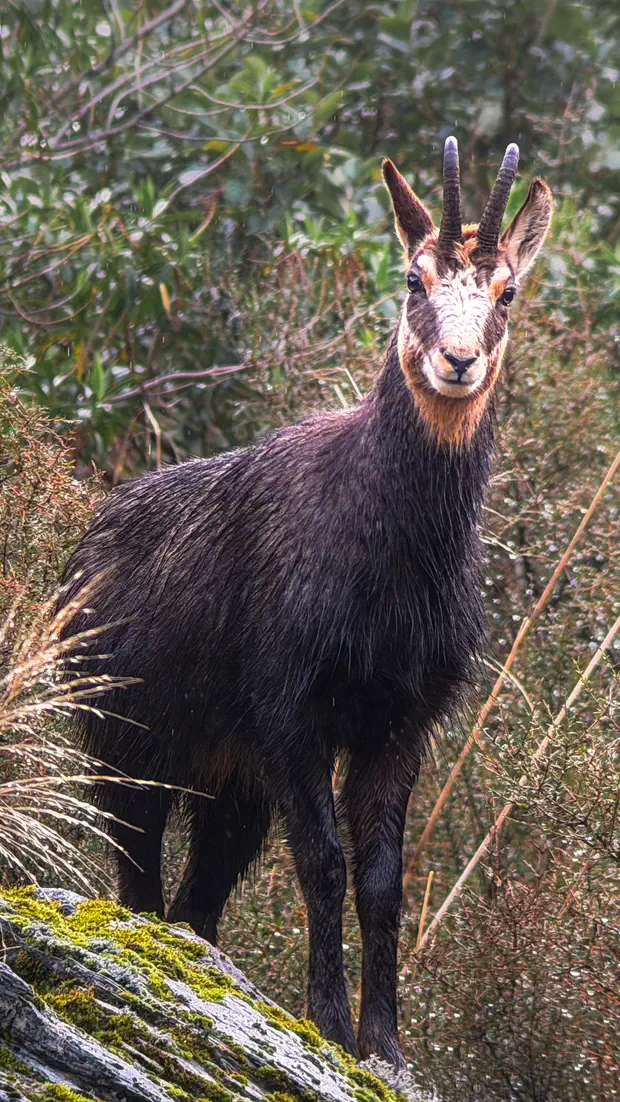
Small, slim and long in the leg, with an upright neck and pointed ears. Next to a tahr a chamois looks built for speed rather than weather. A buck weighs 25 to 45kg and stands 65 to 90cm at the shoulder. DOC puts a doe at 19 to 35kg, and the Game Animal Council and the Deerstalkers at around 19kg.
The face is what you glass for. It is pale, with a dark band running from the nose through the eye to the horns and ears. Pale cheeks and throat, and a dark stripe down the spine.
- 1HornsBoth sexes. Black and slender, straight up from the forehead, then hooked back at the tip. Behind them sit glands that swell in the rut, and a buck's smell strongly.
- 2Face bandDark, from the nose through the eye to the horns and ears. The give-away at range.
- 3Back stripeA dark line from the neck to the tail. In winter a buck grows a ridge of long, silver-tipped hair along his back.
- 4Belly and rumpMuch paler in summer, close to white.
- 5HoovesLike a tahr's: a soft pad inside a hard rim. Up to three inches long on a big buck.

The coat changes more than a tahr's. In summer a chamois is grey-brown, tan or honey-gold, with the belly and hindquarters going nearly white. In winter the coat goes dark brown to almost black, and the pale face stands out like a mask. Drag the line across the buck to change the season.
A winter buck also grows the ridge of long, silver-tipped hair along his back that Alpine hunters tie into the Gamsbart, the tuft on a Bavarian hat.
Fig. 3 · The same buck in summer and in winter. Traced from the engraving.
Lore
Old Alpine stories had chamois hanging from ledges by the hooks of their horns to hide. A French writer in 1573 claimed that a chamois scratching its thigh could hook itself fast and fall off the cliff. Neither is true. They are just very good at standing on things you wouldn't.
Buck or doe
This is harder than with tahr. Both sexes carry horns, both have the same face, and outside the rut they look far more alike than a bull and a nanny do. You read three things: the hook, the thickness of the horn, and the company the animal keeps.
A buck's horns are stouter, with a deeper hook that curls further round. A doe's are thinner, and the hook is more open. The horns spread apart where they bend, often a long way on a doe. Length won't settle it. A doe's horns can be as long as a buck's, and the New Zealand record chamois is a doe.
A typical buck: stout horns, a deep hook, the tips close together.
Deep or open
Side on, a buck's hook curls further round, often until the tip points back down. A doe's bends back in a wider, shallower curve. Along with thickness, it is the sign most hunters go by, and you need a side view through good glass to see it.
Stout or slender
A buck's horns are thicker at the base and stay thicker up the shaft. A doe's are slender all the way.
Where they part
Face on, the horns separate where they bend into the hook, often widely on a doe. A buck's tend to stay closer and more parallel. Useful, but it varies a lot between animals.
Alone or in a group
Outside the rut, mature bucks are mostly on their own, and does run in loose groups with their young. Bucks leave the doe groups at two or three years old. In a study near Arthur's Pass, does stayed put while bucks roamed and young males dispersed. A lone chamois is probably a buck, but not certainly.
May and June
The rut starts early to mid May and peaks from late May to early June, about a month ahead of the tahr. A dominant buck holds a harem of does and seldom has to fight for it. Kids are born from November to February after five and a half to six months, one at a time.
Eyes on the slope
Chamois have a good nose and very good eyes, and they lean on the eyes. A chamois parks itself on a lookout, a knob or a ledge with a view, and watches the ground below. DOC's hunting advice is that they scan downhill far more than up. That one habit decides most stalks.
They are usually silent. When something is wrong, the alarm is a sharp whistle, often with a stamp of the forefeet. When you hear it, the animal you were after has gone, and so has everything else that heard it.
In summer they feed for three or four hours from first light, rest through the middle of the day and feed again before dusk. In winter the feeding shifts to mid-morning and mid-afternoon. They often keep away from feeding tahr. On the West Coast they also use the low forest, slips and creek beds, so the bush edges are worth glassing as well as the tops.
- Glass for the dark face bandIt shows at range when the body blends in.
- Check the lookouts firstKnobs, ledges and spur ends with a view down.
- Plan to come in from aboveThe side he watches least.
- Read the air before you moveSinking air carries your scent downhill to him.
- Move when his head is downFreeze when it comes up.
- Count every animal you can seeThe one you didn't see whistles.
Shooting one
A chamois is a small animal with a small heart and lungs. DOC's advice for chamois is a .223 out to about 200 metres, and a .243, a .25 or bigger beyond that. The rifles on this trip are tahr rifles, so calibre isn't the question. Distance and a steady rest are. Range it, get settled, and get closer if the ground lets you. Shot Placement has the rest.
From below: seen
You're walking up the very ground he is watching. Even with the air in your favour, he'll see you long before you're in range, and with the air rising, he'll smell you too.
From above, air sinking: smelt
Better ground, wrong air. In the cold of early morning and late evening, and on faces in shade, air slides downhill and takes your scent straight to him.
From above, air rising: unseen
The way to do it. Once the sun has warmed the face, the air rises and carries your scent up and away, and you're coming from the side he checks least. A westerly front can override all of it, so keep checking.
Lore
In 1925 the first two chamois shot legally in New Zealand came off the Wakefield Range behind the Hermitage, for the Tourist Department's display at the Dunedin Exhibition. The papers reported the bigger one at 93 pounds with ten-inch horns, and the paper claimed it outweighed the heaviest shot in Austria. The taxidermist who mounted them, a former Tyrolean mountain guide, called them exceptionally fine specimens.
Ten inches, and the table
A chamois horn is measured like a tahr's: over the outside of the curve from the base to the tip, and around the base. The Douglas Score takes the shorter horn and the thinner base and doubles them, so a matched pair beats a lopsided one, and there is no spread measurement for chamois.
The NZ Deerstalkers' Association calls 9 to 9½ inches on the shorter horn a representative head. Its record book takes a chamois with 10 inches on the shorter horn, or a Douglas Score of 27. The New Zealand record scored 31⅛ and came from the Styx Valley in 1968. It is a doe.
Chamois horns carry growth rings like a tahr's, and some hunters age them by counting. We haven't found a New Zealand source that sets out the method, and the rings are fine and close, so treat any count as rough.
A good head
Inches on the shorter horn. NZDA calls 9 to 9½ representative.
The record book
Ten inches on the shorter horn, or a Douglas Score of 27.
The record
Douglas Score of the New Zealand record, a doe from the Styx Valley in 1968.
Lore
The record could have been a buck. One shot near the Drake River in the Waiatoto in 1972 scored 32 2/8, more than the record doe. But it is suspected of having been taken with a helicopter's help, and the record stays with the doe from the Styx.
Horn rot on the West Coast
Many West Coast chamois carry horn rot: a sore that starts low on the horn, grows, and can eat into the bone until the horn snaps off. Nobody knows the cause. Hunters on the Coast say clean horns are getting hard to find in some places. An international survey, which the Deerstalkers are joining, is collecting reports from hunters in New Zealand, France and Italy. If you shoot one with damaged horns, photograph them and pass the pictures on through the Deerstalkers.
Europeans rate chamois very highly. A 1965 review of New Zealand's chamois allowed that the meat was palatable and suggested the European reputation might owe more to how hard it is to get than to the meat itself. In the Alps it is still highly prized.
Treat it like good venison. It is lean, so the backstraps want a hot pan and a short rest, and the shoulders and shanks want long, slow braising. As with any game: cool it fast, keep it clean and dry, and trim anything dirty, hairy or bullet-damaged. Field to Freezer and Camp Kitchen cover the rest.
The neighbours
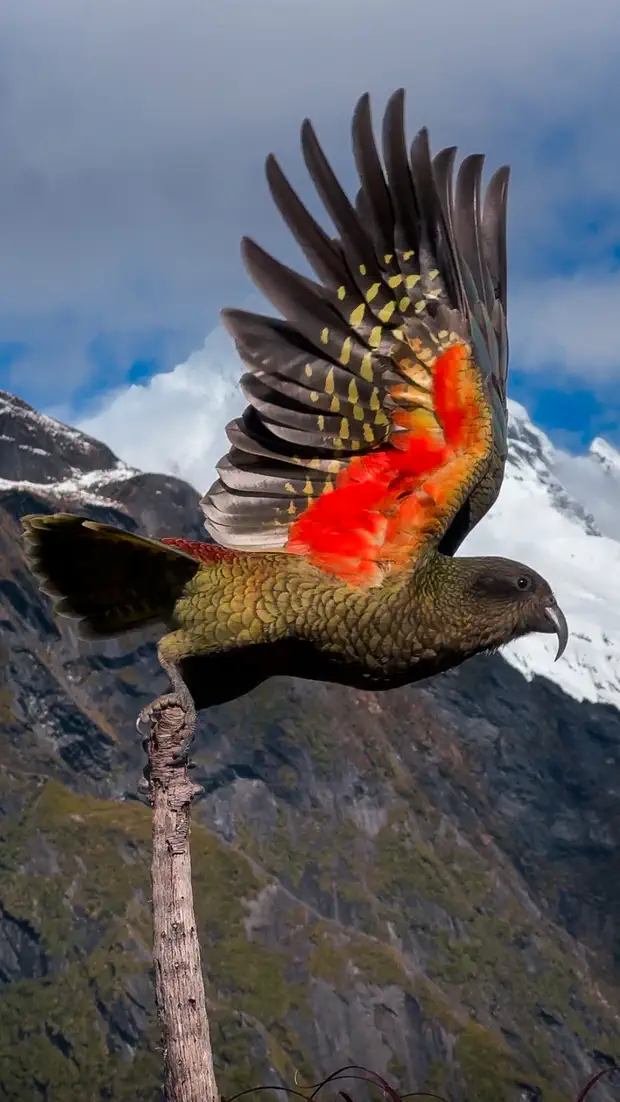
You will hear them before you see them: a long, wailing "kee-aaa" that sounds like their own name. Kea are mountain parrots, olive green with a flash of orange-red under the wings, and they live only in the South Island, from the mountains to the sea. They are one of the cleverest birds in the world. They turn on taps, use tools, set off traps to steal the bait and, in one story DOC tells, locked someone in a toilet.
They are also in trouble. DOC estimates 1,000 to 5,000 are left and lists them as Nationally Endangered. Stoats and cats kill adults, chicks and eggs, possums damage nests, and kea nest on the ground. Between 1870 and 1970 a bounty killed more than 150,000, because high-country farmers blamed them for attacking sheep. They have been fully protected since 1986, and it is illegal to harm one.
In tahr country they will find you. They follow people up from the valley, and tahr, deer and chamois carcasses are an important food for them up high. That is also why lead matters. Most kea lead poisoning has come from chewing lead nails and flashing on huts, but bullet fragments in carcasses are a risk too, and a little lead can kill one. DOC suggests lead-free bullets in kea habitat. The Game Animal Council agrees and, if you do use lead, suggests carrying out or hiding the bullet-damaged parts of a carcass.
- Nothing left lying aboutBoots, gaiters, packs and clothing go inside or get packed away, especially when you head out for the day.
- Hard cases beat soft bagsSoft, pliable things are what they shred first.
- Food scraps buried or carried outA kea that finds food at a camp comes back.
- Don't feed, chase, talk to or throw things at themThey take any attention as a game.
- Bright gear packed awayResearch suggests white, yellow and red draw them most.
- Dawn and dusk are the danger timesThat's when they're busiest, often while you're out.
Lore
Kea are protected, clever and bored, and your gear is the most interesting thing on the mountain. They'll pull the rubber off a car, shred a pack and fly off with whatever is loose. The young ones, with yellow around the base of the beak, are the worst. Kea were voted New Zealand's Bird of the Year in 2017. Nobody who has lost a pair of boots to one voted for them.
Seen a kea?
Hunters go where few others do, so sightings help. The Kea Conservation Trust's database and the NZ Tahr Foundation's app both take reports, especially of banded birds.