Alpine Craft
A recording: episode 7 of Listen, the library read aloud
The helicopter, the glass, the air, the weather and the ground, and knowing when the honest answer is no.

The machine
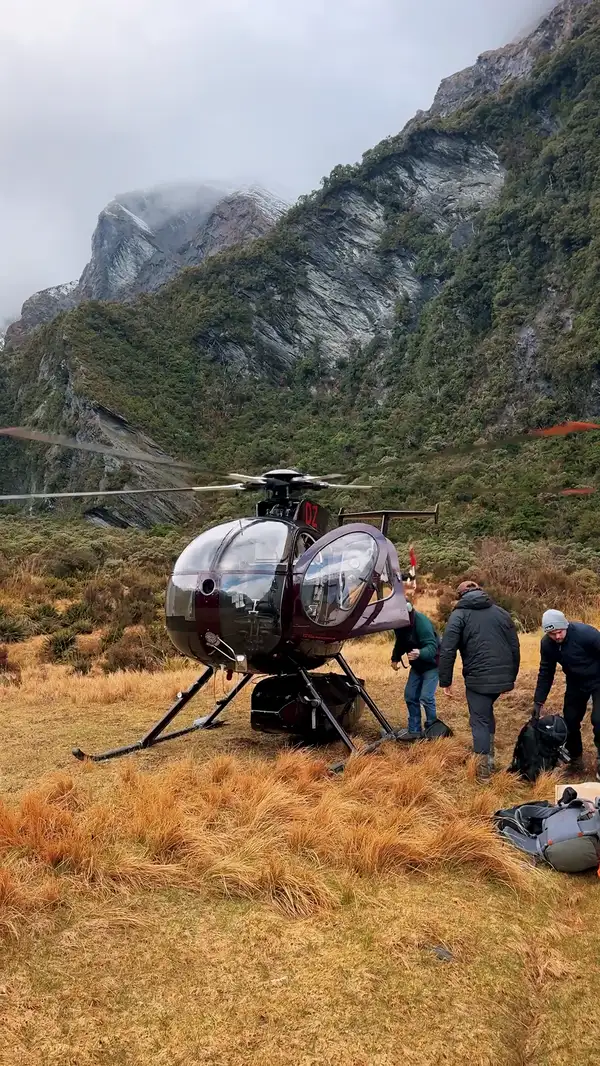
The trip starts and ends with a helicopter, and for most people it is the first time they have stood near one with the blades turning. It is the most dangerous machine you will go near all week, and most of that danger comes from noise and wind pushing you into doing something without thinking.
The rule that covers almost everything: nobody moves towards a running helicopter until the pilot, or the person loading it, waves them in. Not when the skids touch, not when the door opens. You wait, crouched, where the pilot can see you, and you go when you get the nod.
Every pilot briefs a version of the same rules, and the US Federal Aviation Administration's helicopter handbook sets them out in much the same words. On the day, the pilot's brief is the one that counts.
Think of the helicopter as a clock seen from above, nose at twelve. From roughly ten o'clock round to two you are in the pilot's view, and that is the way in and the way out. On some machines the blades dip lowest at the front, which is why many pilots bring people in at an angle from a front corner rather than dead ahead. Go where you're waved.
Further round the sides you are drifting out of view. Behind the doors you are invisible, and back there is the tail rotor.
On a slope it changes. The ground on the uphill side rises towards the main blades, so you come in and go out on the downhill side, never the uphill one. Tap the drawing to choose where you'd walk in from, then switch the ground to a slope and try again.
Tap where you would walk in from
Anywhere on the drawing. The verdict comes up here.
- Before it lands
One pile, held down
Packs, cased rifles and bags in a single pile where the loader shows you, with the heaviest on top. Hats in pockets, ear plugs in. Anything light and loose, from a bin liner to a sleeping mat, gets sat on or strapped down, because the downwash will throw it into the blades or into the next valley.
- It lands
Crouch and wait
Stay crouched beside the pile, back to the machine, a hand on the gear. If grit blinds you, stop, get lower or sit down, and wait. Never walk towards it while the blades are starting up or slowing down: at low speed they droop and flap.
- The signal
In from the front, low
When the pilot or loader waves you in, walk, don't run, crouched, from the front where the pilot can see you. Anything long, rifle cases and poles included, is carried flat and below the waist, never upright and never on your shoulder. If your hat blows off, let it go. Nobody reaches up or chases anything near a helicopter.
- In the seat
Belt on, latches clear
Seat belt done up first. Nothing loose on your lap. Keep clothing and gear away from the door latches: New Zealand's Civil Aviation Authority warns that a door can look shut without being latched, and pop open in flight. Do exactly what the pilot says about doors and headsets.
- Getting out
Out, crouch, stay put
Out the way you came in, towards the front, low. Back to the pile, crouch, hold it down, and stay there until the machine has gone and the noise has dropped. Then stand up and have a look at where you are.
Rifles near the machine
Unloaded, always, in or anywhere near a helicopter. Cased, usually with the bolt out, and carried low like everything else long. Where the rifles ride is the pilot's and the guide's call, and that is the end of the discussion.
Never push the pilot
Helicopters don't fly into cloud, so either end of the trip can slide a day. In November 2015 a scenic flight crashed on the Fox Glacier in deteriorating weather and seven people died. New Zealand's Transport Accident Investigation Commission found the weather was unstable and unsuitable, and that the pilot's ability to judge height had probably been degraded. A weather hold costs a day. Nobody talks a pilot into a gap in the cloud.
Lore
Helicopters changed New Zealand hunting. From the 1960s they lifted deer carcasses out of the mountains for the venison trade, and from 1965 hunters were shooting from them, several hundred deer in a day. When deer farming was legalised in 1969 the same machines went after live deer, and men jumped from the skids onto running deer and wrestled them down, rodeo style. Te Ara, the encyclopedia of New Zealand, notes that the jumpers often lost teeth.
Sit down and look
Hunting the tops is mostly sitting still and looking. You climb to a spot that sees across and down into the country, you sit, and you work the binoculars over it slowly. Most animals are found from a seat, not on the move. Walking around hoping to bump into one is how you see the back end of everything leaving.
The word for it is glassing, and it is a skill. Two people can sit on the same rock for an hour and one of them will find three animals the other never saw.
Brace it
Elbows on knees, binoculars on the pack, or on a tripod. Shaky glass hides animals. Braced, the same binoculars show you far more.
Work in strips
Near to far, left to right, each view overlapping the last, holding each one for a few seconds. Then do the whole face again. Animals stand up, move, and appear where there was nothing ten minutes ago.
Look for pieces
A horizontal line in vertical country, a flick of an ear, legs under a bush, something the wrong colour. You rarely see a whole animal standing broadside.
Binoculars first, then the spotter
Binoculars to find, the spotter to decide. The scope tells you bull or nanny, young or old, and whether he is worth the climb.

Here is a face the way it looks from across the valley. There are animals on it, and a rock that will try to fool you. Tap a square to put the binoculars on it, and work it the way you would on the hill: strip by strip, not by jumping to the obvious bits.
Pick a square
Start at one corner and work across in strips, the way you would on the hill. The face doesn't mind where you start.
The Department of Conservation's description of tahr is a timetable worth learning. They rest through the middle of the day among the rock outcrops above the bushline, feed from mid to late afternoon into the evening, then climb back up. On the West Coast, where the cover is thick, they often lie up below the bushline, come out onto the tussock and slips in the evening, and go back into cover early in the morning. So the evening is prime time, and first light catches them heading home.
October is spring up there. Tahr come lower and look paler than in winter, nanny groups tend to hold the high ground, and bulls range wider and lower. Chamois sit on lookouts and watch downhill more than up, which is why DOC's advice is to come at a chamois from above.
Look, then look again
DOC's advice is to glass from a good vantage point and then look again later, because animals that were lying down or out of sight will have moved. The Deerstalkers' advice is to spend the first day glassing before you climb anything. A bedded animal is the hardest thing to see and the easiest thing to stalk.
Two habits
Glass from the shade if you can: sitting in the sun puts glare across the lenses and puts you on show. And never glass with the rifle scope. Anyone you look at through it has a rifle pointed at them.
Which way the air goes
An animal that smells you is gone, and DOC's advice for tahr is to move into the wind using cover, because they smell, hear and see well. On flat country the wind is the wind. In the mountains there is a second, smaller wind underneath it that changes direction on a timetable, and it is called a thermal.
The ground heats and cools faster than the air around it. At night the slopes cool, chill the air touching them, and that cold, heavy air drains downhill like water, pooling on the valley floor. Once the sun gets onto a face it warms the ground, and the air starts to climb. Meteorologists call the downhill flow katabatic and the uphill flow anabatic. The American Meteorological Society puts a fair-weather upslope breeze at typically 3 to 5 metres a second and the night drainage at 3 to 4, faster on long slopes. That is barely a breeze, and plenty to carry your scent a long way.
Everything drains
The faces have been losing heat all night. Cold air slides down every slope and pools on the valley floor, and the whole valley's air drifts gently down the valley. Your scent goes downhill. The animal below you has it.
The flip starts at the top
Sun touches the top of the face it hits first, and up there the air starts to lift. Where you are, still in shade, it is draining. That half-and-half morning is the one that catches people out, so check the air where you are, not where the sun is.
The face turns
Once the sun is properly on your face, the air climbs it, and your scent goes uphill. The shaded face across the valley is still draining. Anything above you on a sunny face now has your scent coming straight to it.
Up everywhere
Both faces are warm and the air climbs both of them, while the valley as a whole breathes up towards its head. This is the settled part of the day. Approach from above, or across at the same height.
Still climbing
The afternoon face is in full sun and pulling hard, and yours is still lifting. Animals that were bedded are thinking about getting up to feed. Stay above them, or work across, and keep checking.
The evening flip
Your face goes into shade and soon the air there starts to drain again, while the face across the valley, still in sun, keeps climbing. A stalk that started in one wind can finish in the other. The animal below you is back in your scent.
Draining again
Both faces cool and the air slides down them. The valley breeze dies, then turns. Your scent goes downhill, which is the right way round if the animal is above you, and it is time to be heading for the hut anyway.
Back to the start
Cold air drains and pools, frost forms on the valley floor first, and the whole valley's air drifts down it until morning. Then it starts again.
The big wind beats the little wind. Thermals are the rule on calm, clear days. When a real wind is blowing, a nor'wester over the tops for example, it overrides them on the ridges and swirls round in the gullies, and cloudy days barely make thermals at all.
Ice makes its own wind. Air chilled against glaciers and big snowfields keeps draining downhill even on a sunny day, so near the ice, and in shaded faces, the air can still be sliding down when the textbook says it should be climbing.
So you check the air constantly. A puff of fine powder from a squeeze bottle, a strand of wool tied to the rifle, a pinch of dry grass dropped from shoulder height: watch where it goes, every time you stop, and again before you commit to the last part of a stalk.
Weather off the Tasman
The West Coast sits straight in the path of the westerlies, with nothing between it and Australia but the Tasman Sea. Moist air comes off the sea, hits the Southern Alps, is forced up, cools, and drops its water on the western side. DOC warns that the park can get heavy rain at any time of year, and up to five metres of it in a year.
October is about as wet as it gets. NIWA's long-term averages for Hokitika, up the coast, make it the wettest month of the year there, with 285 millimetres and the most rain days of any month. Up at 1,500 metres on that coast, across the last ten Octobers, the average day got to 5.7°, the average night went to minus 0.8°, more than half of all nights sat below freezing, and it rained on 55% of days. Plan for that, and anything better is a gift.
The nor'wester
Ahead of a front the wind swings into the north-west and gets up, warm and wet off the sea. Cloud piles onto the Main Divide and the tops start to disappear. It can feel like a good day down low while it is blowing a gale on the ridges.
The front
The rain arrives properly and the western slopes wring the air out. Rain like this lifts rivers fast, and a creek you stepped across yesterday can be a torrent by the afternoon. This is a hut day. Nobody crosses a flooded river on this trip.
The southwest change
Behind the front the wind swings to the south-west and the temperature drops hard. Showers fall as snow on the tops, the freezing level can drop more than a kilometre in a day, and fresh snow on old snow is avalanche weather.
The clearance
High pressure moves in. Clear skies, a hard frost, fresh snow on the tops and rivers on the way down. The best glassing day of the week often comes straight after the worst one, which is why you don't waste the bad one getting hurt.
The freezing level is the height where the air drops to zero. Above it, rain is snow, wet rock is ice, and a slope you walked up yesterday may be frozen hard this morning. NIWA's rule of thumb is that air cools by about 0.7° for every 100 metres you climb, so the tops at 1,500 metres run nine or ten degrees colder than the coast. The township forecast tells you very little about where you will be.
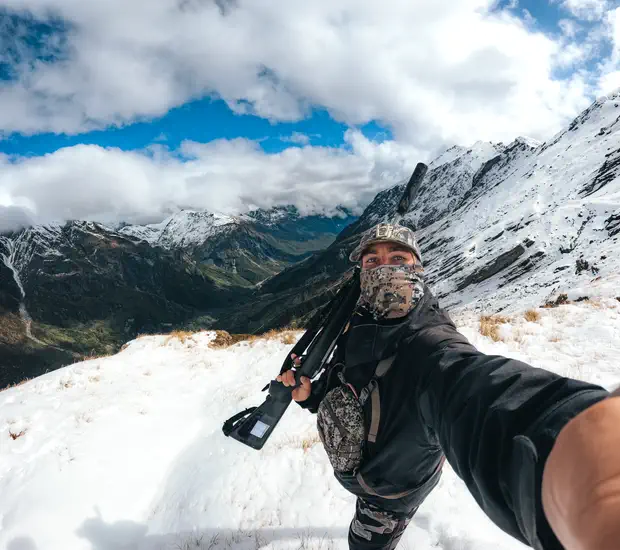
The town forecast is the wrong forecast. MetService writes separate forecasts for the national parks, built for people going high: winds at 1,000, 2,000 and 3,000 metres, the freezing level, the hazards and the wind chill. There isn't one for Westland Tai Poutini itself, so the guide reads the Aoraki/Mount Cook park forecast next door, the Westland forecast and the avalanche advisory every morning.
Tap each line of the example to see what it is telling you. The decision isn't yours to make up there, but you should understand it. Bad conditions mean a day of glassing from somewhere safe, or a day in the hut, and that is a normal day, not a wasted one.
Today: Fine at first. Cloud thickening from the west in the afternoon, with rain developing on the tops in the evening. Northwest winds rising to gale on the tops.
Hazards: Heavy rain from evening. Severe gales on exposed ridges. Wind chill below minus 10° on the tops.
Tomorrow: Rain, heavy at times. Snow to 1,200 m late. Southwest change.
Which forecast
Park forecasts are written for a mountain area, not a town. Check which park it covers and when it was issued. A forecast from yesterday afternoon is old news on the West Coast.
The words
Read the timing, not just the weather. "Fine at first" with rain "in the evening" means a short day and an early start for home, not a fine day.
Freezing level
Where water turns to ice. Falling during the day means wet slopes freezing hard by evening, and that is the walk home. Snow can settle a little below the freezing level.
Wind down low
About the height of the valley floor and the bush edge. Thirty kilometres an hour is a breeze you hardly notice down there.
Wind up high
About the height of the tops, and the one that matters most. Eighty with gusts of 120 knocks people over on an exposed ridge, makes long shots impossible, and keeps helicopters on the ground.
Wind over the peaks
The big wind above it all. It tells you what is coming and how hard the ridges will be hit as the day goes on.
Hazards
The forecaster's own list of what can hurt you. Wind chill is how cold it feels on wet skin in that wind, and it is what turns a long wait behind the glass into hypothermia.
Tomorrow
The outlook decides whether you push today. If tomorrow is heavy rain with rivers rising, today is the day to be on the right side of every river you need to cross.
Ground that bites
The thing most likely to hurt you up there is not the rifle and not the weather on its own. It is the ground. The New Zealand Mountain Safety Council looked at sixteen years of alpine hunting deaths and found that ten of the eleven hunters who died fell. Coroners' reports on experienced hunters killed on bluffs and waterfalls keep coming back to the same two things: complacency, and being set on a goal.
The Council's advice reads like a description of this trip. Go down only routes you know, allow for the weight of the meat on the way down, expect snow to ice up in the evening, stay back from crumbling bluff edges, and hunt with a mate. There is no track where we are going. Every line you take is one somebody chose.
Fig. 641 deaths in ten years, from the Mountain Safety Council's hunting study.

- 1Wet snowgrassLong, slick tussock, and the most underrated danger up there. Wet or frosted, walking on it is like walking on oiled hair, and a slip on a steep face does not stop.
- 2BluffsCliff bands, often hidden below a slope that rolls over out of sight. Never go down anything you couldn't climb back up. If you get bluffed, stop and call for help rather than gamble.
- 3Running screeSmall, even stones that slide together. Going down, you can plunge-step heels first and ride it. Going up, it is two steps up and one back.
- 4Loose rockBigger blocks that roll. Never stand below someone on it, move close together or one at a time, and shout "rock" the moment anything moves.
- 5Frozen snow and chutesHard and slick early in the day. One slip and you are sliding down a gully with nothing to stop you before the bluff. Later the sun softens it and starts slides of wet snow.
- 6CornicesOverhanging lips of snow on the downwind side of a ridge. From above they look like ground. Stay well back from any edge you can't see under.
- 7Snow bridgesSnow lying over a creek looks solid and often is not, especially in spring and late in the day. Cross on the rocks if there is any choice.
- 8RiversWest Coast rivers come up fast, from rain you can't see. The Mountain Safety Council ranks river crossings as the second biggest killer of trampers.
Between 2007 and 2021, 21 people died crossing rivers in New Zealand's outdoors, six of them hunters. Spring rain and snowmelt raise West Coast rivers fast, from rain falling in headwaters you may never see, and a stream that was a hop on the way in can be a wall of brown water on the way out.
The rule the Mountain Safety Council teaches is short: if in doubt, stay out. You wait it out on the bank, overnight if that is what it takes. Nobody crosses a flooded river on this trip. Nobody.
Don't cross if
The current is faster than walking pace, at any depth. The water is murky, surging, or carrying debris. You can hear boulders rolling along the bottom. Or it would come above the thighs of the shortest person in the group.
And ask what is pushing the decision. A pickup time, a weather window or being tired are reasons people drown, not reasons to cross.

Read it first
From above if you can. Look for the widest, shallowest, slowest section, ideally braided, with a safe exit and no rapids, logs or gorge just below.
Set up
Boots stay on. Baggy rain gear goes in the pack. Chest strap undone, hip belt done up, the pack liner sealed so the pack floats. The beacon is clipped to your body, not the pack.
Link up
Side by side, each person gripping the next one's hip belt. Strongest at the upstream end, another strong one downstream. Practise the signals and the turn on dry land first.
Move as one
Short shuffling steps, feet felt down before weight goes on. If it gets deeper or faster than you read it, come back together.
If you are swept away
Lie back on the pack, feet downstream, and steer with your arms for the bank or an eddy. If the pack snags, unclip it.
October is spring up there, and snow can fall in any month. The NZ Avalanche Advisory, run by the Mountain Safety Council, forecasts thirteen backcountry regions on a five-level danger scale, rated separately for height bands, normally above 1,800 metres, 1,200 to 1,800, and below 1,200. Since 2026 every forecast also says how confident the forecasters are. The guide checks the nearest region, Aoraki/Mount Cook, every morning.
Spring has its own pattern. Sun on new snow sets off slides of wet snow at fairly predictable times of day, rock lets go from warming faces in the afternoon and comes down the gullies you climbed in the morning, and frozen morning snow is harder than it looks. New Zealand's avalanche incidents peak in September, and most recreational ones happen when the rating is only Moderate. The Council's kit list for alpine hunting in winter and spring runs to helmet, crampons, ice axe, transceiver, probe and shovel. Some days the answer is a different face, or no face at all.
- 1LowGenerally safe. Watch isolated features.
- 2ModerateDanger on specific features. Look at the snow and the terrain.
- 3ConsiderableDangerous. Careful route-finding and conservative decisions.
- 4HighVery dangerous. Stay out of avalanche terrain.
- 5ExtremeAvoid all avalanche terrain.
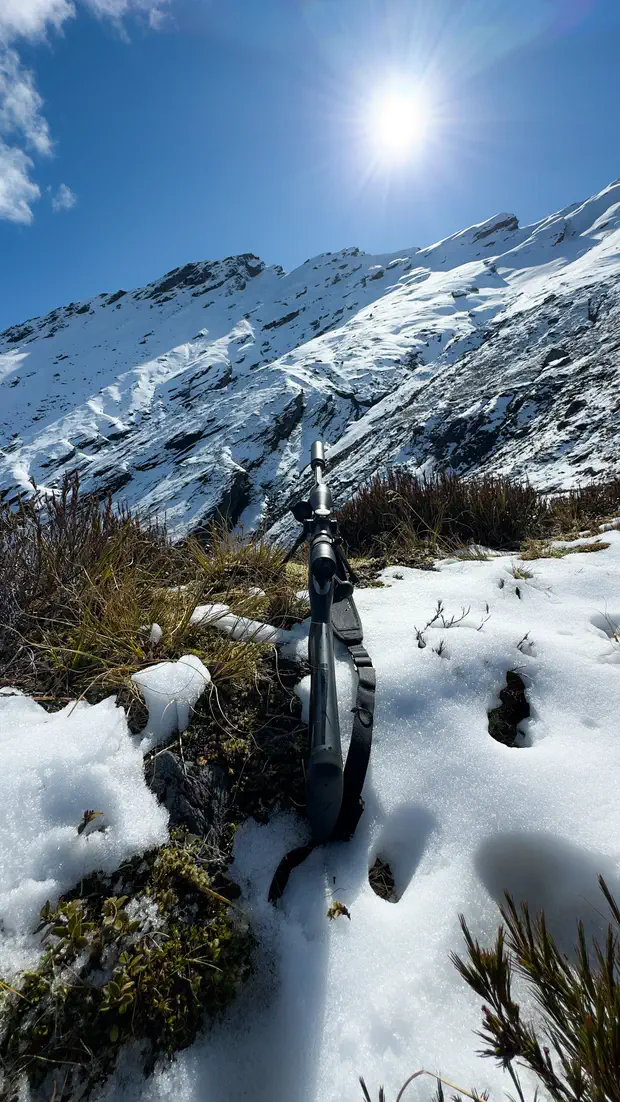
The shot you leave
Up here the shot is often possible when the retrieval is not. A bull on a ledge across a gut is a shot you can make, and an animal you may never reach. So before anyone settles behind the rifle, two questions get asked out loud: where will it fall, and can we get to it and back safely before dark?
An animal shot on a steep face rarely drops where it stood. It slides, rolls and tumbles until something stops it: a bench, a scree fan, the bottom of a bluff, or a creek bed in a gorge. Where it stops is where you have to go. If the honest answer is "nowhere safe", the rifle stays quiet.
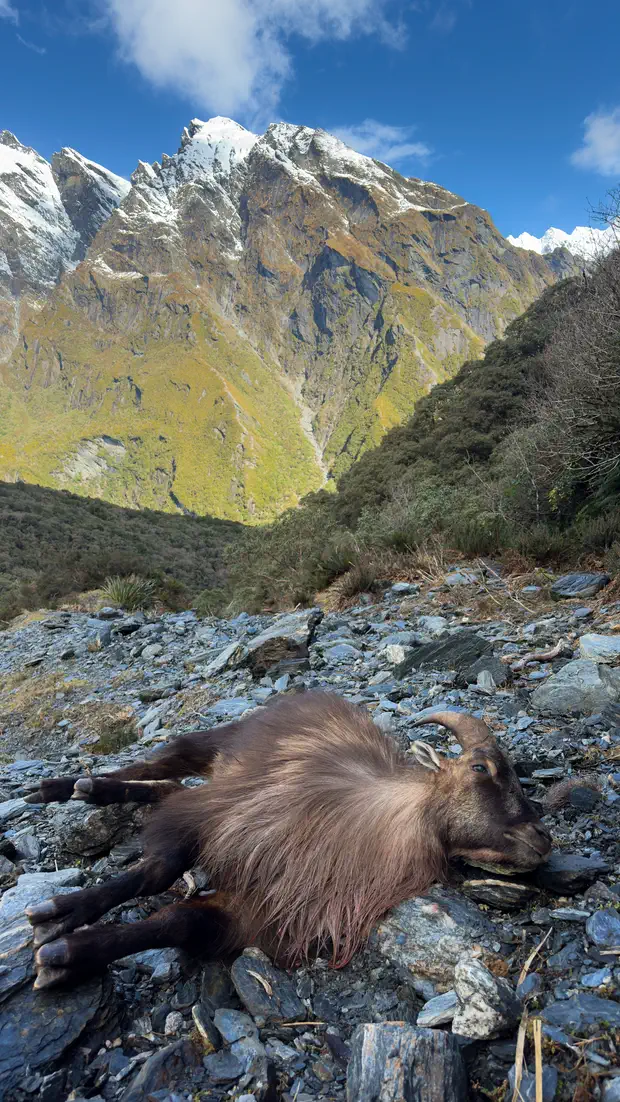
Pick a spot and take the shot
Then move the clock and see how the answer changes.
Steep country throws one more trap. Gravity only pulls the bullet down over the horizontal distance to the animal, not the distance along your line of sight. Shoot up or down a steep face with the rangefinder's straight-line distance dialled, and the bullet goes high, uphill or downhill alike.
The fix is to use the horizontal distance, which most hunting rangefinders show in an angle-compensated mode. As a worked example for a .270 zeroed at 200 metres, a 400 metre shot at 30 degrees with the level-ground dial goes about 16 centimetres high, enough to miss the heart and lungs altogether. At steep angles and long ranges, get closer.
Never from directly below
An animal shot straight above you comes down at you, and it brings rocks with it. In one account the Mountain Safety Council published, a bull shot about 200 metres upslope rolled and set off rockfall onto the hunters.
Is it the right animal, beyond doubt?
Seen whole, through the spotter, by the guide as well as you.
What's behind it?
Never on a skyline with nothing behind but air. A bullet carries kilometres.
Where will it fall?
And is there a safe way to get there and back?
Is there light and time?
To reach it, cape it, and be back at the hut by dark.
Can you make this shot, now?
Breathing settled, solid rest, wind read, distance known. DOC warns that bull tahr are hard to stop when they're disturbed or poorly hit. If you are not sure, wait or walk closer.
Legs, beacon, pack
Up is the work, down is the damage. The climbs are what you feel on day one. The descents, steep, loose, often in failing light with weight on your back, are where people get hurt, and the legs that do them are the legs you trained before you came.
Going up: short steps, a pace you could hold a conversation at, the whole boot flat on the ground where you can. On steep pitches, pause for a breath with each step and let a straight back leg take the weight for a moment, rather than stopping every hundred metres with your heart in your mouth.
Going down: knees soft, weight over your feet, small steps, and poles planted out in front. On the steepest ground turn side-on, or face in and climb down. Never run a slope you can't see the bottom of. Poles earn their place here: in a study of people walking down a steep ramp, using poles cut the forces through the knee by 12 to 25%.
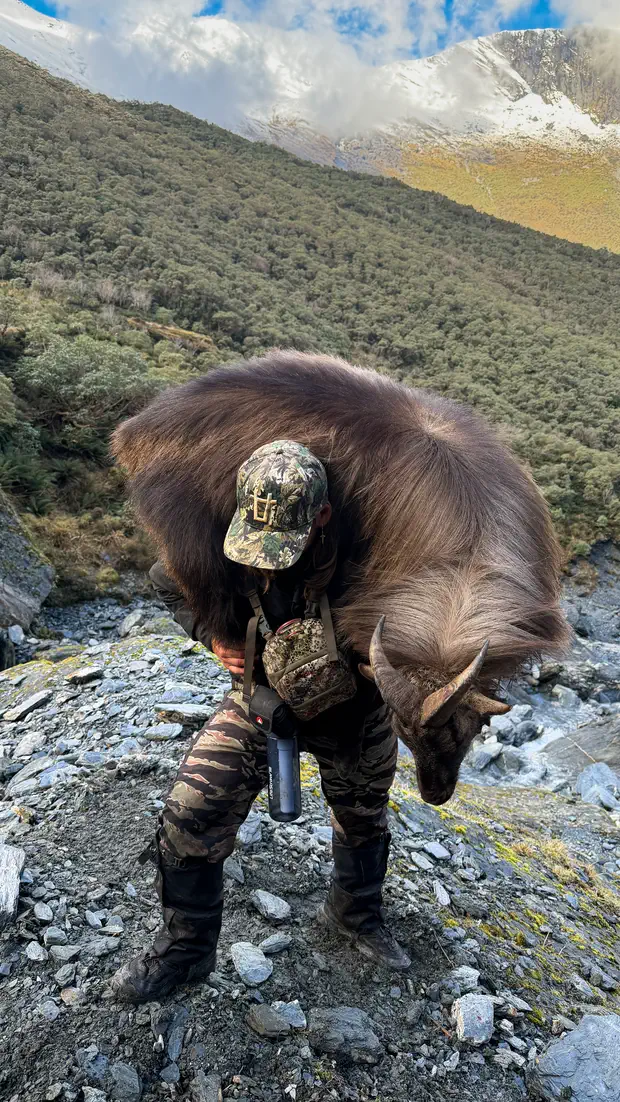
There is no phone reception up there at all, not a scraped bar. Tell whoever needs to know that you are out of contact from the Thursday to the Monday, and mean it. Leave your trip details with someone reliable at home, using the Mountain Safety Council's Plan My Walk trip plan or its Outdoor Intentions Form: where you are, who you're with, when you expect to be out, and what to do if they haven't heard by then.
The party's link to the outside world is a PLB or a satellite device. Find out on day one who carries it and where it lives in their pack. If you bring your own beacon from home, keep it registered with AMSA in Australia: New Zealand's rescue centre says a beacon registered in your home country is fine to use while you visit, as long as your contacts know your plans.
When do you set a beacon off?
Only in grave and imminent danger, when there is no other way to get help: a serious injury, someone missing, someone hypothermic and getting worse. Get the antenna up under open sky. Once it is on, leave it on and stay where you are, because the beacon is how they find you.
And if it goes off by accident?
In New Zealand the rule is the opposite of what most people expect: leave it on, and contact the Rescue Coordination Centre New Zealand on 0508 472 269, or +64 4 577 8030 from an overseas phone. There is no charge. In Australia, AMSA asks you to switch it off and call them. Know which country you're in.
What about a satellite phone or messenger?
A satellite phone can't call 111. New Zealand Police take calls from satellite phones on +64 9 571 2800. Messaging apps that call over data can't reach 111 either. Satellite messengers send two-way text and route an SOS through the maker's own response centre. All good to have. None replaces a registered beacon.
Is a rescue going to cost money?
NZ Police say people who are rescued are not expected to pay, though they can seek costs where someone has been reckless. What costs lives is waiting too long to ask, because the rescue helicopter can't fly at night or in cloud any more than the one that dropped you off.
What is the hut book for?
Write in it: names, date, where you're going and when you expect back. The Mountain Safety Council calls it a must-do. If a search starts, it is one of the first places searchers look, and other people's entries can show where you were last seen.
Lore
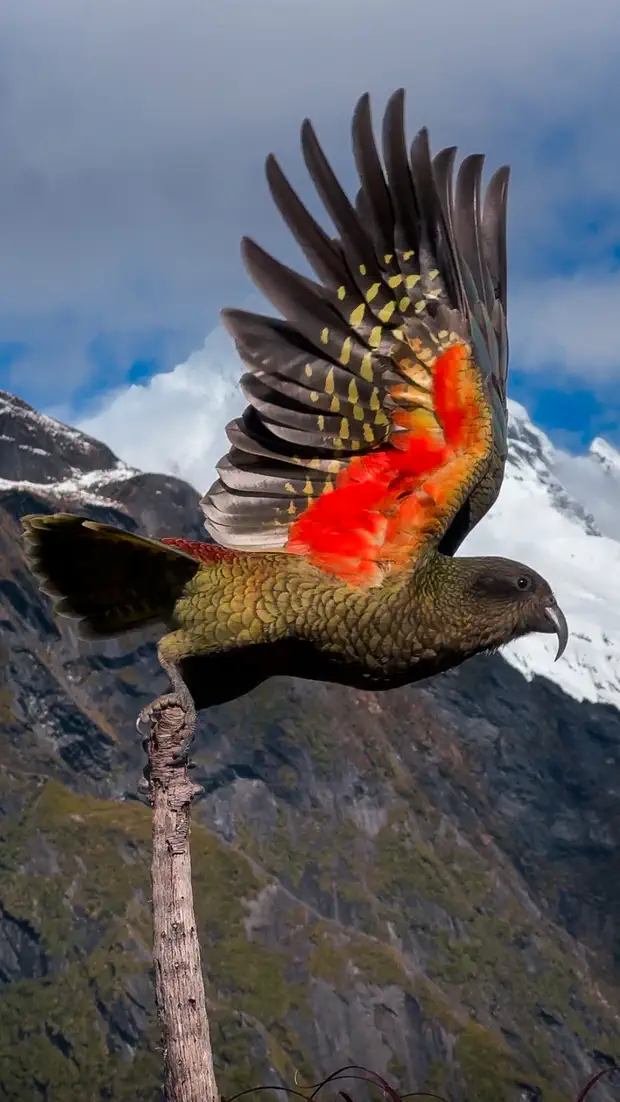
Kea. New Zealand's mountain parrot, found only in the South Island, and a lot smarter than you would like. Settlers paid a bounty on them, and about 150,000 were shot between 1860 and 1970. The bounty ended in 1971, full protection came in 1986, and they are now Nationally Endangered, with DOC estimating between 1,000 and 5,000 left. They are busiest at dawn and dusk and drawn to white, yellow and red gear, and DOC's list of their exploits includes locking someone in a toilet.
Kea and your camp
Leave nothing out and feed them nothing. Pack up the camp each morning and keep soft gear in hard bags. Kea also scavenge carcasses, and lead bullet fragments poison them, so DOC and the Game Animal Council ask hunters in kea country to use lead-free bullets, or to take, bury or hide the bullet-damaged meat.
- Boots you have already walked inStiff sole, over the ankle, broken in well before the plane.
- Wet weather jacket and overtrousersBoth, not just the jacket. It rains on more than half of October days up there.
- GaitersKeeps scree, snow and spaniard out of your boots.
- Thermals, top and bottomMerino. Two sets: one to hunt in, one that never leaves the hut dry bag.
- Good socks, more than you thinkMerino again. A dry pair at the hut is the best part of the day.
- A mid layerFleece or a light puffer. Hot climbing, cold the moment you stop to glass.
- Gloves and a beanieMost of the heat goes off your head while you lie still behind the glass.
- A day pack, 30 to 40 litresYour layers up the hill, and some of an animal back down it.
- Sunglasses and sunscreenSnow throws the sun back up under your chin and nose.
- Head torch and spare batteriesKeep the batteries warm overnight.
- A warm sleeping bagRated for the cold. More than half the nights go below freezing.
- Dry bagsOr bin liners. Something has to still be dry at the end of the day.
- Poles, if your knees have opinionsUp is the work, down is the damage.
- Your usual stuffMedications, and anything you can't buy in a hurry in a small town.
Already sorted
Rifles and ammunition, permits, passes and animal tags, the helicopter both ways, the hut, all the food and every transfer from the airport.
Leave at home
Cotton. Jeans, cotton hoodies, cotton socks. Wet cotton stops keeping you warm, and it never dries in a hut. At altitude that is a genuine problem, not just an uncomfortable one.
There is a shop stop
There's a stop at a hunting and fishing store once you land, so anything missing from this list can be picked up there, in New Zealand dollars. Then try the field game.